
Free Safe Operating Procedure (Drip Line Flushing) Template
Develop a systematic approach to safely flushing agricultural or industrial drip lines. Download our free Safe Operating Procedure for Drip Line Flushing today.
Free Safe Operating Procedure (Drip Line Flushing) Template
DOCX • 126 KB + PDF
Updated Oct 2026
No signup required
Purpose of the Free Safe Operating Procedure (Drip Line Flushing) Template
Drip line flushing is a critical maintenance task in agriculture, horticulture, and landscaping to prevent blockages and ensure efficient water distribution. However, it involves significant hazards, including exposure to cleaning chemicals, high-pressure fluids, and ergonomic strains.
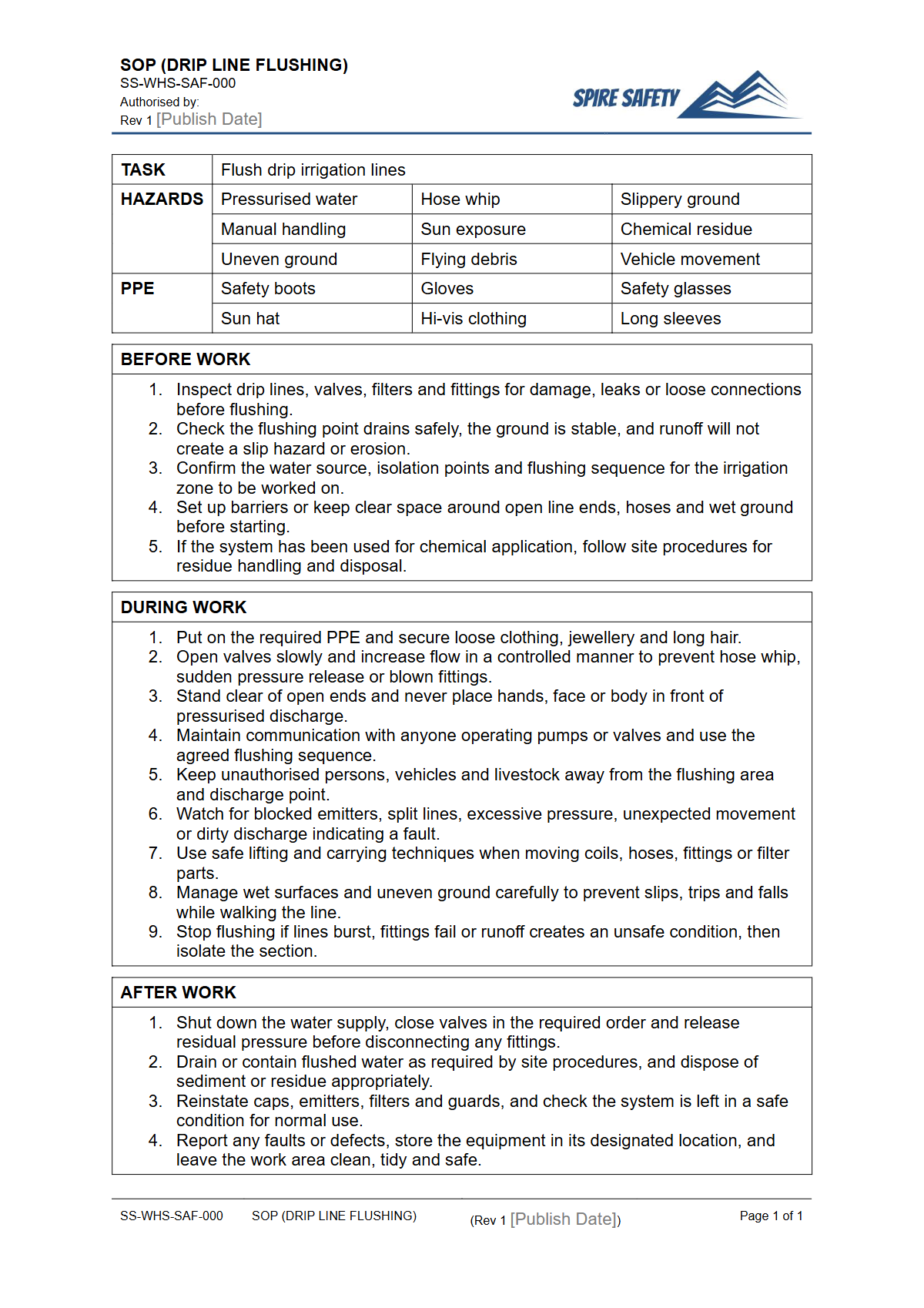
This Free Safe Operating Procedure (Drip Line Flushing) Template provides a structured framework for documenting the required steps to perform this task safely. It helps organisations manage risks and provide clear, consistent instructions to workers.
Using a documented SOP is a fundamental part of a robust safety management system. It ensures all workers, from new starters to experienced hands, follow a pre-approved, risk-assessed process.
This template prompts you to consider hazards such as chemical handling, personal protective equipment (PPE) requirements, system depressurisation, and environmental protection. Integrating this SOP into your broader operational framework is a key step in building comprehensive and effective WHS management systems.
Video walkthrough
How to use the Free Safe Operating Procedure (Drip Line Flushing) Template
This document is a template, not a finished procedure. It must be customised to reflect the specific equipment, chemicals, pressures, and environmental conditions at your workplace.
Download the DOCX file and adapt each section to align with your site's unique requirements and the manufacturer's instructions for your drip line system.
Important: We have provided a comprehensive starting point based on Australian WHS principles. However, you are responsible for ensuring the final document is accurate and sufficient for your workplace.
We recommend a competent person, such as a supervisor or safety advisor, reviews and approves the customised SOP before it is implemented. You should also train all relevant workers on the contents of the final procedure.
When to use it
A Drip Line Flushing SOP should be used whenever the task is performed. This typically includes:
- Routine Maintenance: Flushing lines at regular intervals (e.g., monthly, quarterly) during the growing season to prevent the buildup of minerals, algae, and sediment.
- Pre-Season Start-up: Ensuring the entire system is clean, clear, and operational before the first irrigation cycle of the season.
- Post-Season Shutdown: Clearing lines of water and contaminants before winter to prevent damage from freezing or microbial growth.
- Troubleshooting: When diagnosing and clearing specific blockages or pressure issues within the system.
- Post-Repair: Flushing any section of the system that has been repaired or replaced to remove debris.
This SOP complements other machinery and task-based procedures, such as those detailed in our Free Air Compressor SOP Template, which may be used as part of the flushing process.
Who should use it
This Safe Operating Procedure is intended for any person conducting, supervising, or managing drip line flushing activities. This includes:
- Agricultural Workers and Farm Hands
- Horticulturalists and Nursery Staff
- Landscapers and Groundskeepers
- Irrigation Technicians
- Maintenance Personnel
- Site Supervisors and Managers
The principles of safe work outlined in this SOP are applicable across many agricultural tasks. For instance, the systematic approach to hazard control is similar to that required when preparing a free Spreader SOP template for handling fertilisers or other agents.
Regularly reviewing and updating your SOPs is crucial for maintaining safety standards. Periodic reviews can be integrated into your site's safety audit schedule to verify that documented procedures still match workplace practice, a process that can be supported by formal WHS compliance auditing.
Explore our complete range of templates and guides in our free WHS resources library to build out your organisation's safety documentation.
Common mistakes
Common mistakes to avoid
- Failing to fully depressurise and isolate the system before starting work.
- Using incorrect or incompatible cleaning chemicals, leading to system damage or hazardous reactions.
- Neglecting to wear appropriate PPE, especially chemical-resistant gloves and eye protection.
- Allowing contaminated flush water to run off into drains or environmentally sensitive areas.
Legal references
Legal considerations
The following legal requirements may be relevant to this type of work.
- Work Health and Safety Act (Harmonised) — Provides the primary duties for protecting workers and other people from work health and safety risks.
- Work Health and Safety Regulations (Harmonised) — Sets out requirements supporting the management of workplace hazards and risks.
The following codes may be relevant to this type of work.
- Managing WHS Risks Code of Practice — Provides practical guidance on identifying hazards, assessing risks and applying effective controls.
- Work Health and Safety Consultation, Cooperation and Coordination Code of Practice — Provides practical guidance on consulting workers and coordinating with other duty holders.
- Managing the Work Environment and Facilities Code of Practice — Provides practical guidance on safe work environments, workplace facilities and related controls.
Did you know
Pressure Hazard
Fluid injection injuries can occur at pressures as low as 700 kPa (100 psi). A tiny, harmless-looking leak can inject toxic fluids into the skin, causing severe tissue damage that requires immediate specialist medical attention.
FAQ
Frequently asked questions
01What are the main hazards involved in drip line flushing?
02Does this SOP template cover all types of drip irrigation systems?
03Who is responsible for reviewing and updating the Drip Line Flushing SOP?
04Why can't I just use the manufacturer's instructions for flushing?
Share this resource
Free Safe Operating Procedure (Drip Line Flushing) Template
Browse Categories
How To Use It
- 1Download and open in Word or PDF.
- 2Replace the placeholders with your business details.
- 3Get it reviewed by a WHS specialist before rollout.
Need it customised?
Our WHS consultants can adapt this template to your site, run a gap analysis, or audit what you already have in place.
Book a Free Consultation WHS consulting servicesor call 1300 156 382
Related templates
- Free Safe Operating Procedure (Drive Shaft Removal) Template
- Free Safe Operating Procedure (Driver Check In) Template
- Free Safe Operating Procedure (Driver Handover) Template
- Free Safe Operating Procedure (Driver Rest Break) Template
- Free Safe Operating Procedure (Driver Route Briefing) Template
- Free Safe Operating Procedure (Driver Vehicle Handover) Template