
Free Safe Operating Procedure (Driver Check In) Template
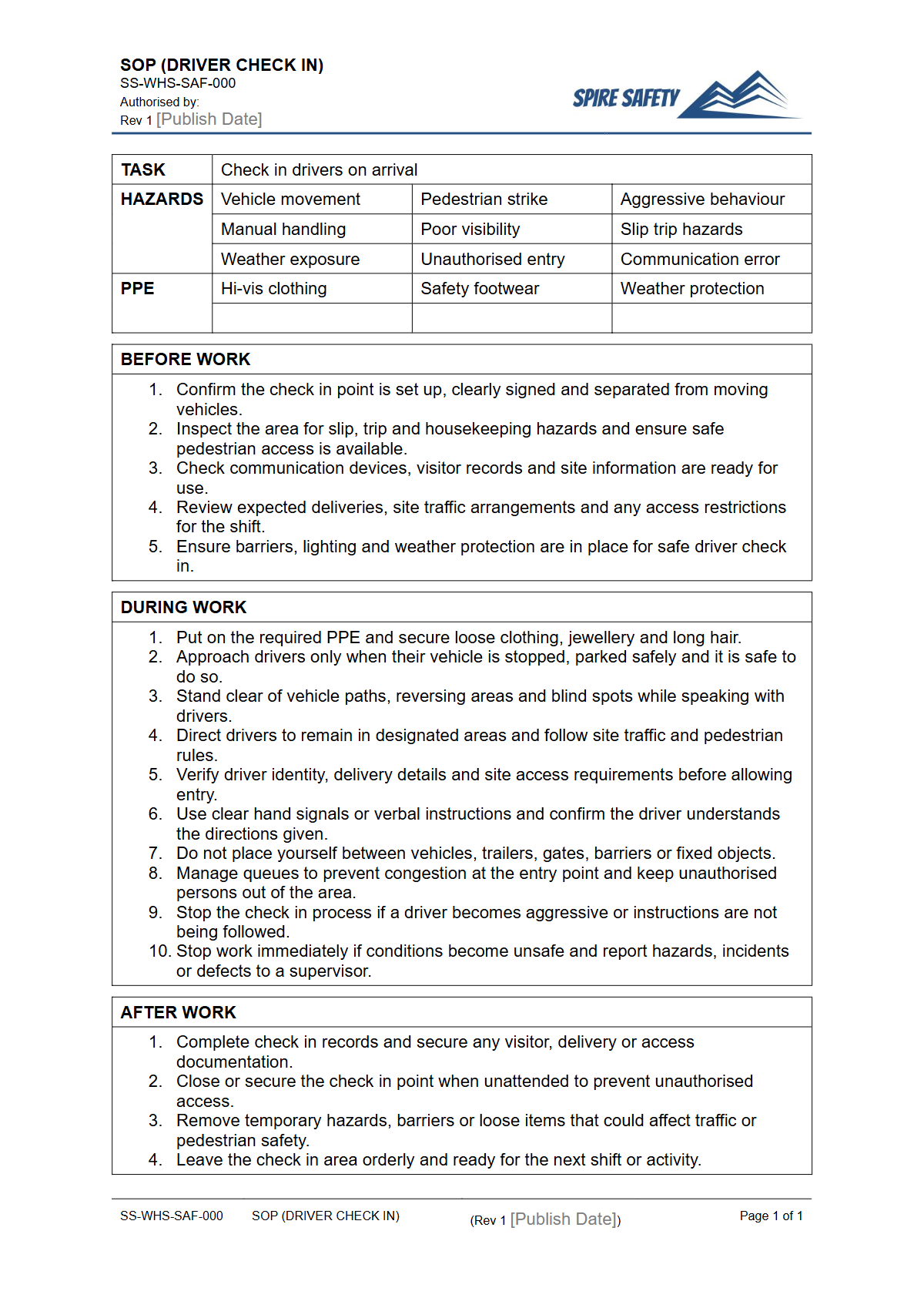
Formalise your site entry process with our free Safe Operating Procedure for driver check-ins. Download this user-friendly template to streamline logistics.
Free Safe Operating Procedure (Driver Check In) Template
DOCX • 126 KB + PDF
Updated Oct 2026
No signup required
Purpose of the Free Safe Operating Procedure (Driver Check In) Template
Managing the flow of vehicles and visiting personnel is a critical safety and logistical challenge for many Australian workplaces. This Free Safe Operating Procedure (Driver Check In) Template provides a structured framework for formalising how you manage drivers arriving at your site.
A documented check-in process ensures that every visiting driver is aware of your site's specific rules, hazards, and emergency procedures before they proceed to loading bays, drop-off points, or parking areas. It standardises communication, clarifies responsibilities, and provides a clear record of who is on-site at any given time.
Implementing a robust SOP for driver check-ins is a key component of an effective traffic management plan and demonstrates a commitment to proactively managing health and safety risks.
By establishing a clear, repeatable process, you can significantly reduce the risk of incidents involving vehicles and pedestrians, prevent unauthorised site access, and ensure loading and unloading activities are conducted efficiently and safely. This procedure forms a vital part of your overall safety framework, integrating directly with your broader WHS management systems to control site-specific risks.
It helps you meet your duty of care obligations to all workers, including contractors and visitors who enter your operational areas.
Video walkthrough
How to use the Free Safe Operating Procedure (Driver Check In) Template
This template is available for download as a DOCX file for easy editing or as a PDF for quick reference. To make it effective for your business, you must adapt it to your specific operational context.
Start by downloading the DOCX version and opening it in your preferred word processor. Go through each section and replace the placeholder text with information relevant to your worksite.
This includes adding your company name, specific site locations, key personnel contact details, and the revision date. The core of the customisation involves detailing your site-specific traffic flow, parking rules, hazard locations, required Personal Protective Equipment (PPE), and step-by-step instructions for the check-in process.
Important: This document is a template designed as a starting point. We have developed it to align with Australian WHS principles, but you must customise it with your site-specific details, hazards, controls, and personnel roles to ensure it is effective for your workplace.
This may involve attaching a site map with designated driver routes and waiting areas clearly marked. Once customised, the SOP should be reviewed and approved by a competent person within your organisation before being communicated to all relevant staff and transport providers.
Regular reviews are essential to keep the procedure current, particularly after any site changes or incidents.
When to use a Driver Check In Safe Operating Procedure
A Driver Check In SOP should be implemented at any workplace that receives regular or occasional visits from external transport vehicles for pickups or deliveries. This applies across a wide range of industries, including manufacturing facilities, distribution centres, warehouses, construction projects, agricultural operations, and large retail sites.
It is particularly crucial for sites with complex layouts, multiple tenants, or significant interaction between heavy vehicles and pedestrians. Use this procedure as a foundational document for your site induction process for all visiting drivers, whether they are frequent visitors or arriving for the first time.
The SOP should be activated the moment a driver arrives at the site entry point. It governs their actions from arrival to departure, including where to park, how to report to the site office or gatehouse, what information they must provide, and the safety briefing they must receive.
This process is also essential for managing risks associated with specific tasks they may perform, such as operating vehicle-mounted cranes or using equipment like a telehandler for unloading goods. For tasks involving specific machinery, supplementary documents such as our FREE Telehandler SOP Template may also be required.
Who should use this Safe Operating Procedure
This Safe Operating Procedure is intended for a range of personnel within an organisation. WHS Managers, Site Supervisors, and Logistics or Warehouse Managers are typically responsible for developing, implementing, and reviewing the procedure to ensure it aligns with the site's risk profile.
They use it as a tool to establish and enforce a safe system of work. Gatehouse security staff, administration personnel, and receiving/despatch team members are the frontline users who will execute the check-in process with drivers, conduct inductions, and ensure the rules are followed.
Visiting drivers are also primary users, as the SOP contains the rules and instructions they must adhere to for their own safety and the safety of others on site. The procedure should be a core part of their induction.
In workplaces with integrated logistics, staff may also manage equipment like conveyor belts near loading docks. Ensuring drivers are aware of such automated systems is crucial, and procedures like a FREE Conveyer System SOP should be understood by workers in the area.
Ultimately, a successful driver check-in system requires buy-in from everyone. It's not just a document but a shared understanding of how to operate safely.
The process should be simple to follow, well-communicated, and consistently enforced. To ensure your procedures are robust and correctly implemented, engaging with a professional for periodic WHS compliance auditing can provide valuable third-party verification and identify opportunities for improvement. You can find this and many other helpful documents in our free WHS resources library.
Common mistakes
Common mistakes to avoid
- Failing to adequately communicate the procedure to all visiting drivers and their transport companies before arrival.
- Not updating the SOP after a site layout change, an incident, or the introduction of new hazards.
- Treating the procedure as a 'tick and flick' exercise without providing a proper, understandable induction to the driver.
- Forgetting to include clear instructions and maps for emergency procedures, assembly points, and first aid locations.
Legal references
Legal considerations
The following legal requirements may be relevant to this type of work.
- Work Health and Safety Act (Harmonised) — Provides the primary duties for protecting workers and other people from work health and safety risks.
- Work Health and Safety Regulations (Harmonised) — Sets out requirements supporting the management of workplace hazards and risks.
The following codes may be relevant to this type of work.
- Managing WHS Risks Code of Practice — Provides practical guidance on identifying hazards, assessing risks and applying effective controls.
- Work Health and Safety Consultation, Cooperation and Coordination Code of Practice — Provides practical guidance on consulting workers and coordinating with other duty holders.
- Managing the Work Environment and Facilities Code of Practice — Provides practical guidance on safe work environments, workplace facilities and related controls.
Did you know
Transport Industry Risk
According to Safe Work Australia, the transport, postal, and warehousing industry has one of the highest rates of serious workers' compensation claims, with vehicle incidents being a leading cause of fatalities.
Loading Zones are High-Risk
A significant percentage of workplace transport incidents occur not while a vehicle is in transit, but while it is stationary during loading and unloading operations where people and moving plant interact.
FAQ
Frequently asked questions
01What is the main purpose of a driver check-in procedure?
02Is a driver check-in SOP a legal requirement in Australia?
03Who is responsible for inducting visiting drivers?
04How often should we review our driver check-in SOP?
Share this resource
Free Safe Operating Procedure (Driver Check In) Template
Browse Categories
How To Use It
- 1Download and open in Word or PDF.
- 2Replace the placeholders with your business details.
- 3Get it reviewed by a WHS specialist before rollout.
Need it customised?
Our WHS consultants can adapt this template to your site, run a gap analysis, or audit what you already have in place.
Book a Free Consultation WHS consulting servicesor call 1300 156 382
Related templates
- Free Safe Operating Procedure (Driver Handover) Template
- Free Safe Operating Procedure (Driver Rest Break) Template
- Free Safe Operating Procedure (Driver Route Briefing) Template
- Free Safe Operating Procedure (Driver Vehicle Handover) Template
- Free Safe Operating Procedure (Drone Ground Handling) Template
- Free Safe Operating Procedure (Drone Takeoff and Landing) Template