
Free Safe Operating Procedure (Driver Handover) Template
Standardise vehicle handovers and minimise risks with our detailed Safe Operating Procedure template. Download your free driver handover SOP today.
Free Safe Operating Procedure (Driver Handover) Template
DOCX • 126 KB + PDF
Updated Oct 2026
No signup required
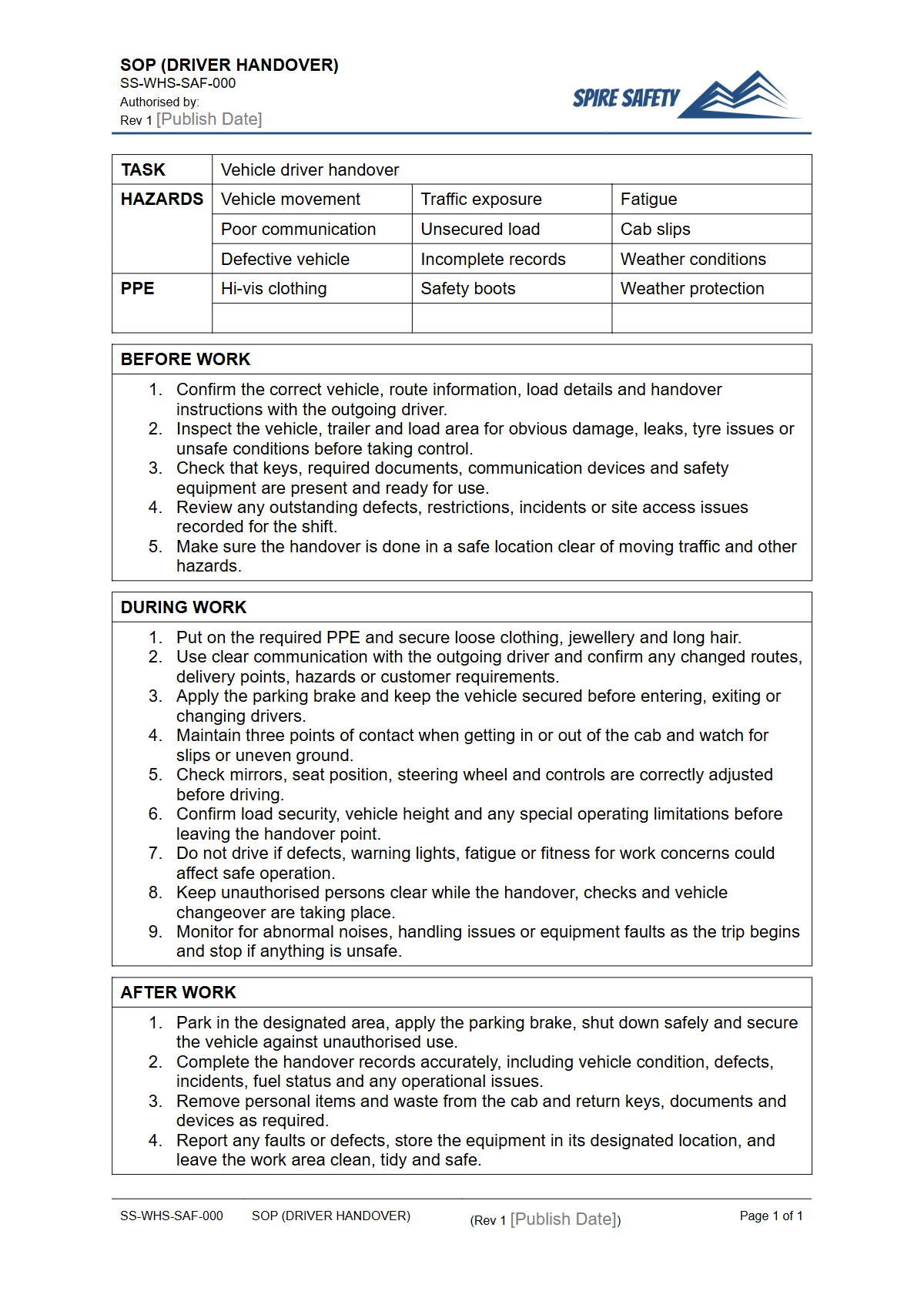
Purpose of the Free Safe Operating Procedure (Driver Handover) Template
This Free Safe Operating Procedure (Driver Handover) Template provides a structured framework for managing the transfer of responsibility for vehicles and mobile plant between operators. A formal handover process is a critical control measure that ensures continuity of safety, proper communication of the vehicle's condition, and clear accountability at all times.
It helps prevent incidents caused by misinformation or assumptions about a machine's fitness for use. Implementing a robust SOP for driver handovers is a key part of an organisation's duty to provide a safe system of work, especially in environments with shift work or shared equipment. Similar detailed procedures are essential for complex machinery, as outlined in our free Dozer SOP (Safe Operating Procedure) Template.
Video walkthrough
How to use the Free Safe Operating Procedure (Driver Handover) Template
Download the template in your preferred format (DOCX for easy editing or PDF for straightforward printing). The document is designed as a comprehensive starting point, not a final, ready-to-use policy.
Important: You must customise this template to suit your specific workplace. This includes adding your company branding, and detailing the exact makes and models of vehicles, site-specific hazards, and internal communication protocols. Consultation with your drivers and supervisors during this customisation process is vital for creating a practical and effective procedure. An SOP like this is a fundamental element of robust WHS management systems.
Key Sections of the Template
Our template guides you through the essential components of a thorough handover, including:
- Pre-Handover Checks: A checklist for the outgoing driver to confirm the vehicle's state.
- Fault & Damage Reporting: A clear process for documenting and communicating any new or existing issues.
- Receiving Driver Checks: Steps for the incoming driver to verify the vehicle's condition before accepting responsibility.
- Logbook & Record Keeping: Sections for signatures and dates to create a formal record of the transfer.
- Emergency Equipment: Verification that items like fire extinguishers and first aid kits are present and serviceable.
The structure ensures no critical step is missed, which is just as important for a complex machine like the one covered in our free Telehandler SOP Template.
When to use it
This SOP should be used every time operational control of a vehicle or piece of mobile plant is transferred from one person to another. Common scenarios include:
- End-of-shift changes between operators.
- Handovers to maintenance personnel for servicing or repairs.
- Transferring a vehicle to a different operator mid-shift.
- When a supervisor or temporary operator needs to use the vehicle.
A formal handover should also be conducted when returning a vehicle to service after major repairs. Establishing this routine ensures consistent practice across all equipment, whether it's a truck or a specialised machine requiring its own free Grader SOP (Safe Operating Procedure) Template.
Integrating with Other Safety Procedures
A driver handover SOP does not exist in isolation. It should be integrated with your broader safety framework.
This includes linking it to your site's Traffic Management Plan, your incident and hazard reporting procedures, and your operator training and competency programs. The records generated from the handover SOP can be valuable inputs for maintenance scheduling and safety meetings.
Periodic reviews, perhaps as part of your internal WHS compliance auditing program, ensure the procedure remains effective and integrated.
Who should use it
This procedure is primarily for anyone who operates or supervises the use of company vehicles or mobile plant. Key personnel include:
- Vehicle Operators/Drivers: Responsible for conducting the handover checks and communicating vehicle status accurately.
- Supervisors/Team Leaders: Responsible for overseeing the process and ensuring it is followed correctly. They also manage any reported defects.
- Fleet Managers: Use the handover records to monitor vehicle condition and schedule maintenance.
- WHS/Safety Officers: Responsible for developing, implementing, and reviewing the SOP as part of the overall safety system.
For organisations needing assistance in defining these roles and responsibilities clearly, our general WHS consulting services can provide expert guidance. A well-defined procedure, understood by all, is the cornerstone of a safe operational culture.
Browse our entire free WHS resources library for more templates and guides to support your safety goals.
Common mistakes
Common mistakes to avoid
- Incomplete handovers where drivers rush and skip steps.
- Failing to document faults or issues found during the handover.
- Assuming the next driver knows about an existing, non-critical defect.
- Using a generic checklist that isn't specific to the vehicle or machinery type.
Legal references
Legal considerations
The following legal requirements may be relevant to this type of work.
- Work Health and Safety Act (Harmonised) — Provides the primary duties for protecting workers and other people from work health and safety risks.
- Work Health and Safety Regulations (Harmonised) — Sets out requirements supporting the management of workplace hazards and risks.
The following codes may be relevant to this type of work.
- Managing WHS Risks Code of Practice — Provides practical guidance on identifying hazards, assessing risks and applying effective controls.
- Work Health and Safety Consultation, Cooperation and Coordination Code of Practice — Provides practical guidance on consulting workers and coordinating with other duty holders.
- Managing the Work Environment and Facilities Code of Practice — Provides practical guidance on safe work environments, workplace facilities and related controls.
Did you know
Communication Breakdown
A significant portion of workplace incidents involving mobile plant can be traced back to inadequate communication during shift changes or handovers. Formal procedures help close these communication gaps.
Chain of Responsibility
Under Chain of Responsibility (CoR) laws, everyone in the supply chain can be held accountable for safety breaches. A documented handover procedure helps demonstrate due diligence for vehicle safety and maintenance.
FAQ
Frequently asked questions
01What is the difference between a driver handover and a pre-start check?
02Is a verbal handover sufficient for transferring vehicle control?
03How often should we review our driver handover SOP?
04Does this driver handover template apply to light vehicles as well as heavy machinery?
Share this resource
Free Safe Operating Procedure (Driver Handover) Template
Browse Categories
How To Use It
- 1Download and open in Word or PDF.
- 2Replace the placeholders with your business details.
- 3Get it reviewed by a WHS specialist before rollout.
Need it customised?
Our WHS consultants can adapt this template to your site, run a gap analysis, or audit what you already have in place.
Book a Free Consultation WHS consulting servicesor call 1300 156 382
Related templates
- Free Safe Operating Procedure (Driver Rest Break) Template
- Free Safe Operating Procedure (Driver Route Briefing) Template
- Free Safe Operating Procedure (Driver Vehicle Handover) Template
- Free Safe Operating Procedure (Drone Ground Handling) Template
- Free Safe Operating Procedure (Drone Takeoff and Landing) Template
- Free Safe Operating Procedure (Drop Saw Mitre Saw Operation) Template