
Free Safe Operating Procedure (Drill Bit Change) Template
Download our Free Safe Operating Procedure (Drill Bit Change) Template to outline a clear, step-by-step process for this common task. Get your DOCX and PDF now.
Free Safe Operating Procedure (Drill Bit Change) Template
DOCX • 126 KB + PDF
Updated Oct 2026
No signup required
Purpose of the Free Safe Operating Procedure (Drill Bit Change) Template
Changing a drill bit is a frequent task in many workshops, construction sites, and manufacturing facilities. While it may seem simple, it carries inherent risks if not performed correctly.
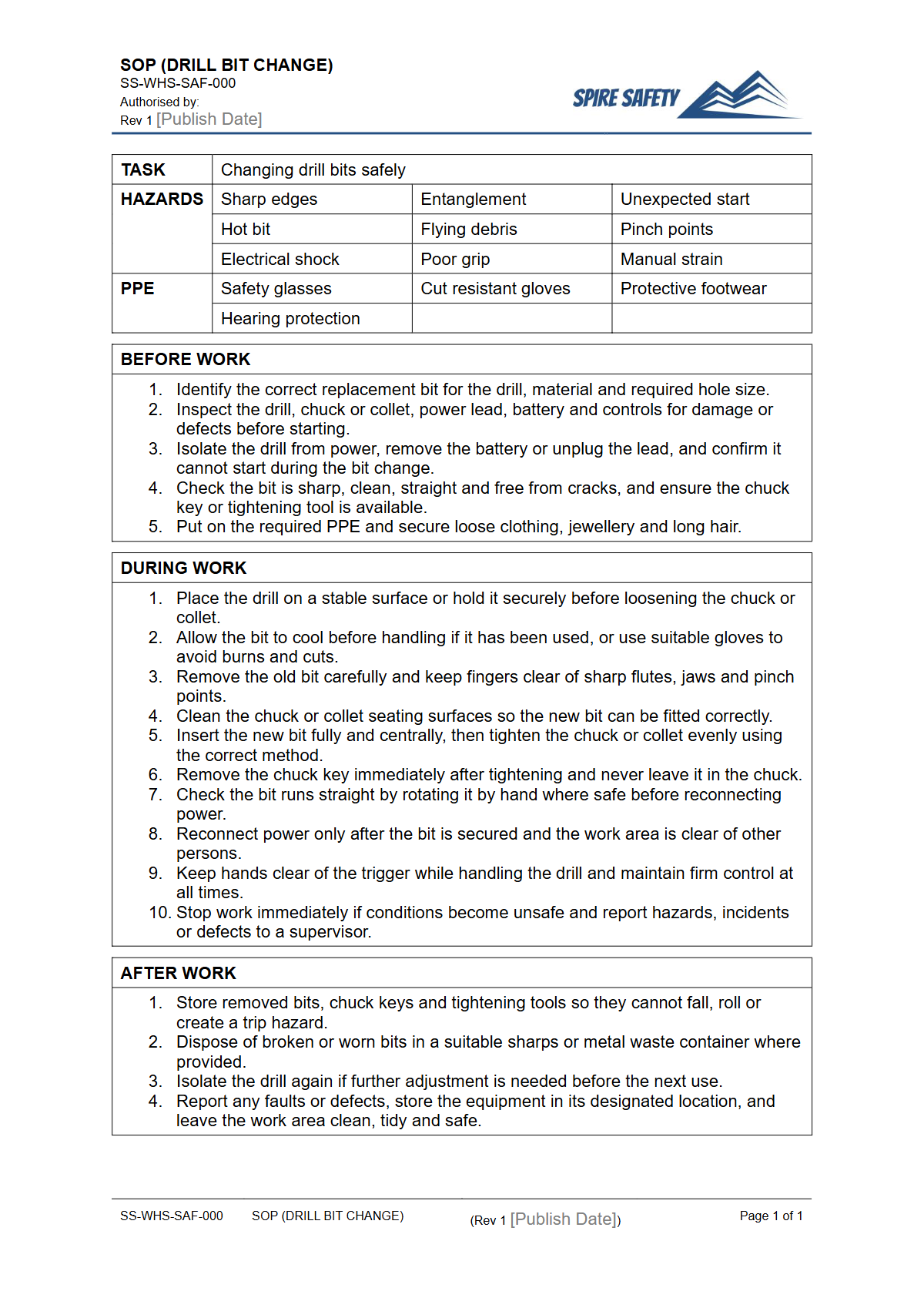
This Free Safe Operating Procedure (Drill Bit Change) Template provides a structured framework to document the approved, safe method for this task. It helps control hazards such as cuts and lacerations from sharp bits, entanglement with rotating parts if the drill is accidentally activated, and muscular stress from poor technique.
A well-defined SOP ensures every worker follows the same safe, efficient process, reducing the likelihood of injury and equipment damage.
Implementing documented procedures like this is a fundamental component of a robust safety framework. By standardising routine tasks, organisations can systematically manage risk and demonstrate due diligence.
Integrating this SOP into your broader WHS management systems helps build a consistent safety culture where correct procedure is the default behaviour.
Video walkthrough
How to use the Free Safe Operating Procedure (Drill Bit Change) Template
This document is a downloadable template in both DOCX and PDF formats, designed for easy adaptation. To use it effectively, you must review and modify its contents to match the specific drills (e.g., handheld, drill press, magnetic base), bits, and work environments at your site.
The template guides you through capturing essential safety information.
Key sections to customise include:
- Required Personal Protective Equipment (PPE): Specify the exact gloves, safety glasses, or other PPE required.
- Pre-operational Checks: Detail the steps to ensure the drill is disconnected from its power source (battery removed or cord unplugged) and is in good working order.
- Step-by-Step Procedure: Outline the sequence for safely removing the old bit and inserting the new one, including the correct use of a chuck key.
- Post-task Actions: List clean-up procedures and storage requirements for bits and tools.
Please note: this is a template that we expect you to customise to reflect the specific equipment, personnel, and risks in your workplace. A generic procedure is not sufficient for compliance; it must be site-specific.
When to use this Safe Operating Procedure
This Safe Operating Procedure should be developed, implemented, and referenced before any worker is required to change a drill bit. It is applicable across all scenarios involving corded, cordless, or pneumatic drills. For air-powered tools, the procedure must include steps for safely disconnecting the air supply, a process which can be further detailed by referencing a specific Free Air Compressor SOP (Safe Operating Procedure) Template.
The SOP should be used as a primary training document for new employees and apprentices. It also serves as a critical refresher for experienced workers to prevent complacency and procedural drift.
Regular toolbox talks can reinforce the key steps outlined in the SOP before work begins.
Who should use this Safe Operating Procedure
This procedure is intended for all personnel who operate drills as part of their job function. This includes tradespeople, workshop hands, maintenance staff, apprentices, and any other worker tasked with changing bits.
Supervisors and managers also have a responsibility to use this document to train their teams, monitor correct implementation, and enforce the outlined safety standards.
Periodically reviewing the effectiveness of your SOPs is a key safety activity. This review process can be integrated into your schedule of WHS compliance auditing to ensure procedures remain current and effective at controlling risk.
Establishing clear, documented procedures is vital for all types of workshop equipment, not just drills. Consistent safety documentation, such as a FREE Circular Saw SOP (Safe Operating Procedure) Template, helps create a predictable and safe environment for all workers by addressing tool-specific hazards.
The principles of isolating energy and managing risks from rotating parts apply to a wide range of machinery, from small handheld tools to larger plant. For instance, the safety logic used here is also foundational for more complex tasks, like those detailed in our FREE Trencher SOP Template.
You can browse our complete collection of procedural templates and safety checklists in our free WHS resources library to support your health and safety program.
Common mistakes
Common mistakes to avoid
- Forgetting to disconnect the power source (unplugging or removing the battery) before starting.
- Using the wrong size chuck key or using pliers, which can damage the chuck and fail to secure the bit properly.
- Not wearing appropriate gloves, leading to cuts from the sharp edges of the drill bit.
- Failing to check that the bit is centred and securely tightened in the chuck before starting the drill.
Legal references
Legal considerations
The following legal requirements may be relevant to this type of work.
- Work Health and Safety Act (Harmonised) — Provides the primary duties for protecting workers and other people from work health and safety risks.
- Work Health and Safety Regulations (Harmonised) — Sets out requirements supporting the management of workplace hazards and risks.
The following codes may be relevant to this type of work.
- Managing WHS Risks Code of Practice — Provides practical guidance on identifying hazards, assessing risks and applying effective controls.
- Work Health and Safety Consultation, Cooperation and Coordination Code of Practice — Provides practical guidance on consulting workers and coordinating with other duty holders.
- Managing the Work Environment and Facilities Code of Practice — Provides practical guidance on safe work environments, workplace facilities and related controls.
Did you know
Chuck Key Dangers
A significant number of drill-related injuries occur when a chuck key is left in the chuck and the drill is activated, causing the key to be ejected at high velocity.
FAQ
Frequently asked questions
01What PPE is typically required for changing a drill bit?
02Why is it critical to disconnect a drill from its power source before changing the bit?
03How often should a Safe Operating Procedure for changing drill bits be reviewed?
04Can I use this one SOP for both a drill press and a handheld drill?
Share this resource
Free Safe Operating Procedure (Drill Bit Change) Template
Browse Categories
How To Use It
- 1Download and open in Word or PDF.
- 2Replace the placeholders with your business details.
- 3Get it reviewed by a WHS specialist before rollout.
Need it customised?
Our WHS consultants can adapt this template to your site, run a gap analysis, or audit what you already have in place.
Book a Free Consultation WHS consulting servicesor call 1300 156 382
Related templates
- Free Safe Operating Procedure (Drill Mast Setup) Template
- Free Safe Operating Procedure (Drill Rod Breakout) Template
- Free Safe Operating Procedure (Drill Rod Handling) Template
- Free Safe Operating Procedure (Drip Line Flushing) Template
- Free Safe Operating Procedure (Drive Shaft Removal) Template
- Free Safe Operating Procedure (Driver Check In) Template