
Free Safe Operating Procedure (Drainage Channel Clean) Template
Download our free Safe Operating Procedure for drainage channel cleaning to manage hazards effectively.
Free Safe Operating Procedure (Drainage Channel Clean) Template
DOCX • 126 KB + PDF
Updated Oct 2026
No signup required
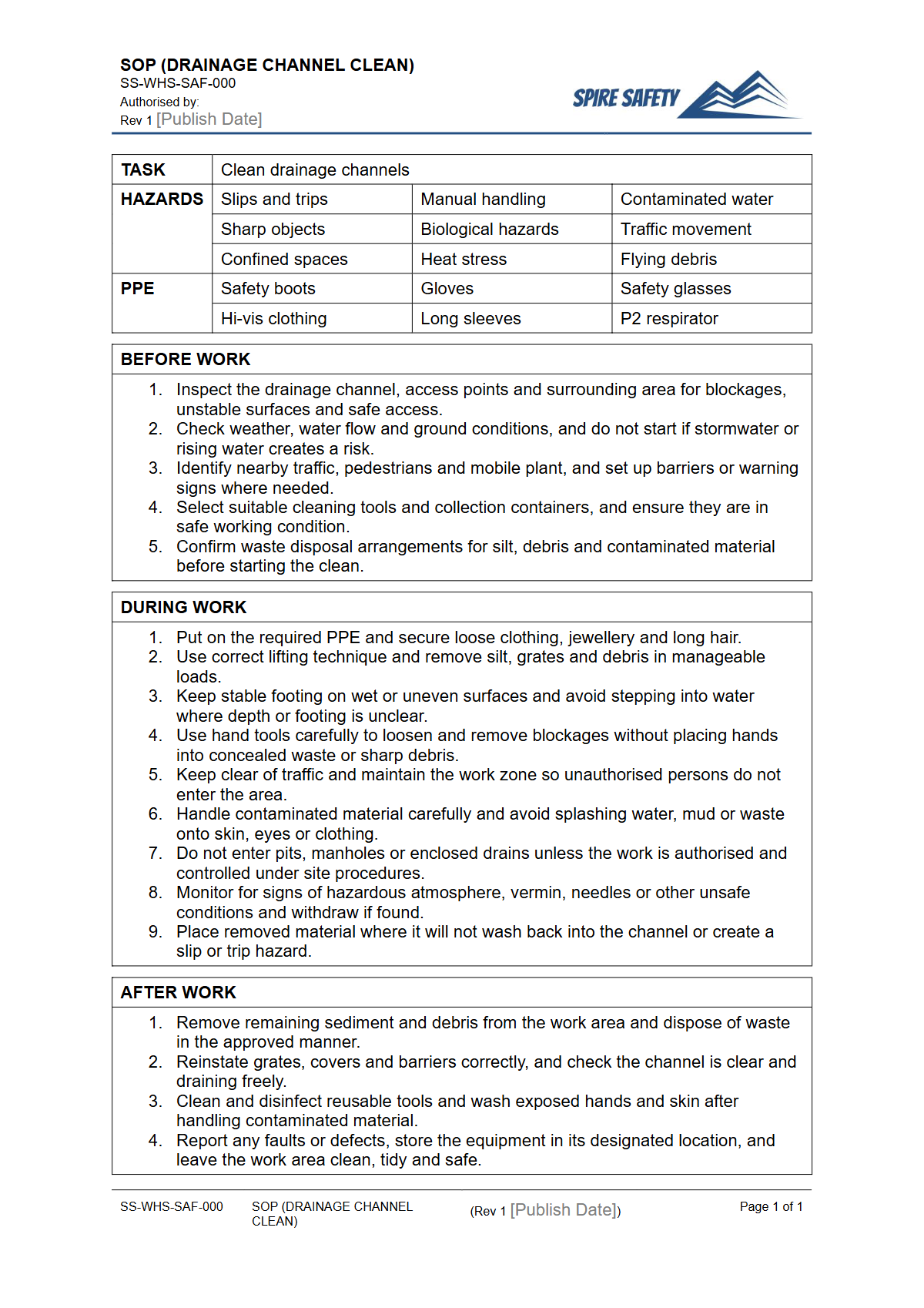
Purpose of the Free Safe Operating Procedure (Drainage Channel Clean) Template
Effectively managing workplace safety during maintenance tasks is critical. This Free Safe Operating Procedure (Drainage Channel Clean) Template provides a structured framework for documenting the required safety controls and step-by-step processes for cleaning drainage channels.
Its primary purpose is to help Persons Conducting a Business or Undertaking (PCBUs) and their workers identify and manage the significant risks associated with this task, such as slips and falls, hazardous manual tasks, exposure to biological contaminants, and the severe dangers of working in confined spaces.
By standardising the cleaning process, this SOP helps ensure every worker follows a consistent, pre-approved method designed to minimise harm. It acts as a vital tool for training, supervision, and incident investigation.
Proper documentation is a cornerstone of a robust safety system, demonstrating a proactive approach to WHS duties. For tasks involving excavation or earthmoving near drains, procedures like a FREE Trencher SOP Template can provide additional, specific guidance.
Video walkthrough
How to use the Free Safe Operating Procedure (Drainage Channel Clean) Template
This template is available for download in both DOCX for easy editing and PDF for straightforward distribution. To use it effectively, begin by downloading the DOCX file and opening it in your preferred word processor.
Systematically work through each section, replacing the placeholder text with information specific to your site, equipment, and workforce. This includes detailing the exact types of drainage channels, the specific tools used (e.g., high-pressure water jets, shovels), and the personal protective equipment (PPE) required.
Important: This resource is a starting point and must be customised to your unique operational environment. We are not WHS consultants providing advice, and the responsibility for creating a safe system of work rests with the PCBU.
You must conduct a site-specific risk assessment and adapt this document to address all identified hazards. If you require assistance in tailoring this document or developing comprehensive safety procedures, engaging professional WHS consulting services is recommended.
When to use this Safe Operating Procedure
A Safe Operating Procedure for drainage channel cleaning should be an active document, integrated into your daily operations. It is not a "set and forget" paper for a folder. Use it in the following situations:
- Pre-Task Planning: Before any drainage cleaning work commences, the SOP should be reviewed by the supervisor and the work crew to ensure everyone understands the process and safety controls.
- Worker Training and Induction: The SOP is an essential training tool for new employees or for workers assigned to the task for the first time.
- Refresher Training: Use the SOP as a basis for regular toolbox talks or safety meetings to reinforce correct procedures and discuss any near misses or incidents.
- Audits and Reviews: The procedure should be reviewed periodically (e.g., annually) or after an incident to ensure it remains current and effective. This process is a key component of well-organised WHS management systems.
Who should use it
This SOP is designed for use by various personnel within an organisation to ensure a shared understanding of the required safety standards. Key users include:
- Workers: The individuals physically carrying out the drainage channel cleaning. They must be trained in the SOP and follow its instructions diligently.
- Supervisors and Team Leaders: Those responsible for overseeing the work must use the SOP to direct workers, monitor for compliance, and ensure all safety measures, such as permits to work, are in place.
- WHS Managers/Officers: Safety professionals use the SOP as part of the overall safety management system, for risk assessments, and during incident investigations. Regular checks that procedures like this are being followed are a key part of any WHS compliance auditing program.
- PCBUs: Business owners and officers can use this document as evidence of the steps they have taken to meet their primary duty of care under WHS legislation.
Key Elements of the SOP
A comprehensive SOP for this task will include several critical sections. Our template guides you through documenting the required PPE, such as steel-capped waterproof boots, high-visibility clothing, and gloves.
It prompts for pre-operational checks, which must include assessing the area for hazards, confirming atmospheric testing for confined spaces, and inspecting all tools and equipment before use. The core of the document is the step-by-step procedure, which breaks the task down into manageable actions, from setting up exclusion zones to the final clean-up and waste disposal.
The procedure should also explicitly outline emergency responses, covering scenarios like first aid for chemical exposure, injury, or the protocol for a confined space rescue. Documenting these elements clearly is as important as the operational steps themselves.
Similar principles apply to other equipment-based procedures, such as those found in a FREE Scraper SOP Template, where operational and emergency steps are clearly defined. You can explore our entire free WHS resources library for more templates to support your safety system.
Common mistakes
Common mistakes to avoid
- Assuming a channel is not a confined space without a formal risk assessment.
- Failing to test the atmosphere for hazardous gases before and during entry.
- Neglecting to implement proper isolation or lockout/tagout for nearby machinery or water sources.
- Using inadequate PPE for the specific biological or chemical hazards present.
Legal references
Legal considerations
The following legal requirements may be relevant to this type of work.
- Work Health and Safety Act (Harmonised) — Provides the primary duties for protecting workers and other people from work health and safety risks.
- Work Health and Safety Regulations (Harmonised) — Sets out requirements supporting the management of workplace hazards and risks.
The following codes may be relevant to this type of work.
- Managing WHS Risks Code of Practice — Provides practical guidance on identifying hazards, assessing risks and applying effective controls.
- Work Health and Safety Consultation, Cooperation and Coordination Code of Practice — Provides practical guidance on consulting workers and coordinating with other duty holders.
- Managing the Work Environment and Facilities Code of Practice — Provides practical guidance on safe work environments, workplace facilities and related controls.
Did you know
Hidden Dangers
Decomposing organic matter in drainage channels can produce hazardous gases like hydrogen sulphide and methane, creating a toxic and potentially explosive atmosphere in poorly ventilated areas.
Silent Engulfment
Even a small amount of water flow or loose material like sand or soil can create an engulfment hazard, quickly trapping a worker inside a trench or channel.
FAQ
Frequently asked questions
01Is cleaning a drainage channel a confined space entry?
02What are the main hazards of cleaning drainage channels?
03What PPE is required for drainage channel cleaning?
04How often should drainage channels be cleaned?
Share this resource
Free Safe Operating Procedure (Drainage Channel Clean) Template
Browse Categories
How To Use It
- 1Download and open in Word or PDF.
- 2Replace the placeholders with your business details.
- 3Get it reviewed by a WHS specialist before rollout.
Need it customised?
Our WHS consultants can adapt this template to your site, run a gap analysis, or audit what you already have in place.
Book a Free Consultation WHS consulting servicesor call 1300 156 382
Related templates
- Free Safe Operating Procedure (Drainage Outlet Check) Template
- Free Safe Operating Procedure (Drainage Outlet Clean) Template
- Free Safe Operating Procedure (Drainage Swale Cleaning) Template
- Free Safe Operating Procedure (Drill Bit Change) Template
- Free Safe Operating Procedure (Drill Mast Setup) Template
- Free Safe Operating Procedure (Drill Rod Breakout) Template