
Free Safe Operating Procedure (Drainage Swale Cleaning) Template
Effectively manage the risks of drainage swale cleaning with our structured Safe Operating Procedure template. Download your free DOCX and PDF copy today.
Free Safe Operating Procedure (Drainage Swale Cleaning) Template
DOCX • 126 KB + PDF
Updated Oct 2026
No signup required
Purpose of the Free Safe Operating Procedure (Drainage Swale Cleaning) Template
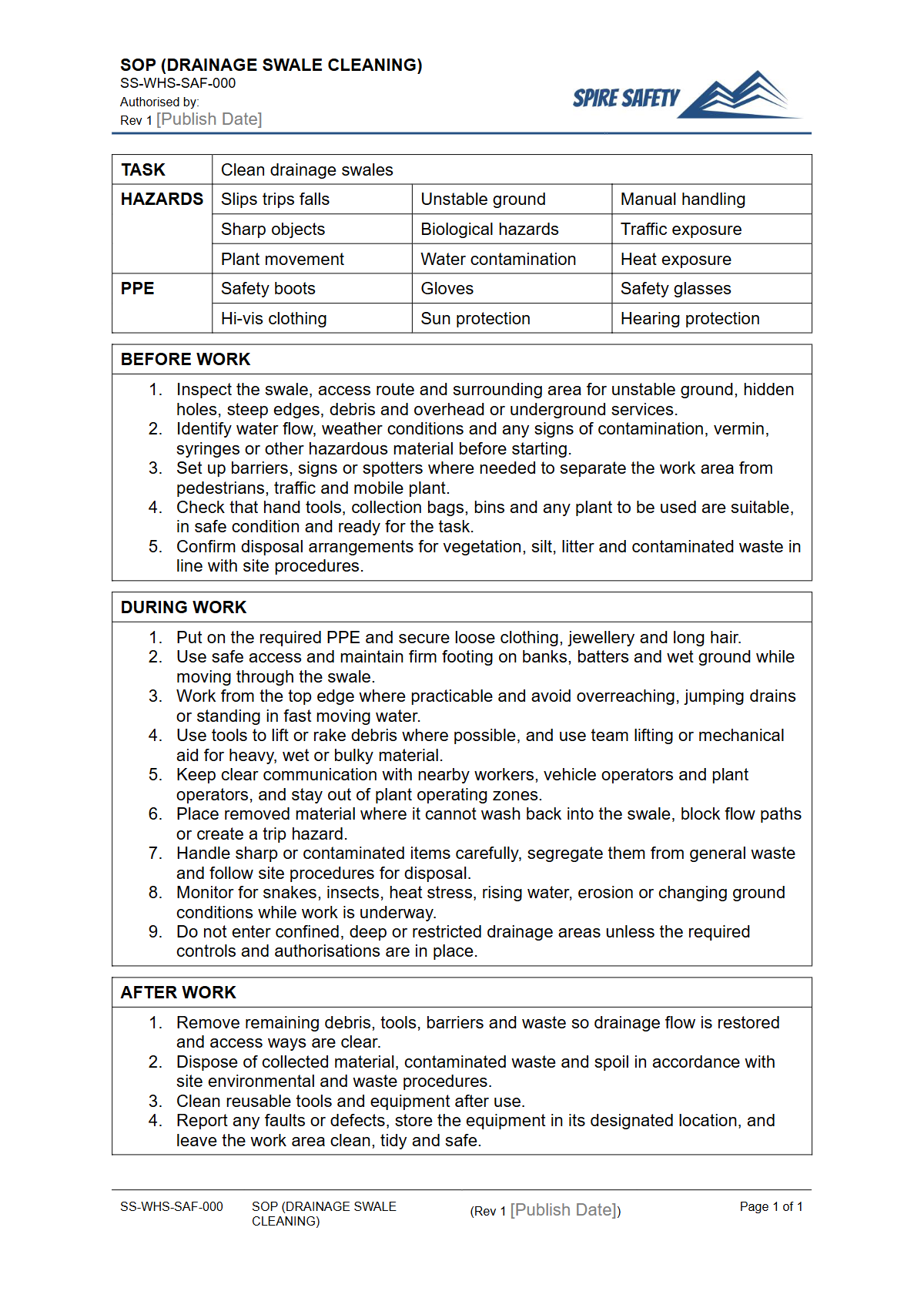
This Safe Operating Procedure (SOP) template provides a structured framework for documenting the hazards, risks, and control measures associated with cleaning and maintaining drainage swales. Its primary purpose is to establish a clear, repeatable, and safe system of work that protects workers from injury and ensures operational consistency.
By using this free Safe Operating Procedure (Drainage Swale Cleaning) template, your organisation can formalise procedures for tasks involving manual handling, mobile plant operation, and interaction with potentially hazardous environments, aligning your processes with Australian WHS best practices.
A well-defined SOP is a critical component of any risk management strategy. It guides workers step-by-step through the task, from pre-start checks to clean-up, minimising the chance of incidents.
This document helps PCBUs (Persons Conducting a Business or Undertaking) fulfil their duty of care by providing necessary information and instruction to employees. The procedure is designed to be adapted to various settings, whether cleaning involves manual shovelling or the use of heavy machinery, similar to those covered in our FREE Trencher SOP Template.
Video walkthrough
How to use the Free Safe Operating Procedure (Drainage Swale Cleaning) Template
To implement this SOP effectively, you must customise it to reflect the specific conditions of your workplace. Download the DOCX file and adapt the content to include details about your site, the specific types of equipment used, the personnel involved, and the unique hazards present.
We have provided a comprehensive starting point, but your customisation is essential for it to be a valid control measure. This process involves conducting a site-specific risk assessment and incorporating its findings into the document.
Key customisation steps include:
- Identifying the exact location and nature of the swales.
- Listing all plant and equipment to be used, such as excavators, loaders, or tipper trucks.
- Specifying the required Personal Protective Equipment (PPE) based on your risk assessment (e.g., high-visibility clothing, waterproof boots, gloves, eye protection).
- Detailing emergency procedures, including contact numbers and the location of first aid kits.
- Outlining environmental controls to manage sediment and contaminated water.
Integrating this procedure into your broader safety framework is crucial for its success. A robust framework ensures that documents like this are consistently used, reviewed, and updated as part of a continuous improvement cycle. If your business needs assistance in developing these overarching structures, exploring options for professional WHS management systems can provide valuable support and expertise.
When to use it
This Safe Operating Procedure should be used before commencing any drainage swale cleaning activities. It is a critical tool for planning work, conducting pre-start meetings or toolbox talks, and inducting new workers onto a site or task.
The SOP should be readily accessible to all personnel involved, including supervisors and operators. It also serves as an essential reference document during incident investigations or when reviewing and auditing safety performance. Periodic reviews of the SOP ensure it remains relevant, especially when new machinery like a grader is introduced, which would also require its own procedure like our FREE Grader SOP (Safe Operating Procedure) Template.
Who should use it
This document is intended for a range of personnel within an organisation. Site managers and supervisors should use it to plan, schedule, and oversee work safely.
Workers and plant operators must use it as a direct guide for performing their tasks according to the established safe method. WHS advisors and safety officers will also use this SOP as part of their roles in risk management, training development, and compliance monitoring.
Ultimately, anyone with responsibility for the health and safety of workers involved in swale maintenance should be familiar with and enforce this procedure. Expert WHS consulting can help define these roles and responsibilities within your team.
Proper documentation forms the basis of a compliant safety system. Ensuring that procedures are not only written but also understood and followed is a key part of regular safety checks.
This verification is a core component of formal WHS compliance auditing, which helps identify gaps between documented procedures and actual work practices.
The equipment used for swale maintenance can vary significantly, from small hand tools to large earthmoving plant. For tasks involving larger machinery, it is essential to have specific SOPs for each piece of equipment, such as our FREE Dozer SOP (Safe Operating Procedure) Template, to address their unique operational risks.
For a wider selection of procedural documents and safety checklists, you can browse our complete free WHS resources library, which covers a broad range of high-risk tasks and equipment.
Common mistakes
Common mistakes to avoid
- Failing to conduct a pre-start site inspection for hidden hazards like concealed drains or underground services.
- Using incorrect manual handling techniques when removing heavy, water-logged debris or silt.
- Neglecting to implement adequate traffic or pedestrian management when working near roadways or public areas.
- Not considering environmental controls, leading to uncontrolled runoff of silt into protected waterways.
Legal references
Legal considerations
The following legal requirements may be relevant to this type of work.
- Work Health and Safety Act (Harmonised) — Provides the primary duties for protecting workers and other people from work health and safety risks.
- Work Health and Safety Regulations (Harmonised) — Sets out requirements supporting the management of workplace hazards and risks.
The following codes may be relevant to this type of work.
- Managing WHS Risks Code of Practice — Provides practical guidance on identifying hazards, assessing risks and applying effective controls.
- Work Health and Safety Consultation, Cooperation and Coordination Code of Practice — Provides practical guidance on consulting workers and coordinating with other duty holders.
- Managing the Work Environment and Facilities Code of Practice — Provides practical guidance on safe work environments, workplace facilities and related controls.
Did you know
Vegetation is Key
Properly vegetated swales are more effective at filtering pollutants and are less prone to erosion, which can reduce the frequency and intensity of cleaning required.
Silent Hazards
Stagnant water in poorly maintained drainage swales can become a breeding ground for mosquitoes and other pests, posing a biological risk to workers that is often overlooked in risk assessments.
FAQ
Frequently asked questions
01What are the common hazards associated with cleaning drainage swales?
02Is a Safe Operating Procedure legally required for this task in Australia?
03How often should a Drainage Swale Cleaning SOP be reviewed?
04What PPE is typically required for swale cleaning?
Share this resource
Free Safe Operating Procedure (Drainage Swale Cleaning) Template
Browse Categories
How To Use It
- 1Download and open in Word or PDF.
- 2Replace the placeholders with your business details.
- 3Get it reviewed by a WHS specialist before rollout.
Need it customised?
Our WHS consultants can adapt this template to your site, run a gap analysis, or audit what you already have in place.
Book a Free Consultation WHS consulting servicesor call 1300 156 382
Related templates
- Free Safe Operating Procedure (Drill Bit Change) Template
- Free Safe Operating Procedure (Drill Mast Setup) Template
- Free Safe Operating Procedure (Drill Rod Breakout) Template
- Free Safe Operating Procedure (Drill Rod Handling) Template
- Free Safe Operating Procedure (Drip Line Flushing) Template
- Free Safe Operating Procedure (Drive Shaft Removal) Template