
Free Safe Operating Procedure (Drain Sediment Removal) Template
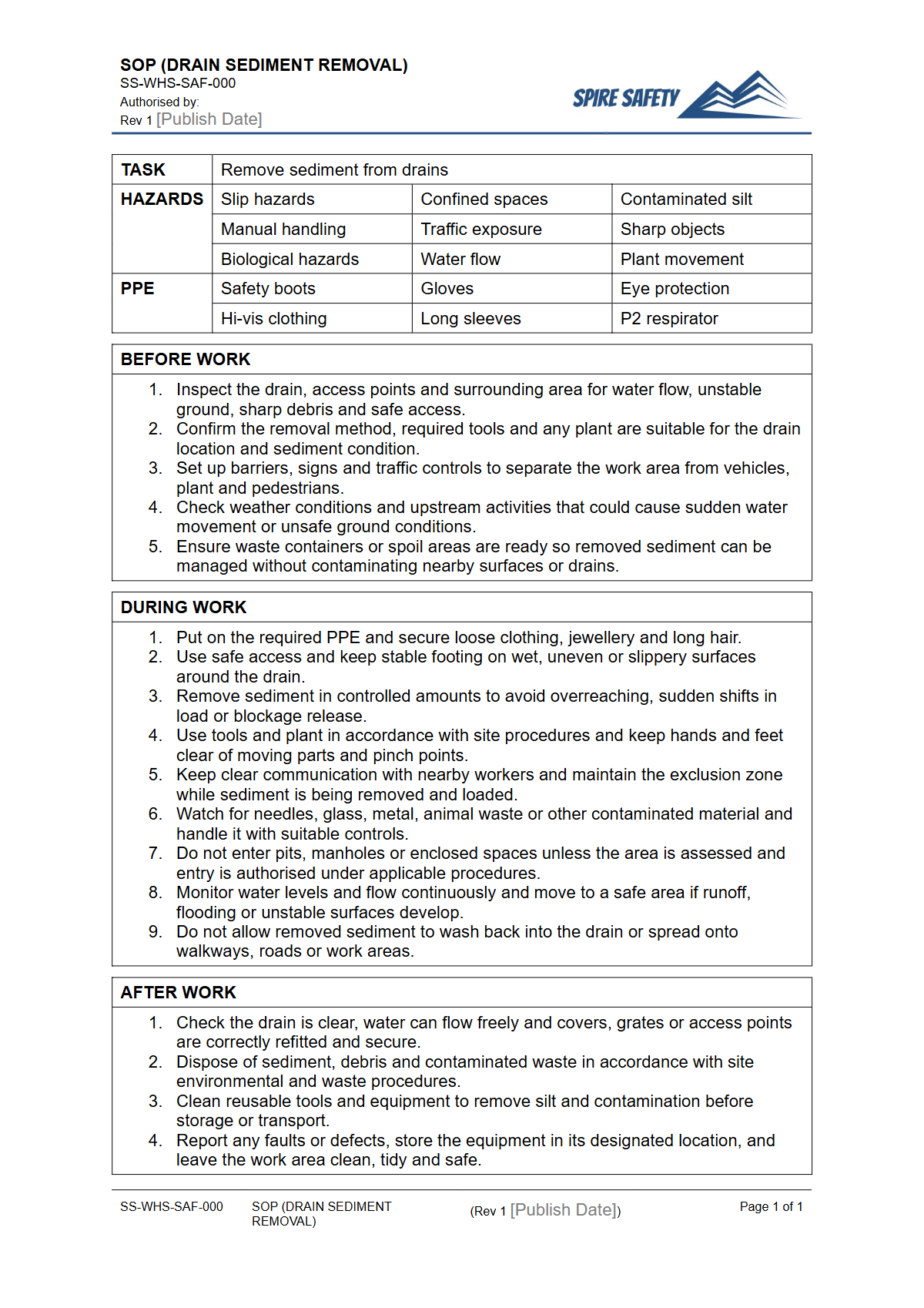
Download our free Safe Operating Procedure for drain sediment removal. This template helps you outline step-by-step processes to manage hazards safely.
Free Safe Operating Procedure (Drain Sediment Removal) Template
DOCX • 126 KB + PDF
Updated Oct 2026
No signup required
Purpose of the Free Safe Operating Procedure (Drain Sediment Removal) Template
Managing workplace safety is critical, and our Free Safe Operating Procedure (Drain Sediment Removal) Template provides a structured starting point for this hazardous task. This downloadable DOCX and PDF resource helps you outline the step-by-step process for safely removing sediment from drains, pits, and channels.
By documenting the required controls, you can significantly reduce risks such as exposure to hazardous substances, manual handling injuries, and potential engulfment. This SOP is an essential tool for any person conducting a business or undertaking (PCBU) whose workers perform drain cleaning and maintenance activities.
A Safe Operating Procedure (SOP) formalises a logical sequence of work steps designed to be completed in a specific way to minimise health and safety risks. For drain sediment removal, this includes identifying hazards like confined spaces, hazardous atmospheres (gases), biological material, sharps, unstable ground, and risks associated with using plant and equipment.
Documenting these procedures helps ensure every worker understands the expected safety standards and control measures. If your work involves excavation, you might also find our free Trencher SOP template a useful addition to your safety documentation.
Video walkthrough
How to use the Free Safe Operating Procedure (Drain Sediment Removal) Template
This SOP template is designed as a foundation, not a finished document. It must be adapted to reflect the specific equipment, environment, and materials at your worksite.
Effective implementation requires a collaborative approach involving risk assessment and consultation with your team.
Step 1: Conduct a Site-Specific Risk Assessment
Before filling out the template, perform a thorough risk assessment for the drain sediment removal task in its specific location. Identify all potential hazards, assess the level of risk they pose, and determine the most effective control measures.
This could involve atmospheric testing, setting up exclusion zones, or selecting specific Personal Protective Equipment (PPE).
Step 2: Customise the SOP Content
Use the findings from your risk assessment to populate the template. Detail the pre-start checks, the step-by-step work process, and the clean-up and shutdown procedures.
Clearly list the required PPE, necessary qualifications (e.g., confined space entry ticket), and emergency response actions. You must consult with the workers who will be performing the task, as their direct experience is invaluable for creating a practical and effective procedure.
Important: This document is a template and requires customisation. As we have not attended your workplace or assessed your specific operational context, you must adapt this procedure to your unique site conditions, equipment, and legal obligations. For assistance in developing site-specific documentation, Spire Safety offers expert WHS consulting services.
Step 3: Train and Supervise
Once finalised, the SOP must be used to train all relevant workers. Ensure they understand every step and have an opportunity to ask questions.
Supervisors should monitor the work to verify the procedure is being followed correctly. Keep records of this training as part of your WHS compliance evidence.
When to use a Safe Operating Procedure
An SOP for drain sediment removal should be used consistently. It is a key document for worker training and induction before they are permitted to perform the task.
It should also be reviewed during toolbox talks to reinforce safe work practices. Furthermore, the procedure must be reviewed and updated whenever there is a change to the task, equipment, or location, or following any incident or near miss.
Who should use it
This Safe Operating Procedure should be used by multiple roles within an organisation. Persons Conducting a Business or Undertaking (PCBUs) and their managers are responsible for ensuring such procedures are developed and implemented.
Supervisors use it to direct work and monitor safety on the ground. WHS advisors use it as part of the overall safety management system.
Most importantly, the workers carrying out the drain sediment removal use it as a direct guide for performing their job safely. For related earthmoving tasks, our Scraper SOP template provides a similar framework.
Integrating this SOP into your safety framework demonstrates a commitment to fulfilling your WHS duties. A well-drafted procedure is a core component of comprehensive WHS management systems, providing clarity and consistency in managing operational risks. To explore more templates, visit our complete free WHS resources library.
Common mistakes
Common mistakes to avoid
- Using the template without performing and incorporating a site-specific risk assessment.
- Failing to conduct atmospheric testing before allowing entry into a drain or pit.
- Neglecting to isolate the drain from potential inflow, creating a risk of engulfment or drowning.
- Assuming removed sediment is non-hazardous and disposing of it without proper assessment.
Legal references
Legal considerations
The following legal requirements may be relevant to this type of work.
- Work Health and Safety Act (Harmonised) — Provides the primary duties for protecting workers and other people from work health and safety risks.
- Work Health and Safety Regulations (Harmonised) — Sets out requirements supporting the management of workplace hazards and risks.
The following codes may be relevant to this type of work.
- Managing WHS Risks Code of Practice — Provides practical guidance on identifying hazards, assessing risks and applying effective controls.
- Work Health and Safety Consultation, Cooperation and Coordination Code of Practice — Provides practical guidance on consulting workers and coordinating with other duty holders.
- Managing the Work Environment and Facilities Code of Practice — Provides practical guidance on safe work environments, workplace facilities and related controls.
Did you know
Invisible Danger
Many gases found in drains, like hydrogen sulphide and methane, are not only toxic or flammable but can also displace oxygen, creating an asphyxiation hazard. Atmospheric testing is non-negotiable before entry.
The Weight of Water
Wet sediment can be deceptively heavy. A single shovel-full of waterlogged sludge can weigh over 20kg, placing significant strain on the body and increasing the risk of manual handling injuries if not managed correctly.
FAQ
Frequently asked questions
01What are the main hazards of drain sediment removal?
02Is a Safe Work Method Statement (SWMS) needed for drain sediment removal?
03How often should a Safe Operating Procedure be reviewed?
04Can this template be used for both stormwater and sewer drains?
Share this resource
Free Safe Operating Procedure (Drain Sediment Removal) Template
Browse Categories
How To Use It
- 1Download and open in Word or PDF.
- 2Replace the placeholders with your business details.
- 3Get it reviewed by a WHS specialist before rollout.
Need it customised?
Our WHS consultants can adapt this template to your site, run a gap analysis, or audit what you already have in place.
Book a Free Consultation WHS consulting servicesor call 1300 156 382
Related templates
- Free Safe Operating Procedure (Drain Snake) Template
- Free Safe Operating Procedure (Drain Trap Cleaning) Template
- Free Safe Operating Procedure (Drainage Channel Check) Template
- Free Safe Operating Procedure (Drainage Channel Clean) Template
- Free Safe Operating Procedure (Drainage Outlet Check) Template
- Free Safe Operating Procedure (Drainage Outlet Clean) Template