
Free Safe Operating Procedure (Drain Snake) Template
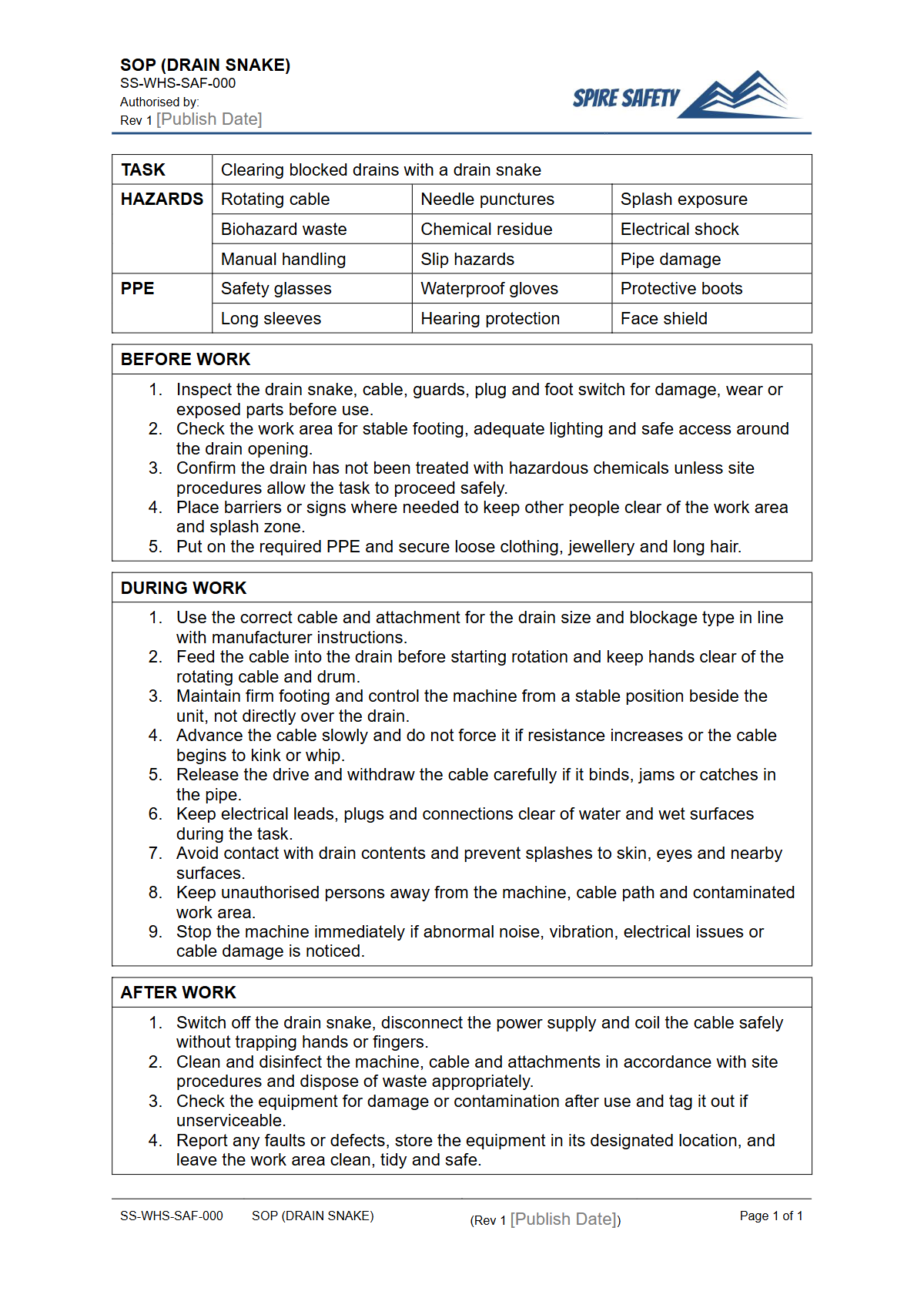
Download our free Safe Operating Procedure (Drain Snake) Template to outline step-by-step instructions for safe use. Get your DOCX and PDF versions today.
Free Safe Operating Procedure (Drain Snake) Template
DOCX • 126 KB + PDF
Updated Oct 2026
No signup required
Purpose of the Free Safe Operating Procedure (Drain Snake) Template
Operating a drain snake, also known as a plumber's auger or electric eel, introduces specific workplace hazards. This includes entanglement with the rotating cable, electric shock from powered models, ergonomic strains, and exposure to biological contaminants from wastewater.
This Free Safe Operating Procedure (Drain Snake) Template provides a structured framework for documenting the step-by-step process required to use this equipment safely. It helps organisations meet their duty of care by clearly defining risks and outlining control measures, ensuring workers are not left to guess about safe work practices.
A well-developed SOP is a fundamental control measure that forms part of all robust WHS management systems. It serves as a practical tool for training, task supervision, and incident investigation, formalising your organisation's commitment to a safe working environment.
Video walkthrough
How to use the Free Safe Operating Procedure (Drain Snake) Template
This document is a template, not a finished procedure. To implement it effectively, you must customise it to reflect the specific circumstances of your workplace.
Start by downloading the DOCX version and carefully reviewing each section. You will need to add details specific to the make and model of drain snake you use, the types of blockages commonly encountered, and the unique environmental conditions of your work areas.
It is crucial to involve workers who actually operate the equipment in the customisation process to ensure the SOP is practical and accurate.
Important: We have developed this template as a starting point based on common Australian WHS principles. However, it is your responsibility to ensure the final, customised document aligns with your specific equipment, tasks, and legal obligations.
For similar process documents, you might find our Free Air Compressor SOP useful for other common workshop equipment.
When to use a Drain Snake SOP
A Safe Operating Procedure for a drain snake should be used consistently as part of the normal workflow. It is not a document to be filed away and forgotten.
It should be consulted during worker induction and training for new employees or operators. It serves as a critical pre-start planning tool, allowing teams to review the steps and required controls before commencing work.
It should also be readily available in the work area as a reference guide for operators during the task, especially when dealing with non-routine blockages.
Regular reviews of the SOP are also essential. This should occur after any incident or near miss, when new equipment is purchased, or if work processes change.
This continuous improvement cycle ensures the procedure remains relevant and effective. The principles of regular review and documentation apply to all hazardous tools, as outlined in resources like our free Circular Saw SOP Template.
Who should use this SOP
This SOP is intended for a range of personnel within an organisation to ensure a consistent approach to safety. The primary users are the operators of the drain snake, who must follow the procedure to perform their work safely.
Supervisors and team leaders should use the SOP to induct new workers, conduct pre-start briefings, and supervise the task to supports your compliance efforts. Furthermore, WHS managers and safety officers will use the SOP as a key document for risk assessments, training program development, and for conducting safety observations or audits.
Embedding SOPs across all operational tasks, from simple tools to complex machinery, is a hallmark of a mature safety culture. You can find more examples of task-specific procedures in our free WHS resources library, which covers a wide array of plant and equipment.
Additional Safety Considerations
Beyond the steps in the SOP, always ensure a thorough risk assessment has been completed for the task. This should consider not just the tool itself, but the environment in which it is being used.
Factors like poor lighting, wet or slippery surfaces, and the presence of other workers can significantly increase risk. For tasks involving excavation to access pipes, a more comprehensive procedure like our Free Trencher SOP Template may be necessary as part of the overall job safety analysis.
Periodically confirming that procedures are being followed correctly is also vital. A formal process of WHS compliance auditing can help identify gaps between the documented SOP and actual work practices, providing valuable opportunities for retraining and procedural improvement.
Common mistakes
Common mistakes to avoid
- Using the wrong size or type of cutting head for the specific blockage and pipe diameter.
- Forgetting to wear appropriate PPE, especially safety glasses and waterproof gloves.
- Applying excessive force to the cable, which can cause it to kink, break, or damage the pipe.
- Failing to conduct pre-start electrical safety checks on powered models, such as inspecting for damaged cords or ensuring a residual-current device (RCD) is used.
Legal references
Legal considerations
The following legal requirements may be relevant to this type of work.
- Work Health and Safety Act (Harmonised) — Provides the primary duties for protecting workers and other people from work health and safety risks.
- Work Health and Safety Regulations (Harmonised) — Sets out requirements supporting the management of workplace hazards and risks.
The following codes may be relevant to this type of work.
- Managing WHS Risks Code of Practice — Provides practical guidance on identifying hazards, assessing risks and applying effective controls.
- Work Health and Safety Consultation, Cooperation and Coordination Code of Practice — Provides practical guidance on consulting workers and coordinating with other duty holders.
- Managing the Work Environment and Facilities Code of Practice — Provides practical guidance on safe work environments, workplace facilities and related controls.
Did you know
Biological Hazards
Blocked drains can contain harmful bacteria, viruses, and pathogens. A key part of drain snake safety is protecting against this biohazard exposure through proper PPE, such as heavy-duty waterproof gloves and sealed eye protection.
The "P-Trap" Problem
The curved P-trap pipe under a sink is designed to hold water to block sewer gases. It is also one of the most common locations for clogs and often the first major obstacle a drain snake must navigate.
FAQ
Frequently asked questions
01What should be included in a drain snake SOP?
02Is an SOP a legal requirement for using a drain snake in Australia?
03How often should a Safe Operating Procedure for a drain snake be reviewed?
04Can this template be used for both electric and manual drain snakes?
Share this resource
Free Safe Operating Procedure (Drain Snake) Template
Browse Categories
How To Use It
- 1Download and open in Word or PDF.
- 2Replace the placeholders with your business details.
- 3Get it reviewed by a WHS specialist before rollout.
Need it customised?
Our WHS consultants can adapt this template to your site, run a gap analysis, or audit what you already have in place.
Book a Free Consultation WHS consulting servicesor call 1300 156 382
Related templates
- Free Safe Operating Procedure (Drain Trap Cleaning) Template
- Free Safe Operating Procedure (Drainage Channel Check) Template
- Free Safe Operating Procedure (Drainage Channel Clean) Template
- Free Safe Operating Procedure (Drainage Outlet Check) Template
- Free Safe Operating Procedure (Drainage Outlet Clean) Template
- Free Safe Operating Procedure (Drainage Swale Cleaning) Template