
Free Safe Operating Procedure (Drain Inlet Cleaning) Template
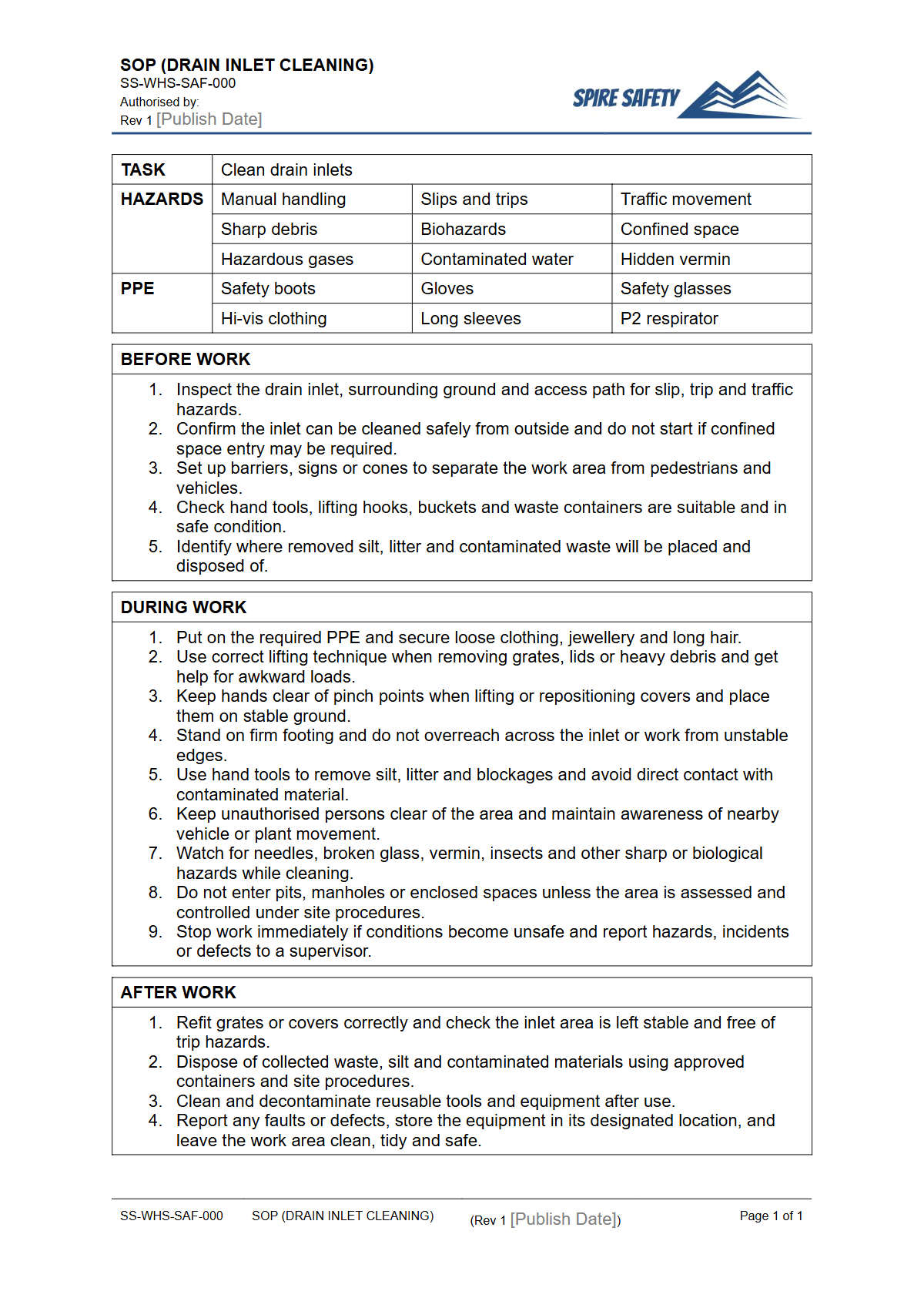
Download our free Safe Operating Procedure (Drain Inlet Cleaning) template to manage risks associated with this common maintenance task.
Free Safe Operating Procedure (Drain Inlet Cleaning) Template
DOCX • 126 KB + PDF
Updated Oct 2026
No signup required
Purpose of the Free Safe Operating Procedure (Drain Inlet Cleaning) Template
This free Safe Operating Procedure (Drain Inlet Cleaning) template provides a structured framework for businesses to outline a safe system of work for this common but potentially hazardous task. It guides you in documenting the step-by-step process required to clean drain inlets safely, helping you manage risks and meet your duties under Australian WHS legislation.
Using an SOP helps standardise your approach, ensuring that all workers follow a consistent, pre-approved method that addresses identified hazards.
Key risks in drain cleaning include exposure to biological hazards, chemicals, manual handling injuries from lifting grates, slips and trips, and interaction with traffic. In some situations, a drain inlet may even be classified as a confined space.
This document serves as a starting point to control these risks, forming a critical component of your overall safety management documentation.
Video walkthrough
How to use the Free Safe Operating Procedure (Drain Inlet Cleaning) Template
To use the Safe Operating Procedure (Drain Inlet Cleaning) Template, simply download the file in your preferred format (DOCX for easy editing or PDF). The document is structured with sections for you to complete, including required Personal Protective Equipment (PPE), pre-operational checks, step-by-step instructions, and emergency procedures.
You can then integrate this procedure into your broader safety framework.
Important: This document is a template and must be customised to suit the specific equipment, chemicals, site conditions, and hazards of your workplace. Consultation with your workers is essential to ensure the SOP is practical and effective. This template is a foundational tool; its proper customisation and implementation are key to building robust WHS management systems.
When to use a Safe Operating Procedure
A Safe Operating Procedure for drain inlet cleaning should be developed and implemented before any worker undertakes the task. It should be used as a primary training document for new employees or those unfamiliar with the procedure.
It also serves as a valuable reference for pre-start meetings or toolbox talks to refresh workers' knowledge of the risks and controls. Following an incident or near-miss, the SOP should be reviewed as part of the investigation to identify any gaps or areas for improvement.
Who should use it
This template is designed for use by Persons Conducting a Business or Undertaking (PCBUs), WHS managers, supervisors, and team leaders responsible for creating and implementing safety procedures. Workers who perform drain cleaning tasks should be trained on the final, site-specific version of the SOP and have easy access to it for reference.
It ensures that everyone, from management to the operator on the ground, has a shared understanding of how to perform the job safely.
For organisations that perform extensive groundwork, this procedure can be used alongside other task-specific documents. For example, if excavation is involved, you might also require our free Trencher SOP Template to manage associated risks.
Managing Specific Hazards
Drain inlet cleaning presents a unique combination of hazards. Biological risks can arise from stagnant water, animal waste, and decaying organic matter.
Chemical risks may be present from unknown substances illegally dumped into the drainage system. The SOP prompts you to consider appropriate PPE, such as waterproof gloves, safety glasses, and respiratory protection, to mitigate these exposures. If pressurised equipment is part of your cleaning process, ensure you have separate procedures for its safe use, similar in principle to our free Air Compressor SOP Template.
Physical hazards are also significant. Lifting heavy drain grates can lead to serious musculoskeletal injuries if correct manual handling techniques are not used.
The work area is often wet, creating slip hazards. If the drain is near a road or path, controls must be in place to manage risks from vehicle and pedestrian traffic.
This template includes sections to detail the specific controls for these common physical risks, ensuring they are not overlooked. Periodically verifying these controls are effective can be integrated into your WHS compliance auditing schedule.
This SOP template is just one of many tools designed to help you streamline your safety processes. You can explore our complete free WHS resources library for more templates, checklists, and guides to support your organisation.
Common mistakes
Common mistakes to avoid
- Failing to assess if the drain constitutes a confined space before starting work.
- Using incorrect or damaged personal protective equipment (PPE) for the identified hazards.
- Not adequately isolating the work area from pedestrian or vehicle traffic.
- Neglecting to plan for the safe handling and disposal of waste collected from the drain.
Legal references
Legal considerations
The following legal requirements may be relevant to this type of work.
- Work Health and Safety Act (Harmonised) — Provides the primary duties for protecting workers and other people from work health and safety risks.
- Work Health and Safety Regulations (Harmonised) — Sets out requirements supporting the management of workplace hazards and risks.
The following codes may be relevant to this type of work.
- Managing WHS Risks Code of Practice — Provides practical guidance on identifying hazards, assessing risks and applying effective controls.
- Work Health and Safety Consultation, Cooperation and Coordination Code of Practice — Provides practical guidance on consulting workers and coordinating with other duty holders.
- Managing the Work Environment and Facilities Code of Practice — Provides practical guidance on safe work environments, workplace facilities and related controls.
Did you know
Confined Space Risk
Many stormwater pits and drain systems meet the legal definition of a confined space. This classification requires a formal risk assessment, entry permits, and specific training before any worker can enter.
Blockage Causes
A significant percentage of drain blockages are caused by materials that shouldn't be in the system, such as fats, oils, grease, and wet wipes, which combine with debris to form solid masses.
FAQ
Frequently asked questions
01What are the main hazards of cleaning a drain inlet?
02Is an SOP legally required for drain cleaning in Australia?
03How often should our drain cleaning SOP be reviewed?
04Can I use this template for cleaning drains inside a building?
Share this resource
Free Safe Operating Procedure (Drain Inlet Cleaning) Template
Browse Categories
How To Use It
- 1Download and open in Word or PDF.
- 2Replace the placeholders with your business details.
- 3Get it reviewed by a WHS specialist before rollout.
Need it customised?
Our WHS consultants can adapt this template to your site, run a gap analysis, or audit what you already have in place.
Book a Free Consultation WHS consulting servicesor call 1300 156 382
Related templates
- Free Safe Operating Procedure (Drain Outfall Check) Template
- Free Safe Operating Procedure (Drain Sediment Removal) Template
- Free Safe Operating Procedure (Drain Snake) Template
- Free Safe Operating Procedure (Drain Trap Cleaning) Template
- Free Safe Operating Procedure (Drainage Channel Check) Template
- Free Safe Operating Procedure (Drainage Channel Clean) Template