
Free Safe Operating Procedure (Dough Sheeter) Template
Effectively manage hazards associated with dough sheeters in your bakery or commercial kitchen. Download our free, customisable SOP template to get started.
Free Safe Operating Procedure (Dough Sheeter) Template
DOCX • 126 KB + PDF
Updated Oct 2026
No signup required
Purpose of the Free Safe Operating Procedure (Dough Sheeter) Template
A dough sheeter is a common piece of equipment in bakeries, pizzerias, and commercial kitchens, designed to automate the process of rolling out dough to a consistent thickness. While efficient, its powerful rollers and moving parts present significant WHS risks, including severe entanglement, crushing, and amputation injuries.
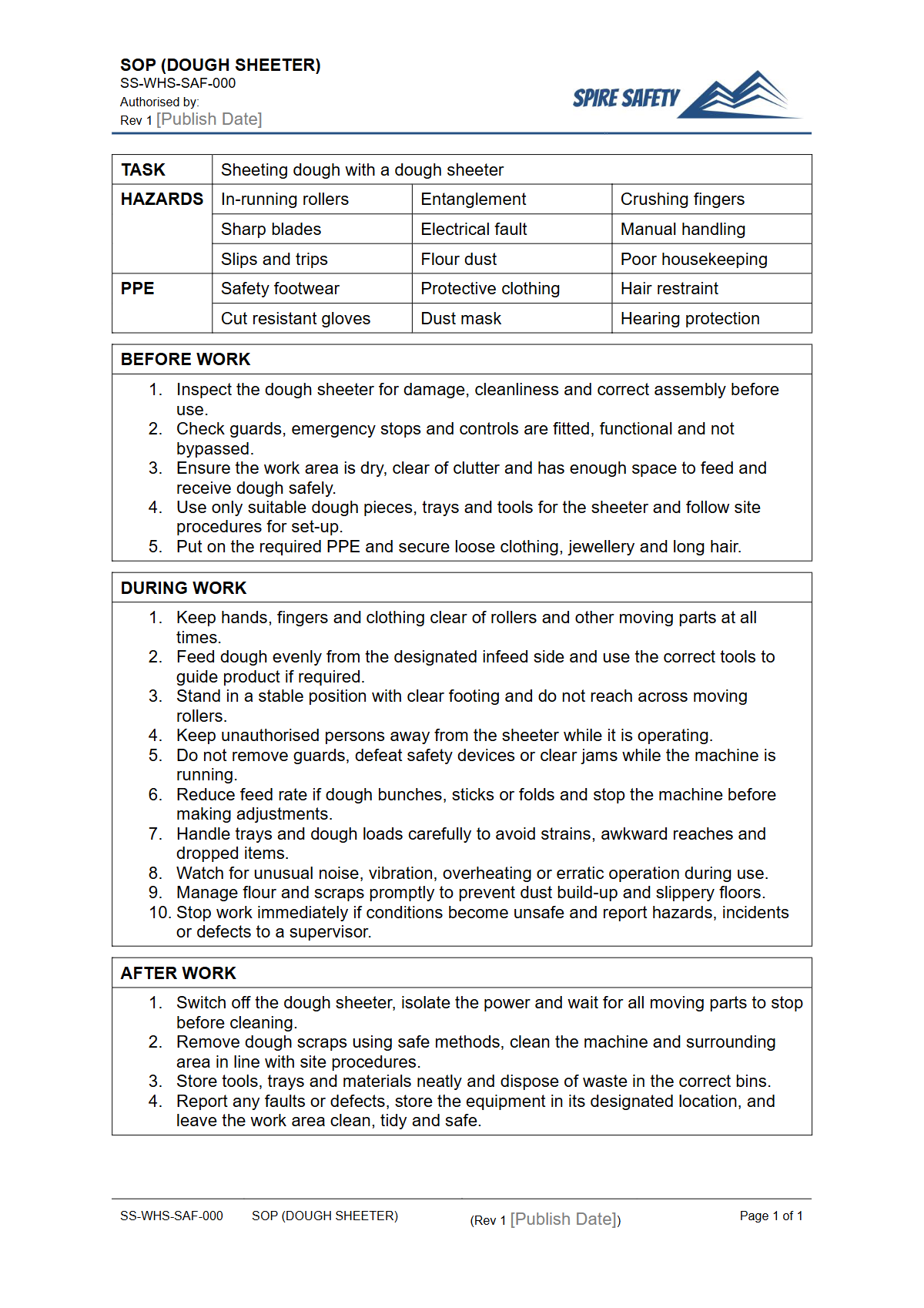
This Free Safe Operating Procedure (Dough Sheeter) Template provides a structured framework for documenting the key steps, hazards, and safety controls required for its use. By implementing a detailed SOP, your organisation can clearly define safe work methods, support worker training, and demonstrate a commitment to risk management.
Just like procedures for other plant with moving parts, such as our conveyer system SOP template, this document is a critical tool for preventing workplace incidents.
Video walkthrough
How to use the Free Safe Operating Procedure (Dough Sheeter) Template
This downloadable document provides a comprehensive starting point for your workplace. It is available in DOCX format for easy editing and PDF for straightforward printing and distribution.
To make it effective, you must customise it to reflect your specific operational context. This includes detailing the make and model of your dough sheeter, the unique layout of your work area, and the specific types of dough being processed.
Important: This is a template and must be customised to your workplace. We have created it as a guide, but you are responsible for ensuring it accurately reflects your equipment, environment, and established safety protocols. Its effectiveness relies on its specific application and integration into your broader WHS management systems.
Key Customisation Steps:
- Plant and Equipment Details: Insert the specific manufacturer, model, and asset ID of your dough sheeter.
- Personal Protective Equipment (PPE): List the exact PPE required for operators, such as non-slip footwear, aprons, and hair nets. Prohibit loose clothing, lanyards, and jewellery.
- Emergency Procedures: Detail the location of emergency stops, first aid kits, and the contact information for first aid officers and emergency services. Outline your site-specific emergency shutdown and response plan.
- Training and Competency: Specify the training and competency requirements for operators, including who is authorised to provide the training and assess competence.
- Review and Approval: Formalise the document by adding names of the approver (e.g., manager or PCBU) and the date for the next scheduled review.
When to use a Dough Sheeter SOP
A Safe Operating Procedure for a dough sheeter is a dynamic document used in daily operations, not just a file stored away for compliance purposes. It should be actively used in several situations to ensure ongoing safety and operational discipline.
These include during the initial training and induction of new kitchen staff or bakery workers, as a reference for pre-operational safety checks, and as a guide for correct shutdown and cleaning procedures. It also serves as a critical document during safety meetings, incident investigations, and formal WHS compliance auditing to verify that safe work practices are being followed.
Who should use this SOP
The responsibility for using and enforcing the SOP extends across several roles within an organisation. Primarily, it is for the operators of the dough sheeter, who must follow the outlined steps to ensure their own safety and that of their colleagues.
Supervisors and Managers must use the SOP to train workers, monitor their performance, and enforce safe work behaviour. WHS Representatives and Committees will use the document as a benchmark for workplace inspections and risk assessments.
Finally, the PCBU (Person Conducting a Business or Undertaking) holds the ultimate responsibility for ensuring that resources like this SOP, and others like our Air Compressor SOP, are developed, implemented, and regularly reviewed as part of their duty of care. For complex safety challenges beyond the scope of a standard template, seeking specialist WHS consulting can provide tailored solutions.
This document is just one of many templates we offer to help Australian businesses improve their safety practices. Explore our complete free WHS resources library for more tools to support your safety management system.
Common mistakes
Common mistakes to avoid
- Bypassing or disabling safety interlocks on guards to speed up work.
- Wearing loose clothing, jewellery, or having untied long hair that can become entangled.
- Attempting to clear dough jams while the machine is still powered on or energised.
- Failing to use Lockout/Tagout (LOTO) procedures before cleaning, servicing, or maintenance.
Legal references
Legal considerations
The following legal requirements may be relevant to this type of work.
- Work Health and Safety Act (Harmonised) — Provides the primary duties for protecting workers and other people from work health and safety risks.
- Work Health and Safety Regulations (Harmonised) — Sets out requirements supporting the management of workplace hazards and risks.
The following codes may be relevant to this type of work.
- Managing WHS Risks Code of Practice — Provides practical guidance on identifying hazards, assessing risks and applying effective controls.
- Work Health and Safety Consultation, Cooperation and Coordination Code of Practice — Provides practical guidance on consulting workers and coordinating with other duty holders.
- Managing the Work Environment and Facilities Code of Practice — Provides practical guidance on safe work environments, workplace facilities and related controls.
Did you know
Roller Guarding
Interlocked guards are a key engineering control on modern dough sheeters. They are designed to stop the rollers automatically if the guard is lifted or opened, preventing access to moving parts during operation.
FAQ
Frequently asked questions
01What is the most common injury from a dough sheeter?
02Is specific training required to operate a dough sheeter?
03Can I modify the safety guards on a dough sheeter?
04How often should a Safe Operating Procedure for a dough sheeter be reviewed?
Share this resource
Free Safe Operating Procedure (Dough Sheeter) Template
Browse Categories
How To Use It
- 1Download and open in Word or PDF.
- 2Replace the placeholders with your business details.
- 3Get it reviewed by a WHS specialist before rollout.
Need it customised?
Our WHS consultants can adapt this template to your site, run a gap analysis, or audit what you already have in place.
Book a Free Consultation WHS consulting servicesor call 1300 156 382
Related templates
- Free Safe Operating Procedure (Dough Tray Handling) Template
- Free Safe Operating Procedure (Drain Cleaning Machine) Template
- Free Safe Operating Procedure (Drain Grate Cleaning) Template
- Free Safe Operating Procedure (Drain Inlet Cleaning) Template
- Free Safe Operating Procedure (Drain Outfall Check) Template
- Free Safe Operating Procedure (Drain Sediment Removal) Template