
Free Safe Operating Procedure (Dough Mixer) Template
Establish clear safety instructions for operating commercial dough mixers with our structured template. Download the free DOCX to customise it for your site.
Free Safe Operating Procedure (Dough Mixer) Template
DOCX • 126 KB + PDF
Updated Oct 2026
No signup required
Purpose of the Free Safe Operating Procedure (Dough Mixer) Template
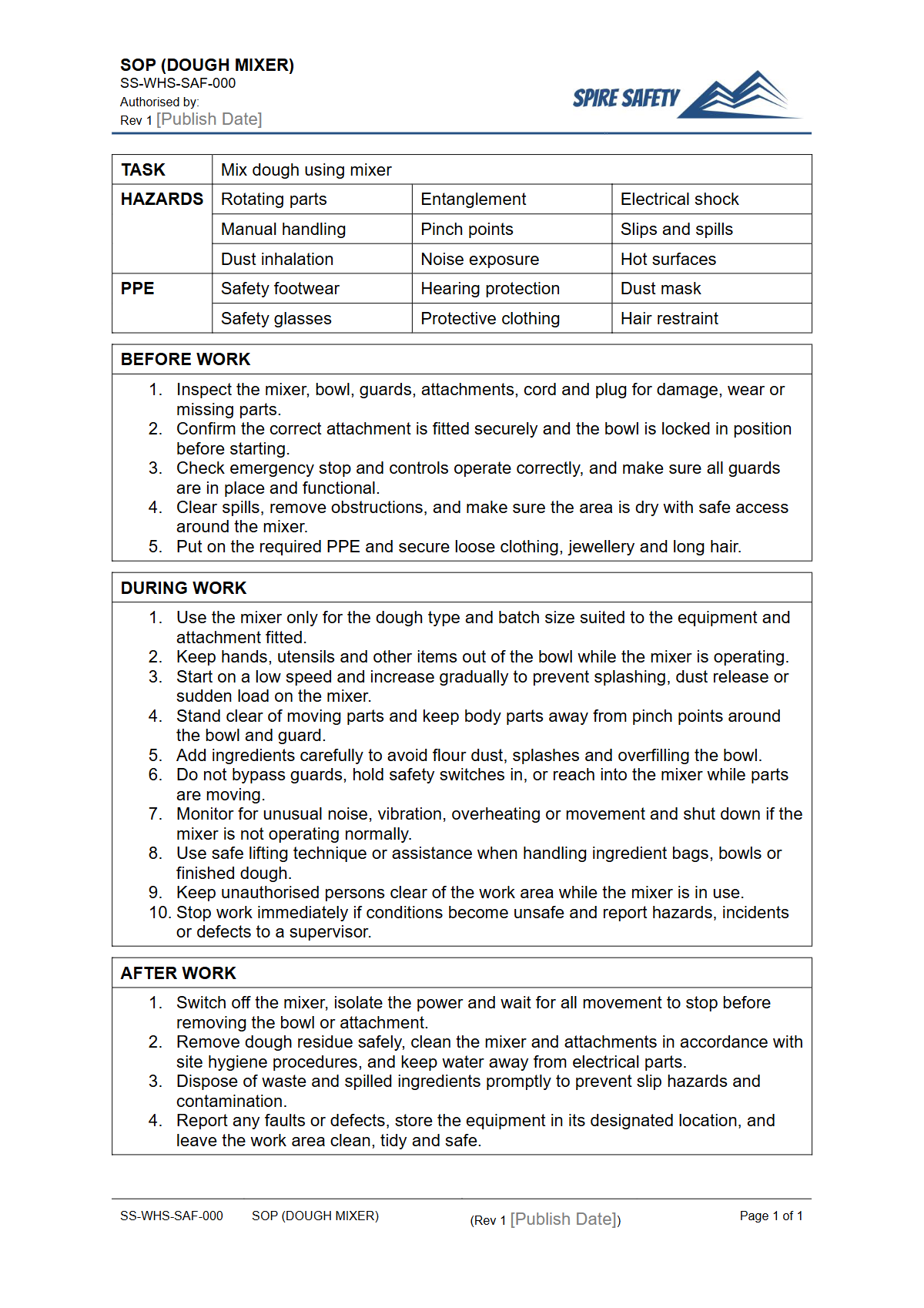
Operating a commercial or industrial dough mixer involves significant risks, including entanglement, crushing, and electrical hazards. This Free Safe Operating Procedure (Dough Mixer) Template provides a structured framework to document the required steps for safely using this equipment.
A documented SOP is a fundamental tool for managing workplace risks, ensuring all workers follow a consistent, safe method for specific tasks. It helps control identified hazards, forms the basis for effective training, and demonstrates your commitment to a safe system of work.
By clearly outlining pre-start checks, operational steps, cleaning protocols, and emergency responses, you reduce the likelihood of incidents and injuries. Formalising these procedures is a key element of any effective WHS management system, helping your business meet its health and safety obligations and protect its workers.
Video walkthrough
How to use the Free Safe Operating Procedure (Dough Mixer) Template
This template is designed as a comprehensive starting point. It is pre-filled with common sections relevant to dough mixer operations, but it must be adapted to reflect the specific equipment and environment at your workplace.
Generic procedures are insufficient; customisation is essential for the document to be effective and relevant.
To correctly use this template:
- Download the DOCX file and open it for editing.
- Consult with the workers who actually operate the dough mixers. Their direct experience is invaluable for identifying practical steps and unforeseen hazards.
- Thoroughly review the specific make and model of your dough mixer(s), noting all controls, safety features (like guards and emergency stops), and potential energy sources.
- Fill in the template with site-specific details, including the required Personal Protective Equipment (PPE), lockout/tagout procedures for cleaning, and steps for handling malfunctions.
- Once completed, have the SOP reviewed and approved by a supervisor or manager.
- Use the final document as a core part of your training program for all new and existing operators.
Once implemented, the effectiveness of your procedures can be verified through practical observation and formal reviews. Regular checks ensure the documented steps are being followed correctly, and WHS compliance auditing can help identify any gaps between your documented process and real-world practice.
When to use a Safe Operating Procedure
A Safe Operating Procedure for a dough mixer should be used as a primary reference document in several situations. It is essential during the initial induction and training of any employee who will be required to operate the machine.
It serves as a consistent benchmark to ensure every operator receives the same safety information and instructions. The SOP should be readily accessible in the work area for quick reference during operation.
It should also be used for conducting refresher training, especially if an operator has not used the equipment for some time. Furthermore, the SOP must be reviewed and referenced following any incident or near miss involving the dough mixer to determine if the procedure was followed and if it requires updating.
This proactive use helps prevent future occurrences. In workplaces with integrated food production lines, this SOP can be used alongside other key documents, such as a free Conveyer System SOP template, to ensure end-to-end process safety.
Who should use this document
This Safe Operating Procedure template is intended for use by anyone responsible for health and safety within a food service or manufacturing environment. This includes WHS Managers, Supervisors, and Team Leaders in bakeries, restaurants, commercial kitchens, and food processing plants.
They are the individuals typically tasked with drafting, implementing, and reviewing safety documentation.
The finalised procedure is for the direct use of plant operators—the workers who physically operate the dough mixers. It gives them a clear, step-by-step guide to follow to perform their tasks safely.
For businesses needing support to develop comprehensive, site-specific documentation, engaging external experts through WHS consulting can provide valuable guidance and ensure your safety systems are robust. This is particularly useful when dealing with multiple pieces of complex plant, such as those covered in our Free Air Compressor SOP template.
Spire Safety offers a wide range of templates and guides to support your safety management efforts. Explore our complete free WHS resources library for more downloadable documents to help you build a safer workplace.
Common mistakes
Common mistakes to avoid
- Using a generic SOP without customising it for the specific make and model of the mixer.
- Failing to include specific lockout/tagout procedures for cleaning and maintenance.
- Neglecting to consult with the actual operators of the equipment when drafting the procedure.
- Treating the SOP as a one-time document and not reviewing it after process changes or incidents.
Legal references
Legal considerations
The following legal requirements may be relevant to this type of work.
- Work Health and Safety Act (Harmonised) — Provides the primary duties for protecting workers and other people from work health and safety risks.
- Work Health and Safety Regulations (Harmonised) — Sets out requirements supporting the management of workplace hazards and risks.
The following codes may be relevant to this type of work.
- Managing WHS Risks Code of Practice — Provides practical guidance on identifying hazards, assessing risks and applying effective controls.
- Work Health and Safety Consultation, Cooperation and Coordination Code of Practice — Provides practical guidance on consulting workers and coordinating with other duty holders.
- Managing the Work Environment and Facilities Code of Practice — Provides practical guidance on safe work environments, workplace facilities and related controls.
Did you know
Entanglement Risk
The powerful motors in commercial dough mixers can cause severe entanglement injuries in less than a second. Interlocked guards and emergency stop buttons are critical safety controls that must never be bypassed or removed.
Flour Dust
In addition to mechanical hazards, fine flour dust can be a respiratory irritant. In high concentrations within an enclosed space, it can also create an explosive atmosphere (combustible dust), posing a serious fire or explosion risk.
FAQ
Frequently asked questions
01What hazards are associated with commercial dough mixers?
02Does this SOP template cover cleaning and maintenance?
03How often should an SOP for a dough mixer be reviewed?
04Can I use this one template for different models of dough mixers?
Share this resource
Free Safe Operating Procedure (Dough Mixer) Template
Browse Categories
How To Use It
- 1Download and open in Word or PDF.
- 2Replace the placeholders with your business details.
- 3Get it reviewed by a WHS specialist before rollout.
Need it customised?
Our WHS consultants can adapt this template to your site, run a gap analysis, or audit what you already have in place.
Book a Free Consultation WHS consulting servicesor call 1300 156 382
Related templates
- Free Safe Operating Procedure (Dough Moulder) Template
- Free Safe Operating Procedure (Dough Rounder) Template
- Free Safe Operating Procedure (Dough Sheeter) Template
- Free Safe Operating Procedure (Dough Tray Handling) Template
- Free Safe Operating Procedure (Drain Cleaning Machine) Template
- Free Safe Operating Procedure (Drain Grate Cleaning) Template