
Free Safe Operating Procedure (Door Alarm Testing) Template
Download our free Safe Operating Procedure (Door Alarm Testing) template to formalise your safety processes.
Free Safe Operating Procedure (Door Alarm Testing) Template
DOCX • 126 KB + PDF
Updated Oct 2026
No signup required
Purpose of the Free Safe Operating Procedure (Door Alarm Testing) Template
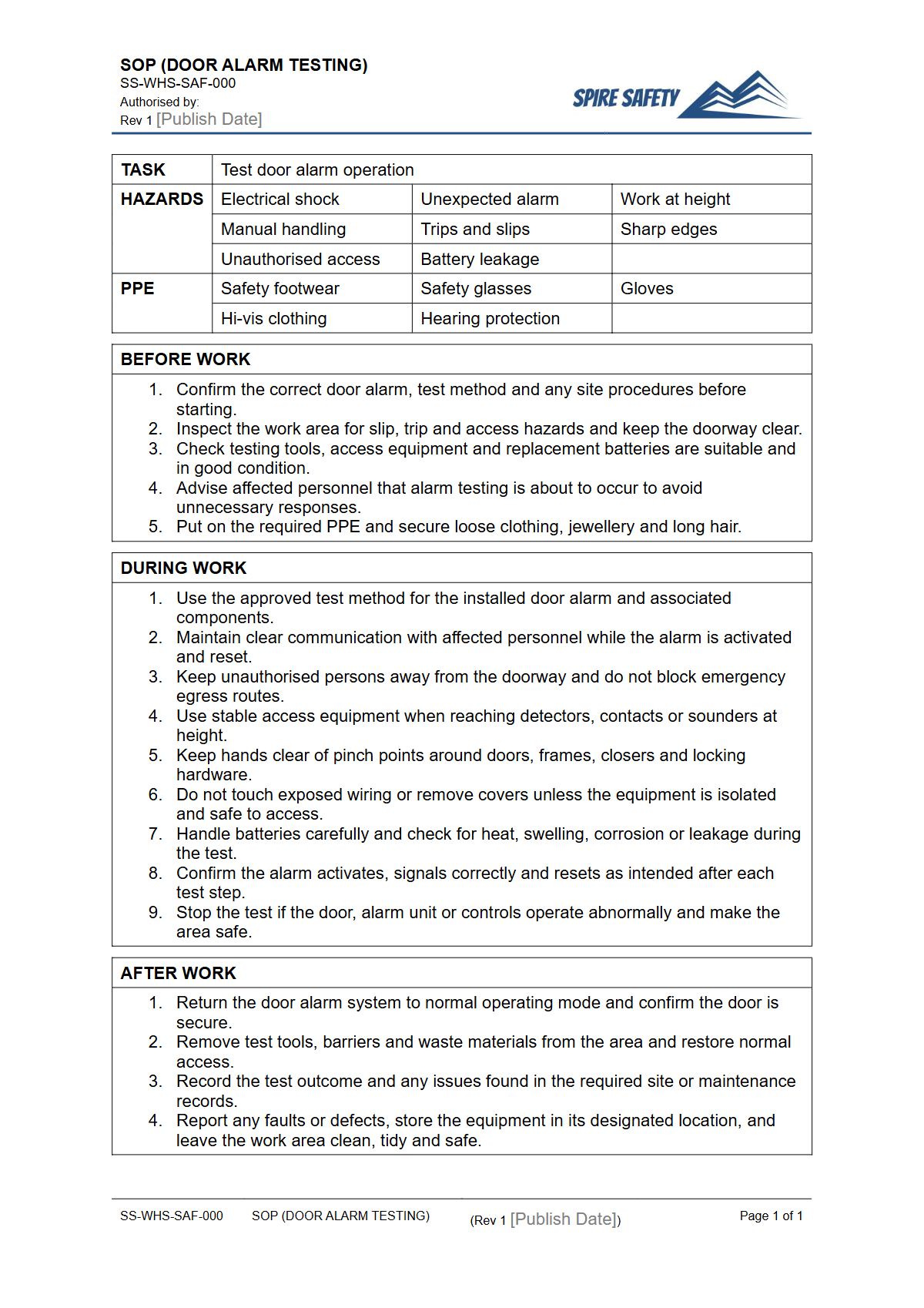
This Free Safe Operating Procedure (Door Alarm Testing) Template provides a structured framework for documenting the step-by-step process for safely inspecting and testing door alarm systems in your workplace. Regular testing of alarms on emergency exits, fire doors, and security access points is critical for ensuring they function correctly in an emergency.
Using a formal SOP helps standardise this task, provides a clear guide for training personnel, and serves as evidence of your commitment to proactive safety management. It forms an essential part of robust WHS management systems by ensuring critical safety equipment is reliable and ready.
Video walkthrough
How to use this Safe Operating Procedure (Door Alarm Testing) Template
To use this Safe Operating Procedure for door alarm testing, simply download the DOCX file and adapt it to your specific operational needs. The template is a starting point, designed for easy customisation.
You should fill in your company’s details, review the pre-filled steps, and add or remove information to match the exact type of alarm systems you use and the unique environment of your site. Regular reviews and updates to the SOP, informed by WHS compliance auditing, will ensure it remains relevant and effective.
Important Customisation Note:
This document is a template and must be customised to your workplace. We are not responsible for the outcomes of any actions taken based on its contents.
You must consult with your team and relevant stakeholders to ensure the final procedure reflects the specific hazards, equipment (brand, model, and configuration), and operational context of your site. A site-specific risk assessment should always be conducted before implementing any new work procedure.
When to Use a Safe Operating Procedure
An SOP for door alarm testing should be used consistently for all scheduled testing and maintenance activities. This includes routine functional tests (e.g., monthly or quarterly checks), annual compliance inspections, and checks following any maintenance or modification to the alarm system or door hardware.
It should also be used as a primary training document for new employees or when assigning testing duties to different personnel, ensuring everyone follows the same safe and effective process.
Who Should Use This Safe Operating Procedure
This template is designed for use by competent personnel tasked with maintaining facility safety. This typically includes facilities managers, maintenance staff, electricians, security personnel, and WHS advisors.
Supervisors can also use the SOP to verify that tasks are being performed correctly and safely by their teams. For organisations seeking to formalise all aspects of their safety framework, guidance from WHS consulting services can help integrate this SOP into a broader system.
Key Elements of a Robust Door Alarm Testing Procedure
A comprehensive SOP for this task goes beyond simply pushing a button. It should be a holistic process that ensures total system integrity. Key sections to include in your customised document are:
- Pre-Test Checks: This involves notifying relevant parties (e.g., security monitoring centres, building occupants) to prevent false alarms and unnecessary panic. It also includes a visual inspection of the door, alarm sensor, wiring, and power supply for any visible damage or tampering.
- Functional Testing: Detail the specific steps to activate the alarm (e.g., opening the door, pressing an emergency push bar). The procedure must specify what to check for, such as the local sounder and visual indicator (strobe light) activation, and confirmation that the signal was correctly received by the central control or monitoring panel. This process is similar to checks performed on other critical equipment, as outlined in documents like our Conveyer System SOP (Safe Operating Procedure) Template.
- Post-Test Procedures: After a successful test, the system needs to be correctly reset. The procedure should outline how to silence the alarm, reset the control panel, and ensure the system is back in its normal state. All test results, whether pass or fail, must be recorded in a maintenance logbook.
- Fault Finding and Reporting: The SOP must clearly define the steps to take if the alarm fails to operate correctly. This includes who to notify, how to secure the area if necessary, and the process for initiating repairs.
Integrating clear and repeatable procedures like this is fundamental to achieving high standards of workplace safety, and can be a key component in an ISO 45001 management system. For more templates covering a wide range of tasks and equipment, browse our complete free WHS resources library.
Common mistakes
Common mistakes to avoid
- Forgetting to notify building occupants or monitoring services before starting a test.
- Only testing the sounder and neglecting to check if the signal reaches the central control panel.
- Failing to properly document test results, including any faults and the corrective actions taken.
- Using a generic procedure without customising it for the specific type of alarm system installed.
Legal references
Legal considerations
The following legal requirements may be relevant to this type of work.
- Work Health and Safety Act (Harmonised) — Provides the primary duties for protecting workers and other people from work health and safety risks.
- Work Health and Safety Regulations (Harmonised) — Sets out requirements supporting the management of workplace hazards and risks.
The following codes may be relevant to this type of work.
- Managing WHS Risks Code of Practice — Provides practical guidance on identifying hazards, assessing risks and applying effective controls.
- Work Health and Safety Consultation, Cooperation and Coordination Code of Practice — Provides practical guidance on consulting workers and coordinating with other duty holders.
- Managing the Work Environment and Facilities Code of Practice — Provides practical guidance on safe work environments, workplace facilities and related controls.
Did you know
Silent Signals
Many modern door alarms don't just make noise locally. They also send silent signals to a central monitoring station or building management system, which also needs to be verified during testing.
Maintenance is Key
According to building safety data, a significant percentage of alarm failures are due to a lack of regular maintenance and testing, not hardware defects.
FAQ
Frequently asked questions
01How often should door alarms be tested in Australia?
02What should be included in a door alarm test log?
03Is a Safe Operating Procedure a legal requirement for testing door alarms?
04Can this template be used for fire door alarms?
Share this resource
Free Safe Operating Procedure (Door Alarm Testing) Template
Browse Categories
How To Use It
- 1Download and open in Word or PDF.
- 2Replace the placeholders with your business details.
- 3Get it reviewed by a WHS specialist before rollout.
Need it customised?
Our WHS consultants can adapt this template to your site, run a gap analysis, or audit what you already have in place.
Book a Free Consultation WHS consulting servicesor call 1300 156 382
Related templates
- Free Safe Operating Procedure (Door Closer Adjustment) Template
- Free Safe Operating Procedure (Door Glass Cleaning) Template
- Free Safe Operating Procedure (Door Hinge Lubrication) Template
- Free Safe Operating Procedure (Door Seal Cleaning) Template
- Free Safe Operating Procedure (Door Track Cleaning) Template
- Free Safe Operating Procedure (Dough Divider) Template