
Free Safe Operating Procedure (Door Closer Adjustment) Template
Standardise your maintenance tasks with our structured Safe Operating Procedure for door closer adjustments. Download this free template to get started today.
Free Safe Operating Procedure (Door Closer Adjustment) Template
DOCX • 126 KB + PDF
Updated Oct 2026
No signup required
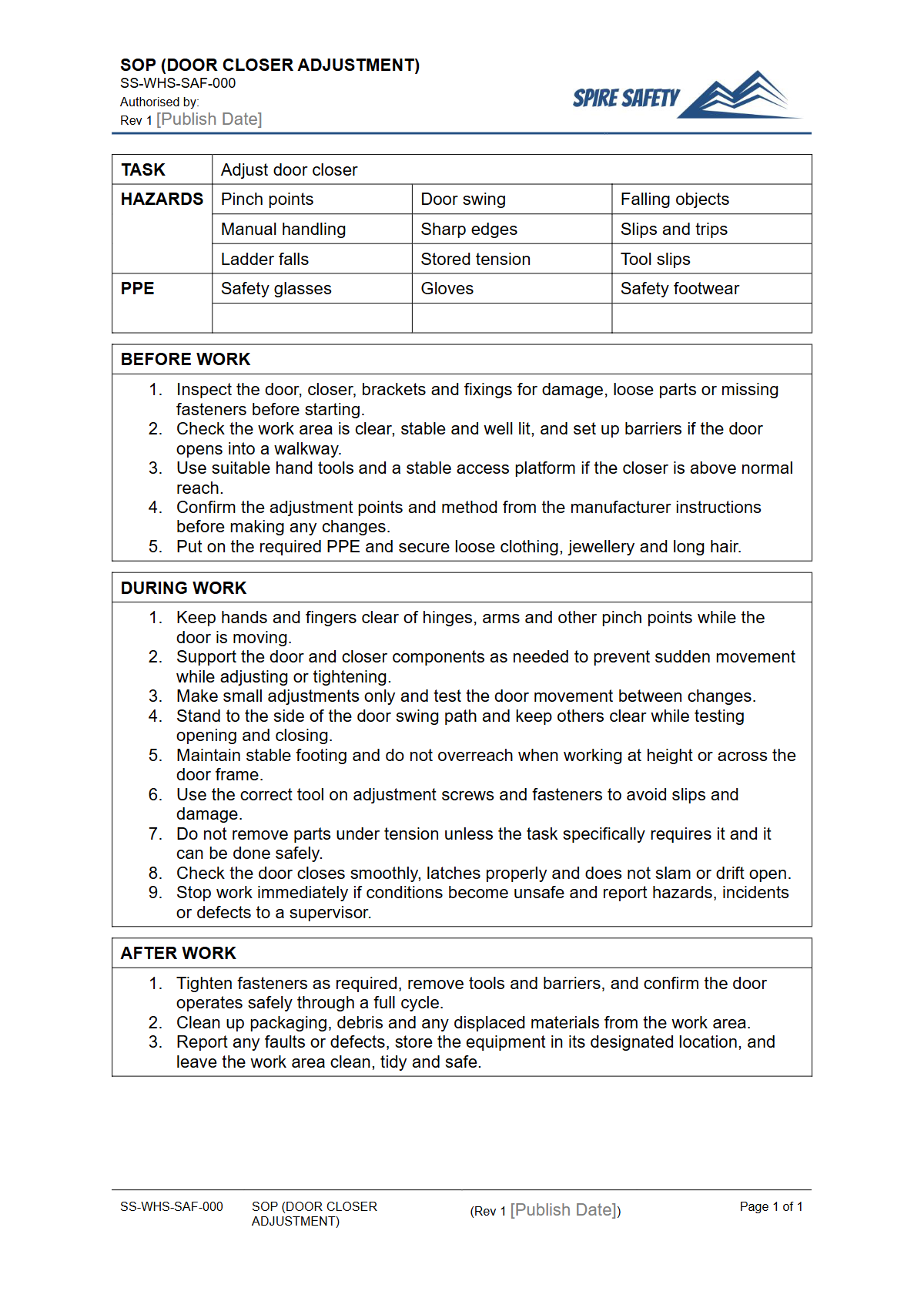
Purpose of the Free Safe Operating Procedure (Door Closer Adjustment) Template
Adjusting door closers is a common task in facilities maintenance, but it carries risks if not performed correctly. This free Safe Operating Procedure (Door Closer Adjustment) Template provides a structured framework for documenting the required steps, safety controls, and responsibilities for this task.
Using an SOP helps ensure that every adjustment is performed consistently and safely, managing hazards such as stored energy in springs, pinch points, and the risk of musculoskeletal injury from awkward postures.
A well-drafted SOP is a critical component of effective WHS management systems. It serves as a clear instruction guide for workers, a training resource for new team members, and auditable proof that your organisation has a formal process for managing the risks associated with this specific maintenance activity. By formalising the procedure, you reduce the likelihood of incidents caused by inconsistent or unsafe work methods.
Video walkthrough
How to use the Free Safe Operating Procedure (Door Closer Adjustment) Template
This document is a downloadable template in both DOCX and PDF formats, designed as a starting point. It must be adapted to suit the unique context of your workplace, including the specific models of door closers in use (e.g., hydraulic, pneumatic, surface-mounted, concealed), the environment they are in, and your organisation's existing safety protocols.
To implement it effectively:
- Download the DOCX file and open it.
- Consult with the maintenance personnel who perform this task to ensure the procedure reflects practical, on-the-ground realities.
- Conduct a site-specific risk assessment for the task, identifying all potential hazards.
- Customise the sections to detail the specific tools, Personal Protective Equipment (PPE), and step-by-step instructions for your equipment.
- Finalise the document, get it approved by the relevant manager, and communicate it to all applicable workers.
IMPORTANT: This document is a template only. We have provided a structured starting point, but you must customise it to reflect the specific equipment, hazards, and control measures relevant to your workplace and jurisdiction.
If you require assistance, consider engaging professional WHS consulting services.
When to use this Safe Operating Procedure
This Safe Operating Procedure should be used before any maintenance worker undertakes an adjustment of a door closer mechanism. It is particularly important in several scenarios:
- Scheduled Maintenance: As part of a regular preventative maintenance schedule to ensure all door closers function correctly and meet accessibility standards.
- Reactive Maintenance: Whenever a door is reported as slamming shut, not closing fully, or being too difficult to open.
- Training and Competency: As a key training document for new or less experienced maintenance staff to ensure they learn the safe and correct method from the start.
- Pre-Audit Preparation: When reviewing your safety documentation to ensure you have formalised procedures for common maintenance tasks.
A workshop or facility will have numerous procedures for different equipment. For example, you may also need a free Air Compressor SOP for general workshop tasks.
Who should use it
This SOP is intended for use by several key roles within an organisation to promote a safe and systematic approach to work:
- Maintenance Workers and Technicians: The primary users who will follow the step-by-step procedure to perform their work safely and to a consistent standard.
- Facilities Managers and Supervisors: Responsible for implementing the SOP, ensuring workers are trained on its contents, and verifying that the procedure is being followed correctly.
- Work Health and Safety (WHS) Officers: To integrate the SOP into the broader safety management system and use it as a reference during inspections or incident investigations. Its existence and proper use are often checked during a WHS compliance auditing process.
Documented procedures are vital for managing risk for all types of workplace equipment. The principles in this SOP can be applied to other fixed plant, such as the processes outlined in a Conveyer System SOP. Standardising work methods across your site is a fundamental aspect of good safety practice.
You can explore our complete free WHS resources library for more templates to support your safety management system.
Common mistakes
Common mistakes to avoid
- Over-tightening adjustment screws, causing internal damage to valves or seals.
- Failing to account for building air pressure ('stack effect'), which can affect closing speed.
- Neglecting to test the final 'latching speed', which can leave a door unsecure if too slow.
- Using the wrong type of oil or fluid for hydraulic models, leading to seal degradation and failure.
Legal references
Legal considerations
The following legal requirements may be relevant to this type of work.
- Work Health and Safety Act (Harmonised) — Provides the primary duties for protecting workers and other people from work health and safety risks.
- Work Health and Safety Regulations (Harmonised) — Sets out requirements supporting the management of workplace hazards and risks.
The following codes may be relevant to this type of work.
- Managing WHS Risks Code of Practice — Provides practical guidance on identifying hazards, assessing risks and applying effective controls.
- Work Health and Safety Consultation, Cooperation and Coordination Code of Practice — Provides practical guidance on consulting workers and coordinating with other duty holders.
- Managing the Work Environment and Facilities Code of Practice — Provides practical guidance on safe work environments, workplace facilities and related controls.
Did you know
A Long History
The first commercially successful overhead concealed door closer was patented in 1880, using a combination of a pneumatic piston and spring mechanism to control the door's swing.
Accessibility is Key
Incorrectly adjusted door closers are a common barrier to accessibility. If the opening force is too high, it can fail to comply with Australian Standard AS 1428.1, making access difficult for people with disabilities.
FAQ
Frequently asked questions
01What are the main hazards when adjusting a door closer?
02Does this SOP template cover all types of door closers?
03Is a Safe Operating Procedure a legal requirement for door closer adjustment in Australia?
04What Personal Protective Equipment (PPE) is typically needed for door closer adjustment?
Share this resource
Free Safe Operating Procedure (Door Closer Adjustment) Template
Browse Categories
How To Use It
- 1Download and open in Word or PDF.
- 2Replace the placeholders with your business details.
- 3Get it reviewed by a WHS specialist before rollout.
Need it customised?
Our WHS consultants can adapt this template to your site, run a gap analysis, or audit what you already have in place.
Book a Free Consultation WHS consulting servicesor call 1300 156 382
Related templates
- Free Safe Operating Procedure (Door Glass Cleaning) Template
- Free Safe Operating Procedure (Door Hinge Lubrication) Template
- Free Safe Operating Procedure (Door Seal Cleaning) Template
- Free Safe Operating Procedure (Door Track Cleaning) Template
- Free Safe Operating Procedure (Dough Divider) Template
- Free Safe Operating Procedure (Dough Mixer) Template