
Free Safe Operating Procedure (Door Glass Cleaning) Template
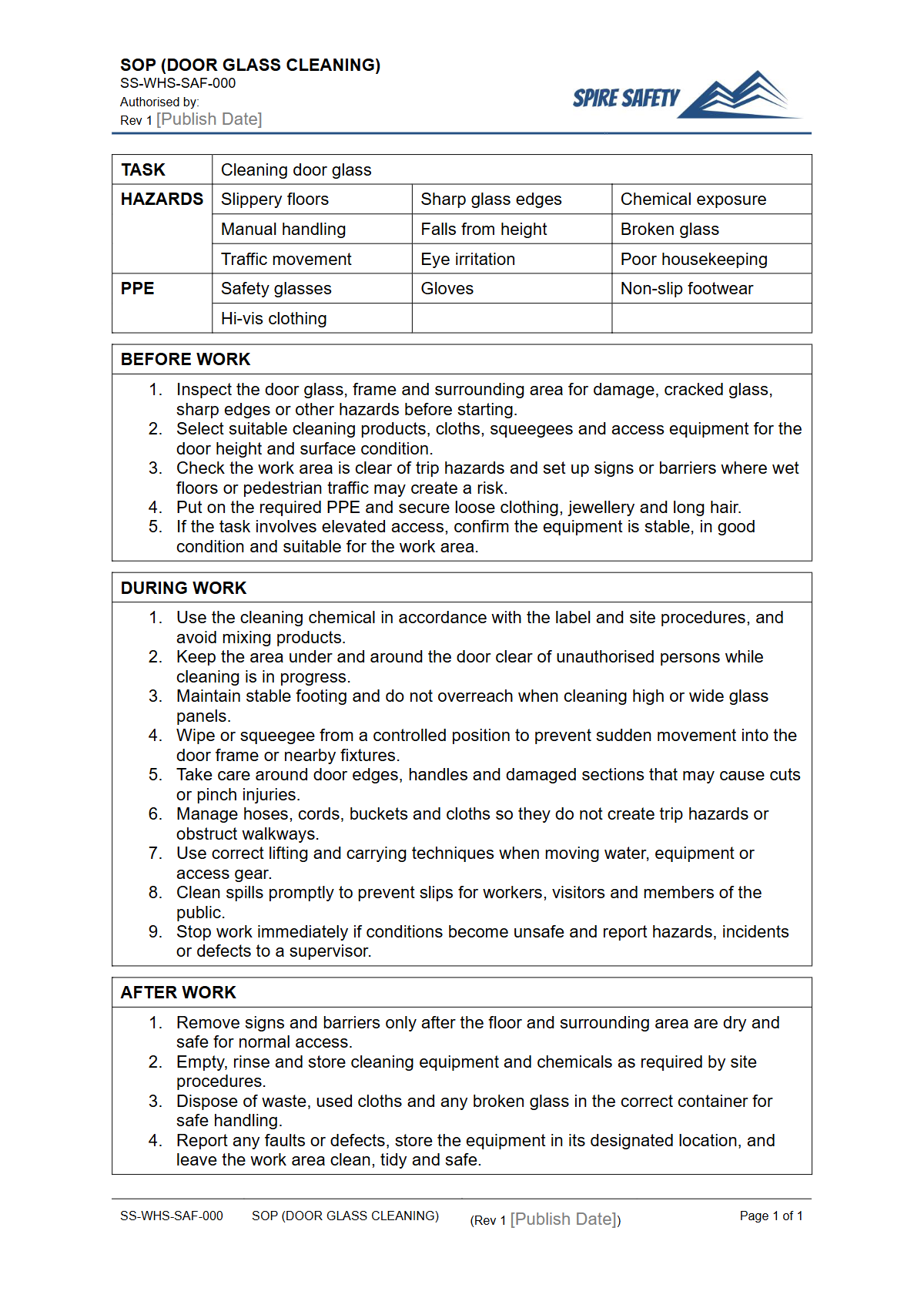
Download our free Safe Operating Procedure for door glass cleaning to establish a clear, repeatable process for your team.
Free Safe Operating Procedure (Door Glass Cleaning) Template
DOCX • 126 KB + PDF
Updated Oct 2026
No signup required
Purpose of the Free Safe Operating Procedure (Door Glass Cleaning) Template
Even seemingly simple tasks like cleaning glass doors carry workplace risks that must be managed. Our Free Safe Operating Procedure (Door Glass Cleaning) Template provides a structured framework to document a safe system of work for this common activity.
The primary purpose of this Safe Operating Procedure is to standardise the process, ensuring every worker follows a consistent, pre-approved method that minimises exposure to hazards. Documenting the procedure helps control risks such as slips from spilled cleaning solutions, ergonomic strains from over-reaching or awkward postures, and exposure to hazardous chemicals.
By implementing a formal SOP, you create a vital tool for worker training, competency assessment, and supervision. It forms a key part of your overall safety management documentation, demonstrating a commitment to proactive risk control.
A robust collection of SOPs is a fundamental building block of effective WHS management systems, helping your organisation fulfil its duty of care to provide a safe working environment.
Video walkthrough
How to use the Free Safe Operating Procedure (Door Glass Cleaning) Template
This Free Safe Operating Procedure (Door Glass Cleaning) Template is provided in an editable DOCX format for easy customisation, as well as a print-ready PDF. To use it effectively, download the file and systematically work through each section, adapting the content to your specific operational context.
This involves identifying the exact cleaning agents used and referencing their Safety Data Sheets (SDS), specifying the required Personal Protective Equipment (PPE) like gloves and safety glasses, and outlining clear steps for preparation, execution, and clean-up.
You must include details relevant to your site, such as procedures for managing spills, erecting warning signs, and disposing of waste materials correctly. Remember, a generic document offers little protection.
It is crucial that this template is customised to reflect the specific equipment, environment, and risks in your workplace. We strongly recommend consulting with the workers who perform the task, as their direct experience is invaluable for creating a practical and effective procedure.
For expert assistance in tailoring safety documents, consider engaging professional WHS consulting services.
When to use this Safe Operating Procedure
A Safe Operating Procedure for door glass cleaning should be a live document integrated into your daily operations. It is not a file to be completed once and forgotten.
It should be used as a primary training document during the induction of new employees who will be assigned the task. It also serves as a benchmark for competency assessments and regular refresher training sessions to prevent procedural drift.
The SOP should be readily accessible to workers as a quick reference guide in their work area. Furthermore, it is an essential tool during safety observations and formal audits, providing a clear standard against which actual work practices can be measured.
Should an incident or near-miss occur during cleaning, the SOP provides a baseline for the investigation process to identify any procedural gaps. Developing clear procedures for all key tasks, from cleaning to operating machinery as detailed in our Conveyer System SOP, is a cornerstone of a safe workplace.
Who should use this document
This Safe Operating Procedure is intended for several key roles within an organisation. The primary users are the workers assigned to perform the glass cleaning tasks; they must be trained on the procedure and are expected to follow its steps to ensure their own safety and the safety of others.
Supervisors and line managers use the SOP to train their team, monitor work performance, enforce safety standards, and conduct informal checks.
WHS managers and safety officers will use this template as part of their role in developing, implementing, and reviewing the organisation's safety systems. They ensure the procedure is comprehensive, reviewed regularly, and aligned with relevant legislation and codes of practice. A supervisor may be responsible for ensuring multiple procedures are followed, covering everything from janitorial tasks to equipment use outlined in documents like a free Air Compressor SOP. The document also provides clarity to management on how specific risks are being controlled on the ground, which is often verified through periodic WHS compliance auditing.
Spire Safety offers a wide range of templates and guides to assist businesses in building out their safety documentation. You can explore our complete free WHS resources library for more tools to support your safety management system.
Common mistakes
Common mistakes to avoid
- Using a generic template without customising it for site-specific hazards and chemicals.
- Failing to consult with the workers who perform the cleaning task during the drafting process.
- Not providing adequate training on the finalised SOP and the specific hazards involved.
- Forgetting to review and update the SOP after an incident or when processes change.
Legal references
Legal considerations
The following legal requirements may be relevant to this type of work.
- Work Health and Safety Act (Harmonised) — Provides the primary duties for protecting workers and other people from work health and safety risks.
- Work Health and Safety Regulations (Harmonised) — Sets out requirements supporting the management of workplace hazards and risks.
The following codes may be relevant to this type of work.
- Managing WHS Risks Code of Practice — Provides practical guidance on identifying hazards, assessing risks and applying effective controls.
- Work Health and Safety Consultation, Cooperation and Coordination Code of Practice — Provides practical guidance on consulting workers and coordinating with other duty holders.
- Managing the Work Environment and Facilities Code of Practice — Provides practical guidance on safe work environments, workplace facilities and related controls.
Did you know
Slips, Trips and Falls
According to Safe Work Australia, slips, trips and falls are a leading cause of workplace injury, making up a significant portion of all serious claims. Proper cleaning procedures, including signage and spill management, are critical in preventing these incidents.
Chemical Safety
Many common cleaning agents are classed as hazardous chemicals. Always consult the product's Safety Data Sheet (SDS) for information on safe handling, storage, required PPE, and first aid measures before use.
FAQ
Frequently asked questions
01What is a Safe Operating Procedure (SOP)?
02Why do I need an SOP just for cleaning glass doors?
03Is this template enough for my business to be WHS-aligned?
04How often should our Door Glass Cleaning SOP be reviewed?
Share this resource
Free Safe Operating Procedure (Door Glass Cleaning) Template
Browse Categories
How To Use It
- 1Download and open in Word or PDF.
- 2Replace the placeholders with your business details.
- 3Get it reviewed by a WHS specialist before rollout.
Need it customised?
Our WHS consultants can adapt this template to your site, run a gap analysis, or audit what you already have in place.
Book a Free Consultation WHS consulting servicesor call 1300 156 382
Related templates
- Free Safe Operating Procedure (Door Hinge Lubrication) Template
- Free Safe Operating Procedure (Door Seal Cleaning) Template
- Free Safe Operating Procedure (Door Track Cleaning) Template
- Free Safe Operating Procedure (Dough Divider) Template
- Free Safe Operating Procedure (Dough Mixer) Template
- Free Safe Operating Procedure (Dough Moulder) Template