
Free Safe Operating Procedure (Dog Park Cleaning) Template
Maintain a clean and safe environment with our detailed Safe Operating Procedure for dog park cleaning. Download our free, customisable template today.
Free Safe Operating Procedure (Dog Park Cleaning) Template
DOCX • 126 KB + PDF
Updated Oct 2026
No signup required
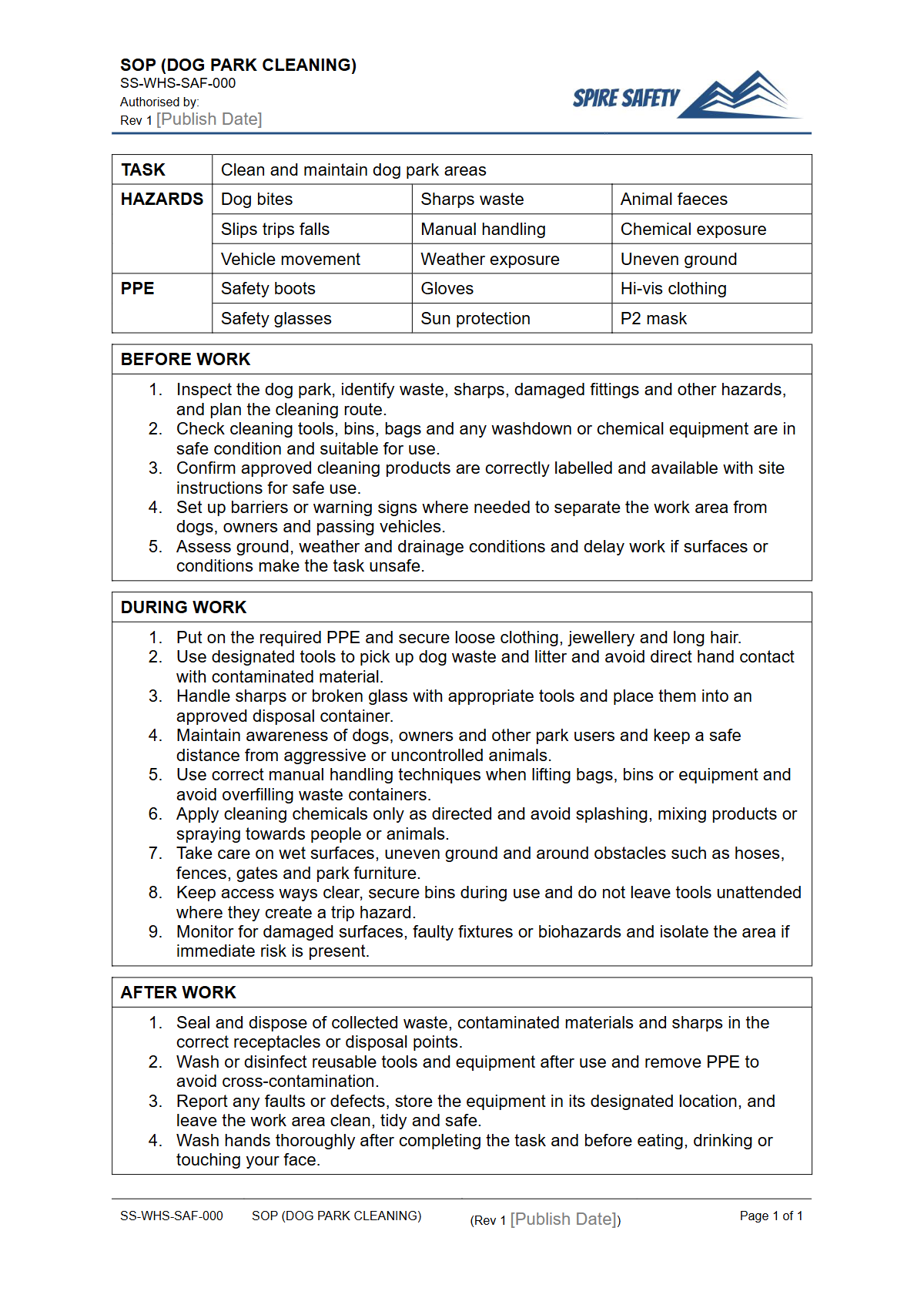
Purpose of the Free Safe Operating Procedure (Dog Park Cleaning) Template
Dog parks are valuable community assets, but they require regular and thorough cleaning to remain safe and hygienic for both people and pets. This Free Safe Operating Procedure (Dog Park Cleaning) Template provides a structured framework for outlining the required steps, safety controls, and responsibilities associated with this task.
Using a formalised SOP helps your organisation meet its duty of care by managing risks such as exposure to biological hazards, manual handling injuries, and chemical exposure from cleaning agents.
A documented procedure ensures that all workers follow a consistent, safe method every time, reducing the likelihood of incidents and promoting a high standard of public hygiene. It formalises risk controls for common hazards like animal waste, sharp objects hidden in grass or bins, aggressive animals, and adverse weather conditions.
Implementing this SOP is a key step in building a robust safety culture within your grounds maintenance team and demonstrates a commitment to workplace health and safety.
Video walkthrough
How to use the Free Safe Operating Procedure (Dog Park Cleaning) Template
This template is designed as a comprehensive starting point, aligned with Australian WHS principles. It must be adapted to reflect the specific conditions and equipment of your workplace.
To use it effectively, download the DOCX file and customise it with your site-specific details. This includes adding your company name, the specific park location, and details of the tools, equipment, and cleaning chemicals used.
If your team uses specific machinery, you may need to supplement this document with a dedicated safe operating procedure for spreaders or other relevant equipment.
Follow these steps to implement the SOP:
- Consultation: Involve the workers who will be performing the cleaning tasks. Their direct experience is invaluable for identifying practical hazards and effective controls.
- Customisation: Fill in all sections with information specific to your dog park. Detail the types of bins, water sources, cleaning agents (including referencing their Safety Data Sheets), and required Personal Protective Equipment (PPE).
- Training: Use the finalised SOP as a training document for new and existing employees to ensure everyone understands the required safety protocols.
- Approval: Have a manager or supervisor review and sign off on the document before it is put into use.
- Review: Schedule regular reviews of the SOP (e.g., annually or after any incident) to ensure it remains current and effective.
Important: This is a template only. We are not a law firm and this document is not a substitute for legal advice.
You are responsible for ensuring your completed SOP is customised to your specific work environment and that it complies with all relevant legislation, regulations, and codes of practice in your state or territory. Integrating this procedure into your broader WHS management systems is crucial for effective safety governance.
When to use it
This Safe Operating Procedure should be used as the primary reference document for every dog park cleaning task. It serves as a practical guide for workers on the ground before and during their shifts.
It is also a critical tool for training, inductions, and risk assessments. Regular reference to the SOP helps reinforce safe work habits and ensures that no steps are missed, particularly when dealing with non-routine situations like biohazard spills or equipment malfunctions. For organisations seeking to verify their safety processes, documents like this SOP form a key part of the evidence reviewed during a WHS compliance audit.
Who should use it
This SOP is intended for all personnel involved in the maintenance and cleaning of dog parks. This includes:
- Local council groundskeepers
- Parks and gardens staff
- Private maintenance contractors
- Strata or body corporate employees
- Supervisors and team leaders responsible for overseeing maintenance activities
It provides clear, actionable guidance that helps workers carry out their duties safely and efficiently, while also giving supervisors a clear standard to manage performance against. If you need assistance tailoring this or other documents to your specific operational needs, consider engaging our professional WHS consulting services for expert support.
You can also explore our full free WHS resources library for other useful templates and guides.
Common mistakes
Common mistakes to avoid
- Using incorrect dilution rates for disinfectants, which can be ineffective or create a chemical hazard.
- Failing to inspect the area for sharps, broken glass, or other hazards before starting work.
- Not adequately cordoning off the area being cleaned, creating a trip or slip hazard for the public.
- Neglecting to wear appropriate PPE, especially gloves and eye protection, when handling waste or chemicals.
Legal references
Legal considerations
The following legal requirements may be relevant to this type of work.
- Work Health and Safety Act (Harmonised) — Provides the primary duties for protecting workers and other people from work health and safety risks.
- Work Health and Safety Regulations (Harmonised) — Sets out requirements supporting the management of workplace hazards and risks.
The following codes may be relevant to this type of work.
- Managing WHS Risks Code of Practice — Provides practical guidance on identifying hazards, assessing risks and applying effective controls.
- Work Health and Safety Consultation, Cooperation and Coordination Code of Practice — Provides practical guidance on consulting workers and coordinating with other duty holders.
- Managing the Work Environment and Facilities Code of Practice — Provides practical guidance on safe work environments, workplace facilities and related controls.
Did you know
Zoonotic Risk
Dog faeces can carry zoonotic pathogens like Giardia, Salmonella, and various parasitic worms that can be transmitted to humans. Proper cleaning protocols and PPE are the first line of defence for groundskeepers.
FAQ
Frequently asked questions
01What PPE is required for cleaning a dog park?
02How often should a dog park cleaning SOP be reviewed?
03Does this SOP cover interactions with dogs or the public?
04What is the difference between an SOP and a SWMS for this task?
Share this resource
Free Safe Operating Procedure (Dog Park Cleaning) Template
Browse Categories
How To Use It
- 1Download and open in Word or PDF.
- 2Replace the placeholders with your business details.
- 3Get it reviewed by a WHS specialist before rollout.
Need it customised?
Our WHS consultants can adapt this template to your site, run a gap analysis, or audit what you already have in place.
Book a Free Consultation WHS consulting servicesor call 1300 156 382
Related templates
- Free Safe Operating Procedure (Door Alarm Testing) Template
- Free Safe Operating Procedure (Door Closer Adjustment) Template
- Free Safe Operating Procedure (Door Glass Cleaning) Template
- Free Safe Operating Procedure (Door Hinge Lubrication) Template
- Free Safe Operating Procedure (Door Seal Cleaning) Template
- Free Safe Operating Procedure (Door Track Cleaning) Template