
Free Safe Operating Procedure (Dock Leveller) Template
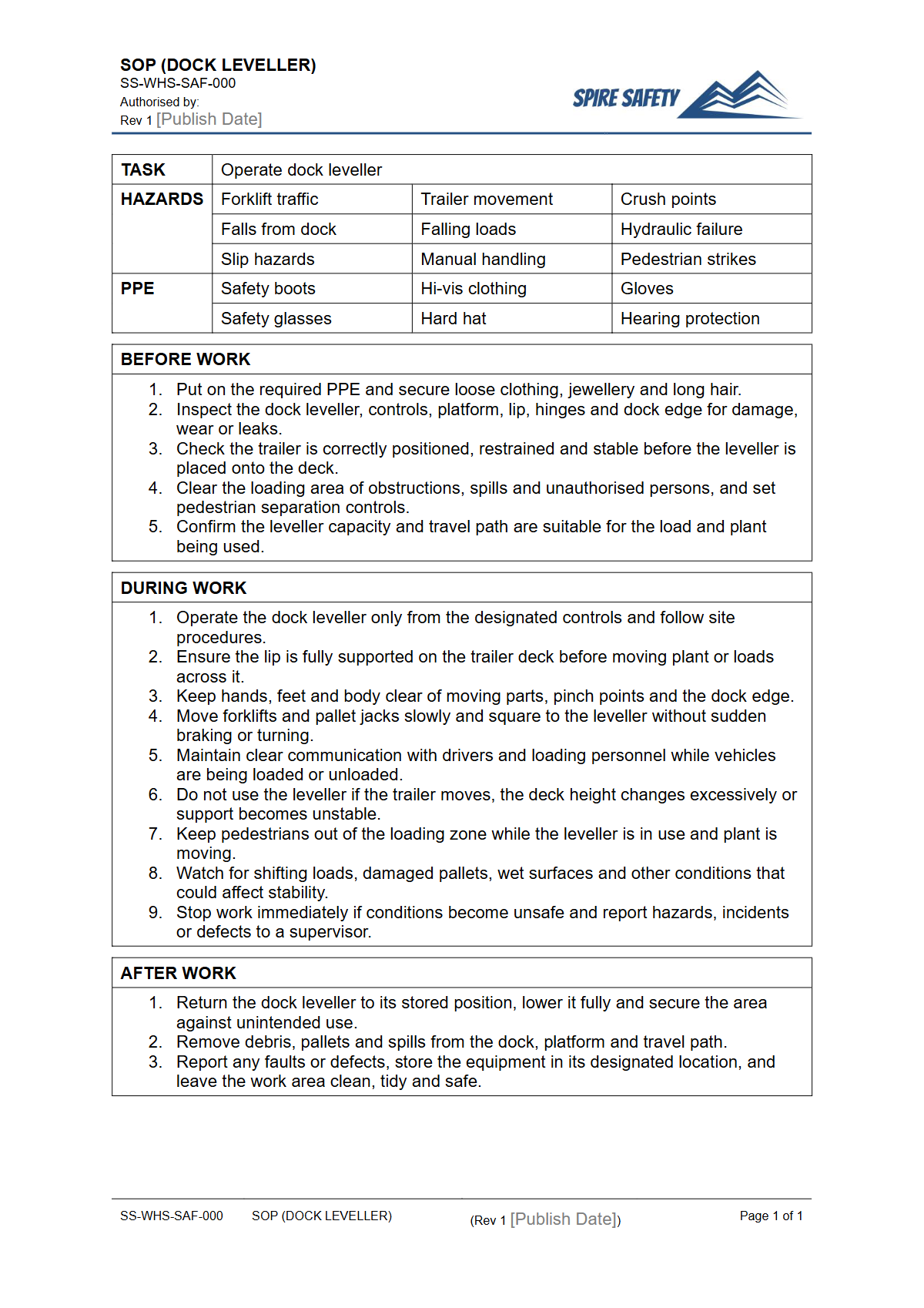
Download our free Safe Operating Procedure for dock levellers to help manage risks and outline safe work steps. Get your DOCX and PDF template today.
Free Safe Operating Procedure (Dock Leveller) Template
DOCX • 126 KB + PDF
Updated Oct 2026
No signup required
Purpose of the Free Safe Operating Procedure (Dock Leveller) Template
A dock leveller bridges the gap between a loading dock and a vehicle, but its powerful moving parts introduce serious risks if not managed correctly. This Free Safe Operating Procedure (Dock Leveller) Template offers a structured framework for documenting step-by-step instructions to ensure safe operation.
By clearly defining pre-start checks, operational steps, and shutdown procedures, businesses can significantly reduce the likelihood of incidents like crush injuries, falls from height, or equipment damage in busy loading bay environments.
The primary purpose of this template is to help your organisation establish and communicate a standardised, safe method for operating dock levellers. A documented SOP serves as a critical training tool for new and existing workers, ensuring everyone understands the required safety controls and emergency procedures.
It forms a key component of your broader WHS management systems, demonstrating a proactive approach to hazard management and helping to meet your duties under WHS legislation.
Video walkthrough
How to use the Free Safe Operating Procedure (Dock Leveller) Template
This resource is provided in both DOCX and PDF formats. To use it effectively, download the DOCX file and adapt it to the specific models of dock levellers, associated tasks, and environmental conditions at your worksite.
You should add site-specific details, including emergency contact information, the names of responsible persons, and any unique hazards present in your loading bay area, such as pedestrian traffic or uneven surfaces.
The SOP should be reviewed and signed by all relevant workers before they begin operating the equipment. Just as a FREE Telehandler SOP Template needs to be specific to that machine's attachments and lifting capacity, this document must be tailored to your exact dock leveller type—whether it's hydraulic, mechanical, or air-powered.
Please note: This is a template only. We are not familiar with your specific operations, so you must customise this document to reflect the unique risks and control measures applicable to your workplace.
When to use a Dock Leveller SOP
A Safe Operating Procedure for a dock leveller should be used in several key situations. It must be consulted during the induction and training of any new worker tasked with operating or working near the loading dock.
It should also be used as a reference for refresher training to prevent complacency and reinforce safe work habits. Regular consultation ensures the documented procedure remains a practical and relevant tool for daily operations.
Following an incident or near miss, the SOP is an essential document for review during the investigation process to identify if procedures were followed and if they remain adequate. Effective loading dock management often involves multiple pieces of equipment working in unison.
It is best practice to have SOPs for all high-risk plant, such as those covered in our FREE Conveyer System SOP (Safe Operating Procedure) Template, to ensure a holistic approach to safety in the area.
Who should use this Safe Operating Procedure
This SOP is designed for several key roles within an organisation. Primarily, it is for the direct operators of the dock leveller, providing them with clear, step-by-step guidance to perform their tasks safely.
Supervisors and line managers must also use the document to oversee operations, conduct safety observations, and supports your compliance efforts with established procedures. It empowers them to correct unsafe behaviour and provides a consistent standard against which to measure performance.
Additionally, WHS personnel and safety committee members will find it valuable for conducting risk assessments, developing training programs, and performing workplace inspections. Regular reviews of SOPs are a fundamental part of a robust safety system and are often checked during a formal WHS compliance auditing process to verify that documented procedures match actual work practices. For other common plant and equipment, you can find more templates in our free WHS resources library.
Common mistakes
Common mistakes to avoid
- Failing to inspect the dock leveller and surrounding area before each use.
- Operating the leveller before the truck is properly secured with wheel chocks or vehicle restraints.
- Leaving the leveller in the raised position when not in use, creating a significant trip and fall hazard.
- Attempting to service or repair the equipment without following proper lockout/tagout procedures.
Legal references
Legal considerations
The following legal requirements may be relevant to this type of work.
- Work Health and Safety Act (Harmonised) — Provides the primary duties for protecting workers and other people from work health and safety risks.
- Work Health and Safety Regulations (Harmonised) — Sets out requirements supporting the management of workplace hazards and risks.
The following codes may be relevant to this type of work.
- Managing WHS Risks Code of Practice — Provides practical guidance on identifying hazards, assessing risks and applying effective controls.
- Work Health and Safety Consultation, Cooperation and Coordination Code of Practice — Provides practical guidance on consulting workers and coordinating with other duty holders.
- Managing the Work Environment and Facilities Code of Practice — Provides practical guidance on safe work environments, workplace facilities and related controls.
Did you know
Gap Dangers
A gap as small as 20cm between the trailer and the dock can be large enough for a forklift wheel to fall into, potentially causing the load to shift or the forklift to overturn.
Load Capacity
Dock levellers have a 'dynamic load capacity' rating, which indicates the maximum weight they can safely support while in motion. Exceeding this is a common cause of catastrophic equipment failure.
FAQ
Frequently asked questions
01What are the main hazards associated with dock levellers?
02How often should a dock leveller SOP be reviewed?
03Is specific training required to operate a dock leveller?
04What is the difference between a mechanical and hydraulic dock leveller?
Share this resource
Free Safe Operating Procedure (Dock Leveller) Template
Browse Categories
How To Use It
- 1Download and open in Word or PDF.
- 2Replace the placeholders with your business details.
- 3Get it reviewed by a WHS specialist before rollout.
Need it customised?
Our WHS consultants can adapt this template to your site, run a gap analysis, or audit what you already have in place.
Book a Free Consultation WHS consulting servicesor call 1300 156 382
Related templates
- Free Safe Operating Procedure (Dock Line Handling) Template
- Free Safe Operating Procedure (Dockside Waste Cleanup) Template
- Free Safe Operating Procedure (Dog Park Cleaning) Template
- Free Safe Operating Procedure (Door Alarm Testing) Template
- Free Safe Operating Procedure (Door Closer Adjustment) Template
- Free Safe Operating Procedure (Door Glass Cleaning) Template