
Free Safe Operating Procedure (Dock Ladder Inspection) Template
Download our free Safe Operating Procedure for dock ladder inspections to formalise your safety processes. Customise this template to ensure worker safety.
Free Safe Operating Procedure (Dock Ladder Inspection) Template
DOCX • 126 KB + PDF
Updated Oct 2026
No signup required
Purpose of the Free Safe Operating Procedure (Dock Ladder Inspection) Template
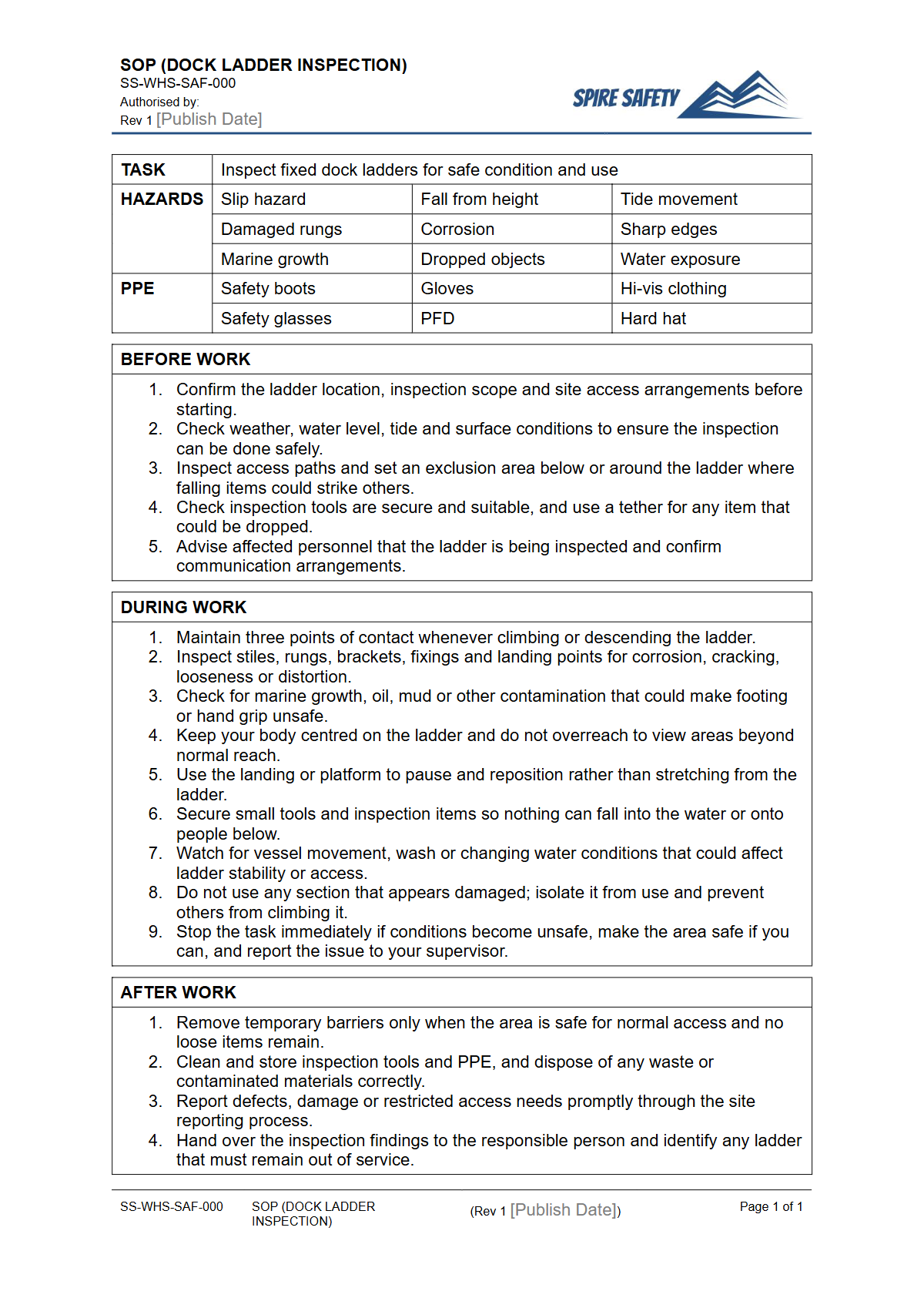
This Free Safe Operating Procedure (Dock Ladder Inspection) Template provides a structured framework for systematically inspecting fixed ladders used at loading docks, wharves, and similar industrial environments. Regular, documented inspections are crucial for identifying hazards such as corrosion, structural damage, loose fittings, or environmental wear and tear before they lead to an incident.
Using this SOP helps a Person Conducting a Business or Undertaking (PCBU) meet their primary duty of care by managing the risks associated with falls from height.
A documented procedure ensures inspections are consistent, thorough, and recorded, forming a key part of your site's overall safety management system. It standardises the process, clarifies responsibilities, and creates an auditable trail of due diligence.
Integrating clear SOPs like this one is a fundamental component of building robust WHS management systems that protect workers and support operational integrity.
Video walkthrough
How to use the Free Safe Operating Procedure (Dock Ladder Inspection) Template
Our Free Safe Operating Procedure (Dock Ladder Inspection) Template is available for download in both DOCX and PDF formats. The DOCX file is fully editable, allowing you to tailor it to your specific operational needs.
The procedure outlines key steps including defining responsibilities, pre-inspection safety checks, the inspection process itself, and criteria for taking a ladder out of service.
Important: This template is a starting point aligned with Australian WHS practice and must be customised for your workplace. We strongly recommend a competent person reviews and adapts the document to address the specific dock ladders, environmental factors (e.g., saltwater exposure), potential for vehicle impact, and unique risks present at your site.
A generic procedure is not sufficient to ensure safety or demonstrate compliance.
While this document focuses on fixed dock ladders, the principles of regular inspection are universal for all access equipment. You may also find our free Extension Ladder SOP useful for managing portable ladders on your site.
When to Conduct Dock Ladder Inspections
A comprehensive inspection schedule is essential for ladder safety and should be determined by a risk assessment. This SOP supports multiple inspection frequencies:
- Pre-use checks: Quick visual checks by users before they access the ladder to spot obvious defects.
- Detailed periodic inspections: In-depth, documented inspections conducted at regular intervals (e.g., monthly or quarterly) by a competent person. The frequency should be based on factors like ladder usage, age, and environmental conditions.
- Post-incident inspections: A full inspection is required after any event that could affect the ladder's integrity, such as a vehicle collision, extreme weather event, or reported user concern.
Formalising this schedule ensures that gradual deterioration is identified and rectified promptly. In busy logistics environments, coordinating these checks with other equipment procedures, such as those in a Conveyer System SOP, can improve efficiency.
Who Should Use This Safe Operating Procedure
This template is designed for use by various personnel within an organisation to ensure a coordinated approach to safety:
- WHS Managers and Safety Officers: To implement and oversee the inspection program as part of the broader safety system.
- Supervisors and Team Leaders: To ensure their teams are aware of the procedure and that inspections are completed as scheduled.
- Maintenance Personnel: To follow a standardised guide when conducting detailed periodic inspections and carrying out repairs.
- Competent Workers: To be trained and authorised to conduct inspections according to the documented process.
Assigning clear roles and responsibilities is a critical step in managing workplace safety. Regular WHS compliance auditing can verify that procedures like this are being effectively implemented and followed by all relevant personnel. Operators of plant like forklifts or telehandlers who work near docks should also be trained to report any observed ladder damage, as detailed in documents like our FREE Telehandler SOP. You can find many other useful templates in our free WHS resources library.
Common mistakes
Common mistakes to avoid
- Using a generic template without customising it for site-specific ladder types and risks.
- Failing to establish and adhere to a regular, documented inspection schedule.
- Neglecting to train workers on how to properly inspect and use dock ladders safely.
- Overlooking damage from environmental factors like corrosion or impacts from vehicles and vessels.
Legal references
Legal considerations
The following legal requirements may be relevant to this type of work.
- Work Health and Safety Act (Harmonised) — Provides the primary duties for protecting workers and other people from work health and safety risks.
- Work Health and Safety Regulations (Harmonised) — Sets out requirements supporting the management of workplace hazards and risks.
The following codes may be relevant to this type of work.
- Managing WHS Risks Code of Practice — Provides practical guidance on identifying hazards, assessing risks and applying effective controls.
- Work Health and Safety Consultation, Cooperation and Coordination Code of Practice — Provides practical guidance on consulting workers and coordinating with other duty holders.
- Managing the Work Environment and Facilities Code of Practice — Provides practical guidance on safe work environments, workplace facilities and related controls.
Did you know
Falls from Height
Falls from height remain a leading cause of workplace fatalities and serious injuries in Australia. Even falls from less than two metres can be fatal, highlighting the importance of inspecting all access equipment, including fixed ladders.
Corrosion is a Critical Factor
For dock ladders in marine or outdoor settings, corrosion is a significant threat. Galvanic corrosion can occur where different metals are in contact, weakening the ladder's structure in ways that may not be immediately obvious.
FAQ
Frequently asked questions
01What should be included in a dock ladder inspection SOP?
02How often should dock ladders be inspected?
03Who is considered a competent person to inspect a dock ladder?
04Is a Safe Operating Procedure a legal requirement for dock ladders in Australia?
Share this resource
Free Safe Operating Procedure (Dock Ladder Inspection) Template
Browse Categories
How To Use It
- 1Download and open in Word or PDF.
- 2Replace the placeholders with your business details.
- 3Get it reviewed by a WHS specialist before rollout.
Need it customised?
Our WHS consultants can adapt this template to your site, run a gap analysis, or audit what you already have in place.
Book a Free Consultation WHS consulting servicesor call 1300 156 382
Related templates
- Free 3D Printer SOP (Safe Operating Procedure) Template
- FREE Agricultural Equipment SOP (Safe Operating Procedure) Template
- Free Air Compressor SOP (Safe Operating Procedure) Template
- Free Angle Grinder SOP (Safe Operating Procedure) Template
- FREE Backhoe SOP (Safe Operating Procedure) Template
- FREE Baler SOP (Safe Operating Procedure) Template