
Free Safe Operating Procedure (Dock Fender Inspection) Template
Establish a clear, safe process for inspecting dock fenders with our structured template. Download your free Safe Operating Procedure to get started today.
Free Safe Operating Procedure (Dock Fender Inspection) Template
DOCX • 126 KB + PDF
Updated Oct 2026
No signup required
Purpose of the Free Safe Operating Procedure (Dock Fender Inspection) Template
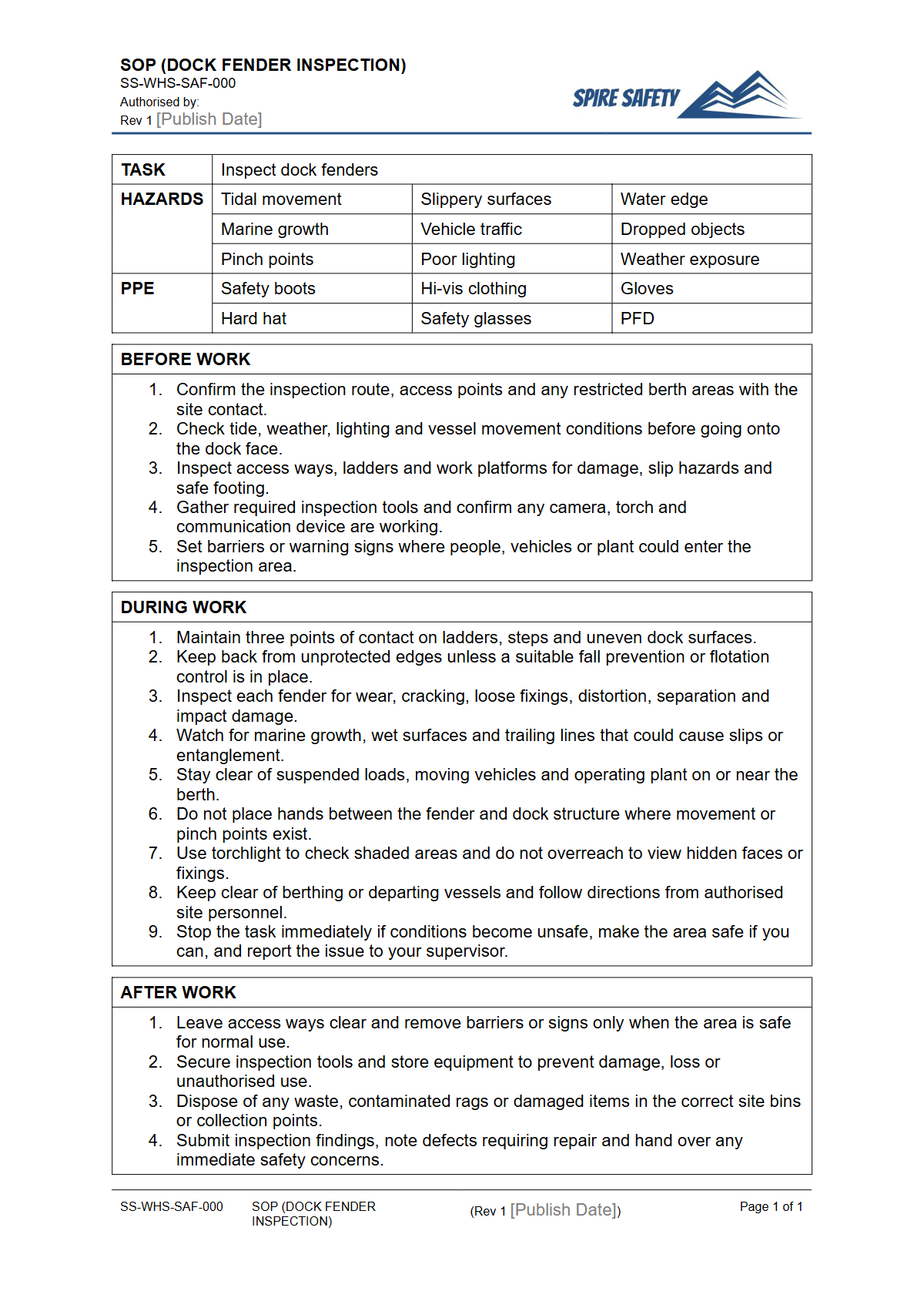
This Free Safe Operating Procedure (Dock Fender Inspection) Template provides a structured framework for businesses to create a comprehensive guide for inspecting marine dock fenders. Regular and systematic inspections are critical for maintaining the integrity of port infrastructure, preventing costly damage to both vessels and wharves, and protecting workers from harm.
This SOP helps formalise the inspection process, ensuring that checks are performed consistently and that all findings are properly documented.
Developing a robust procedure is a key part of managing workplace hazards associated with marine operations, such as falls from height, working over water, manual handling, and potential crushing injuries. By outlining clear steps, required personal protective equipment (PPE), and emergency protocols, this document serves as a vital tool within broader WHS management systems. It helps organisations fulfil their duty of care by providing a safe system of work for this essential maintenance task.
Video walkthrough
How to use the Free Safe Operating Procedure (Dock Fender Inspection) Template
Our template is designed to be a user-friendly starting point. After downloading the DOCX file, you can easily edit and adapt it to your specific operational context.
The document guides you through key sections, including required PPE, risk controls, step-by-step inspection instructions, and emergency response actions. It is crucial to conduct a site-specific risk assessment to inform the content you add to this procedure.
IMPORTANT: This is a template, not a finished document. You must customise this Safe Operating Procedure to reflect the specific types of fenders, equipment, environment, and risks at your workplace.
We cannot be responsible for the outcomes if this is not done. This involves adding details about your specific location, personnel roles, communication protocols, and any unique hazards present.
Many maintenance tasks might require specific tools, and a procedure like an Air Compressor SOP might be a useful supplementary document.
When to Conduct a Dock Fender Inspection
A Safe Operating Procedure for dock fender inspections should be utilised in several key situations to ensure ongoing safety and asset protection. It is not a one-off task but a continuous cycle of observation and maintenance.
- Routine Scheduled Inspections: Integrate this SOP into your regular maintenance schedule (e.g., weekly, monthly, or quarterly) to proactively identify wear and tear.
- Pre- and Post-Berthing: Conduct inspections before a vessel's arrival and after its departure to check for any damage sustained during mooring operations.
- After Severe Weather: High winds, strong currents, and storms can place extreme stress on fenders. An inspection is essential following any significant weather event.
- Following a High-Impact Event: If a vessel makes hard contact with the wharf, a detailed inspection using this procedure is required immediately to assess for structural damage to the fender and its mountings.
- During Audits: The procedure serves as evidence of a formalised process during internal or external safety audits. Having these documented processes is a key part of preparing for WHS compliance auditing.
Who Should Use This Safe Operating Procedure
This SOP is intended for all personnel involved in the inspection, maintenance, and oversight of marine and port facilities. The specific roles may vary between organisations but typically include:
- Maintenance Teams: The primary users who will follow the step-by-step guide to perform the physical inspection.
- Port and Terminal Operators: Staff responsible for the day-to-day management of wharf operations.
- Supervisors and Managers: Individuals responsible for overseeing work, authorising permits, and ensuring procedures are followed correctly.
- WHS Personnel: Safety advisors and officers who use the document for training, risk assessment, and incident investigation purposes.
It is essential that anyone using this procedure is trained and deemed competent to perform the task. This includes understanding the specific hazards of working at the wharf edge, familiarity with the fender systems in use, and training in emergency response.
This SOP is just one of many procedures needed in a complex operational environment, which may also require a conveyer system SOP for loading and unloading activities.
Common mistakes
Common mistakes to avoid
- Ignoring minor surface cracks or abrasions, which can be early indicators of deeper structural issues.
- Failing to properly document inspection findings, leading to a lack of historical data for maintenance planning.
- Conducting inspections alone, especially in areas with a risk of falling into water, without proper communication protocols.
- Using inadequate access equipment or failing to secure it correctly, leading to falls from height.
Legal references
Legal considerations
The following legal requirements may be relevant to this type of work.
- Work Health and Safety Act (Harmonised) — Provides the primary duties for protecting workers and other people from work health and safety risks.
- Work Health and Safety Regulations (Harmonised) — Sets out requirements supporting the management of workplace hazards and risks.
The following codes may be relevant to this type of work.
- Managing WHS Risks Code of Practice — Provides practical guidance on identifying hazards, assessing risks and applying effective controls.
- Work Health and Safety Consultation, Cooperation and Coordination Code of Practice — Provides practical guidance on consulting workers and coordinating with other duty holders.
- Managing the Work Environment and Facilities Code of Practice — Provides practical guidance on safe work environments, workplace facilities and related controls.
Did you know
Energy Absorption
Modern rubber dock fenders are engineered to absorb massive amounts of energy. A single large fender unit can be designed to absorb over 1,000 kJ of impact energy, protecting billions of dollars worth of infrastructure and vessels.
Hidden Damage
The most significant damage to a fender system, such as fatigue in the mounting bolts or internal shearing of the rubber, is often not visible on the surface. This is why a detailed, hands-on inspection procedure is more effective than a simple visual check from a distance.
FAQ
Frequently asked questions
01What is a dock fender and why is its inspection critical?
02How often should dock fenders be inspected?
03What are the main hazards when inspecting dock fenders?
04Can this SOP template be used for different types of dock fenders?
Share this resource
Free Safe Operating Procedure (Dock Fender Inspection) Template
Browse Categories
How To Use It
- 1Download and open in Word or PDF.
- 2Replace the placeholders with your business details.
- 3Get it reviewed by a WHS specialist before rollout.
Need it customised?
Our WHS consultants can adapt this template to your site, run a gap analysis, or audit what you already have in place.
Book a Free Consultation WHS consulting servicesor call 1300 156 382
Related templates
- Free Safe Operating Procedure (Dock Ladder Inspection) Template
- Free Safe Operating Procedure (Dock Leveller) Template
- Free Safe Operating Procedure (Dock Line Handling) Template
- Free Safe Operating Procedure (Dockside Waste Cleanup) Template
- Free Safe Operating Procedure (Dog Park Cleaning) Template
- Free Safe Operating Procedure (Door Alarm Testing) Template