
Free Safe Operating Procedure (Disposable Gown Use) Template
Download our free Safe Operating Procedure for disposable gown use, designed for Australian workplaces. This template helps you document key safety steps.
Free Safe Operating Procedure (Disposable Gown Use) Template
DOCX • 126 KB + PDF
Updated Oct 2026
No signup required
Purpose of the Free Safe Operating Procedure (Disposable Gown Use) Template
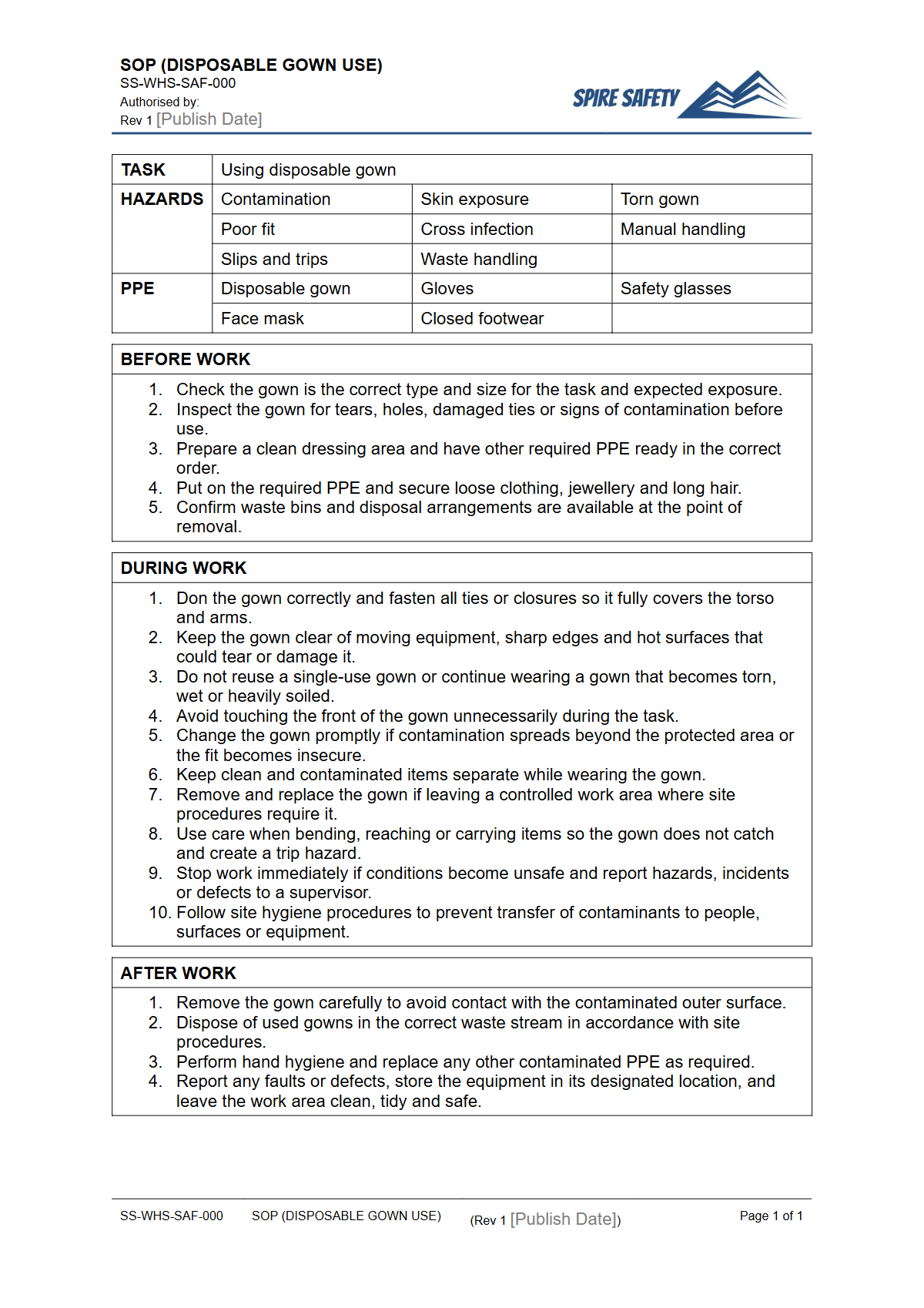
Effectively managing personal protective equipment (PPE) is fundamental to workplace safety, particularly in environments with biological, chemical, or particulate hazards. This Free Safe Operating Procedure (Disposable Gown Use) Template provides a structured framework for documenting the correct methods for selecting, donning (putting on), doffing (taking off), and disposing of single-use gowns.
Using a clear and consistent Safe Operating Procedure (SOP) helps prevent cross-contamination, protects workers from exposure, and ensures procedural discipline across your team. It serves as a vital training tool and a reference point for daily operations, forming a critical component of your overall safety framework.
A well-documented procedure demonstrates a commitment to managing health and safety risks. Integrating this SOP into your broader safety documentation ensures that all control measures are consistent and effectively communicated to workers.
This process is a key function of comprehensive WHS management systems, which aim to systematically reduce workplace risks.
Video walkthrough
How to use the Free Safe Operating Procedure (Disposable Gown Use) Template
This template is provided in both DOCX and PDF formats to suit your needs. The DOCX version is fully editable, allowing you to tailor the content to the specific requirements of your workplace.
To use it, simply download the file and open it in a compatible word processor. You can then add your company branding, specify the types of gowns used, detail site-specific disposal locations, and list the relevant personnel.
The procedure is structured to guide you through key sections, including:
- Hazard Identification
- Required Personal Protective Equipment (PPE)
- Pre-operational Checks
- Step-by-step Donning Procedure
- Step-by-step Doffing Procedure
- Waste Disposal Requirements
- Emergency Procedures
Important: This document is a template and must be customised to suit the specific hazards, materials, and work environment of your business. We strongly recommend that a person with appropriate knowledge, such as a supervisor or safety officer, conducts a thorough risk assessment and consults with workers before finalising and implementing the procedure.
If you require expert assistance in adapting this document, our WHS consulting services can provide tailored support.
When to use a Safe Operating Procedure for disposable gowns
This Safe Operating Procedure should be implemented in any work setting where disposable gowns are used as a control measure to protect against workplace hazards. It is not just for high-risk medical environments; its application is broad and depends on the outcomes of your risk assessment. Common scenarios include:
- Healthcare and Aged Care: To prevent the transmission of infectious agents between patients, residents, and staff.
- Laboratories: To protect personnel from chemical splashes, biological samples, and other contaminants.
- Food Processing and Handling: To prevent contamination of food products by microorganisms or foreign matter from clothing.
- Pharmaceutical Manufacturing: In cleanroom environments where maintaining sterility and preventing product contamination is critical.
- Chemical Handling: When working with certain chemicals where skin contact must be avoided.
- Asbestos Removal and Remediation: As part of a full PPE ensemble to prevent fibre contamination of clothing.
Regular review of this SOP is essential to ensure it remains current. Procedures should be checked and updated as part of your scheduled WHS compliance auditing program to verify they are still effective and being followed correctly.
Who should use it
The responsibility for using and enforcing this Safe Operating Procedure is shared across multiple roles within an organisation:
Workers and Operators
Any employee or contractor required to wear a disposable gown must be trained in this SOP. They are responsible for following the documented steps for donning, doffing, and disposal every time.
This ensures their own safety and prevents the spread of contaminants to colleagues or the work environment.
Supervisors and Managers
Supervisors hold the primary responsibility for implementation. They must ensure that workers have received adequate training, have access to the correct type and size of gowns, and are adhering to the procedure during their work.
They are also responsible for correcting non-compliant behaviour and providing refresher training when needed.
WHS Personnel and Management
Health and Safety personnel, or a designated manager, are typically responsible for creating, authorising, and reviewing the SOP. They ensure the procedure is based on a thorough risk assessment and aligns with current safety standards and regulations.
For organisations seeking certification, aligning procedures with global best practices through ISO 45001 consulting can streamline this process.
By clearly defining these roles and responsibilities, you create a robust system for managing the risks associated with tasks requiring disposable gowns. This SOP is one of many documents available in our free WHS resources library designed to support your safety efforts.
Common mistakes
Common mistakes to avoid
- Touching the contaminated exterior of the gown with bare hands during removal.
- Using a gown that is torn or damaged, compromising its protective barrier.
- Wearing the wrong type of gown for the specific hazard (e.g., a non-fluid-resistant gown for splash protection).
- Disposing of used gowns in general waste instead of designated biohazard or contaminated waste bins.
Legal references
Legal considerations
The following legal requirements may be relevant to this type of work.
- Work Health and Safety Act (Harmonised) — Provides the primary duties for protecting workers and other people from work health and safety risks.
- Work Health and Safety Regulations (Harmonised) — Sets out requirements supporting the management of workplace hazards and risks.
The following codes may be relevant to this type of work.
- Managing WHS Risks Code of Practice — Provides practical guidance on identifying hazards, assessing risks and applying effective controls.
- Work Health and Safety Consultation, Cooperation and Coordination Code of Practice — Provides practical guidance on consulting workers and coordinating with other duty holders.
- Managing the Work Environment and Facilities Code of Practice — Provides practical guidance on safe work environments, workplace facilities and related controls.
Did you know
Material Science
Many disposable gowns are made from non-woven fabrics like SMS (Spunbond-Meltblown-Spunbond). This three-layer material provides a balance of fluid resistance, particle filtration, and breathability.
Doffing is Critical
Studies have shown that self-contamination is most likely to occur during the doffing (removal) process of PPE. A standardised, practiced procedure is the most effective way to reduce this risk.
FAQ
Frequently asked questions
01What is the primary purpose of a disposable gown in a workplace?
02How do you correctly remove a disposable gown to avoid contamination?
03Can disposable gowns be reused?
04Who is responsible for providing PPE like disposable gowns in Australia?
Share this resource
Free Safe Operating Procedure (Disposable Gown Use) Template
Browse Categories
How To Use It
- 1Download and open in Word or PDF.
- 2Replace the placeholders with your business details.
- 3Get it reviewed by a WHS specialist before rollout.
Need it customised?
Our WHS consultants can adapt this template to your site, run a gap analysis, or audit what you already have in place.
Book a Free Consultation WHS consulting servicesor call 1300 156 382
Related templates
- Free Safe Operating Procedure (Dissolved Oxygen Meter) Template
- Free Safe Operating Procedure (Dock Crane) Template
- Free Safe Operating Procedure (Dock Fender Inspection) Template
- Free Safe Operating Procedure (Dock Ladder Inspection) Template
- Free Safe Operating Procedure (Dock Leveller) Template
- Free Safe Operating Procedure (Dock Line Handling) Template