
Free Safe Operating Procedure (Display Stand Setup) Template
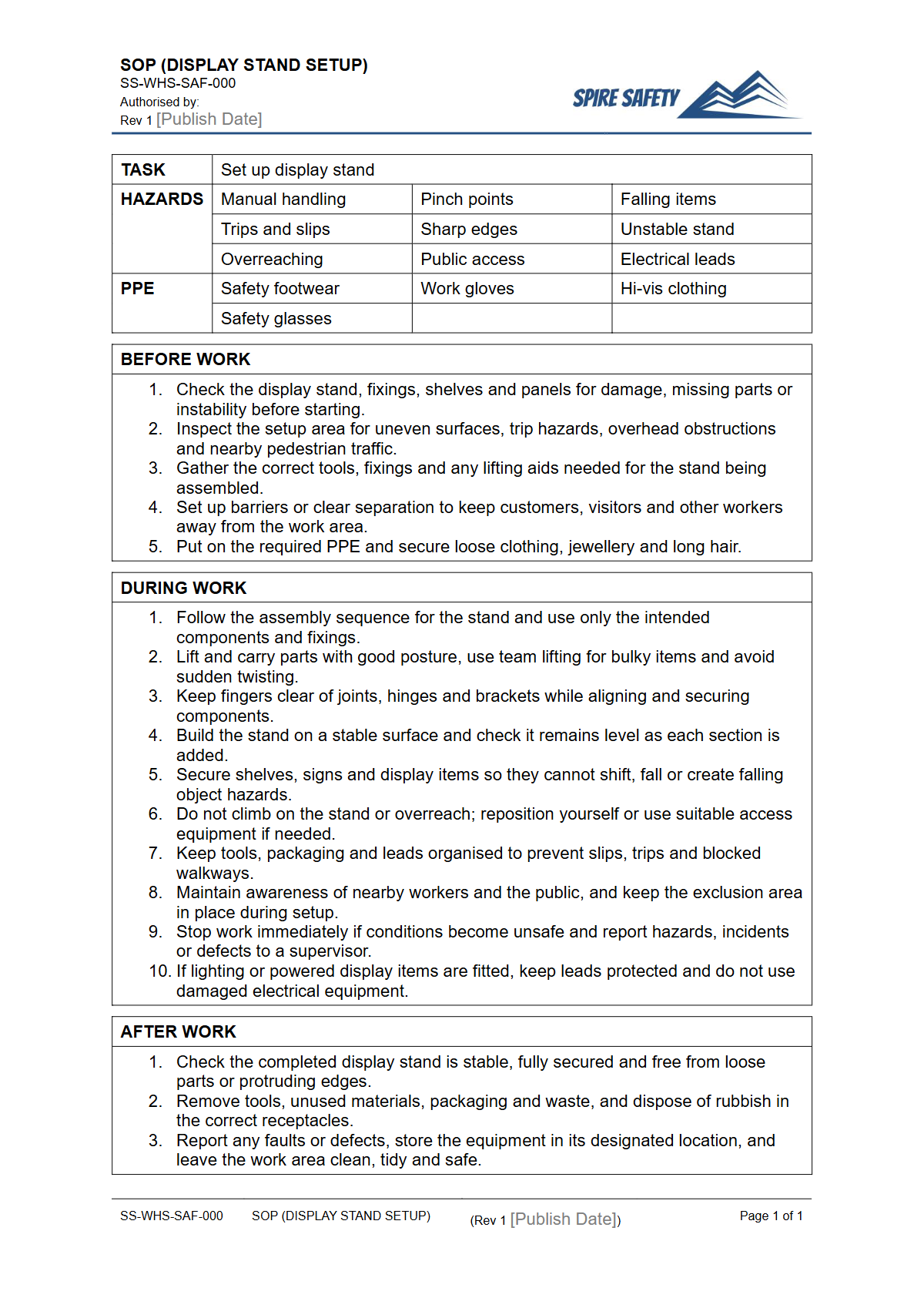
Formalise your safety process for assembling temporary or permanent display units. Download our free Safe Operating Procedure for Display Stand Setup template.
Free Safe Operating Procedure (Display Stand Setup) Template
DOCX • 126 KB + PDF
Updated Oct 2026
No signup required
Purpose of the Free Safe Operating Procedure (Display Stand Setup) Template
Setting up display stands, whether in a retail store, at a trade show, or for a promotional event, involves significant manual handling risks. Our Free Safe Operating Procedure (Display Stand Setup) Template provides a structured framework to manage these hazards effectively.
This document helps your organisation standardise the assembly process, ensuring tasks are performed consistently and safely every time. By outlining key steps, required personal protective equipment (PPE), and potential hazards, this SOP serves as a critical tool for risk mitigation, helping to prevent common injuries such as muscle strains, sprains, cuts, and trips.
Implementing a formal SOP demonstrates a commitment to workplace health and safety. It acts as a vital reference for training new employees and for conducting refresher courses with existing staff.
It also provides a clear, documented process that can be reviewed and updated as part of your continuous improvement cycle. For businesses looking to build a comprehensive safety framework, integrating task-specific SOPs is a foundational element of effective WHS management systems.
Video walkthrough
How to use the Free Safe Operating Procedure (Display Stand Setup) Template
This template is designed as a robust starting point, aligned with Australian WHS principles. To make it effective for your specific circumstances, you must customise it.
Start by downloading the DOCX file and consulting with the workers who actually perform the task. Their direct experience is invaluable for identifying unique site-specific hazards and control measures.
Walk through the process and add details about the exact types of display stands used, the tools required, and the environmental conditions of the setup area (e.g., uneven ground, public access, poor lighting).
Once customised, the SOP should be reviewed and approved by a manager or safety representative. It then becomes an official workplace document.
Use it as the basis for hands-on training and competency assessments. Ensure all relevant personnel read, understand, and sign the document before undertaking the task.
Remember, a document alone does not create safety; it must be embedded in your daily operations and actively used to guide safe work behaviour. If you need assistance tailoring this or other documents to your needs, our WHS consulting services can provide expert guidance.
Important Customisation Note
This is a template document. We have drafted it as a starting point to be adapted to your business.
You must customise this Safe Operating Procedure to reflect your specific equipment, processes, and workplace hazards. The user is responsible for ensuring the final document is appropriate for their operational context and meets their legal obligations.
When to use this Safe Operating Procedure
A Safe Operating Procedure for display stand setup should be used consistently as part of your standard work practices. It is not a document to be filed away and forgotten.
It should be readily accessible and actively referred to before any setup or dismantling task begins, especially for complex or non-routine assemblies. It is an essential resource during the induction and training of new team members, providing them with a clear, step-by-step guide to performing the job safely.
Furthermore, the SOP should be used for annual refresher training and reviewed as part of any incident investigation involving display stand assembly to identify procedural gaps.
Who should use this Safe Operating Procedure
This SOP is intended for a wide range of personnel. This includes retail staff, visual merchandisers, event and exhibition crew, warehouse workers, and brand ambassadors responsible for assembling promotional stands.
Supervisors and managers should also use the document to oversee work, conduct safety observations, and ensure procedures are being followed correctly. The principles within are scalable, from a simple pop-up banner in a shopping centre to a complex, multi-part exhibition booth. In large-scale event builds, where heavy components might be moved and lifted, operators may need to follow procedures for other equipment, as detailed in our FREE Telehandler SOP Template.
The procedure is also relevant for maintenance staff or fabricators who may need to modify or repair display units. Any on-site adjustments involving cutting materials should be governed by strict safety protocols, similar to those found in a FREE Circular Saw SOP Template, to control risks from power tools.
This ensures a holistic approach to safety, covering all associated tasks.
In large logistics centres or exhibition halls where stand components are managed, moving parts from storage to the setup location can present its own set of hazards. Teams working in these environments can benefit from understanding the risks associated with automated transport systems, which are covered in resources like our FREE Conveyer System SOP.
This document is just one of many templates we offer to help businesses improve their safety practices. You can explore our complete free WHS resources library for more checklists, procedures, and forms.
Common mistakes
Common mistakes to avoid
- Ignoring manufacturer's assembly instructions and weight limits.
- Working alone when handling large, heavy, or awkward components.
- Failing to clear the work area of packaging and tools, creating trip hazards.
- Assembling the stand on uneven or unstable ground without proper support.
Legal references
Legal considerations
The following legal requirements may be relevant to this type of work.
- Work Health and Safety Act (Harmonised) — Provides the primary duties for protecting workers and other people from work health and safety risks.
- Work Health and Safety Regulations (Harmonised) — Sets out requirements supporting the management of workplace hazards and risks.
The following codes may be relevant to this type of work.
- Managing WHS Risks Code of Practice — Provides practical guidance on identifying hazards, assessing risks and applying effective controls.
- Work Health and Safety Consultation, Cooperation and Coordination Code of Practice — Provides practical guidance on consulting workers and coordinating with other duty holders.
- Managing the Work Environment and Facilities Code of Practice — Provides practical guidance on safe work environments, workplace facilities and related controls.
Did you know
Manual Tasks are a Major Risk
According to Safe Work Australia, hazardous manual tasks are the leading cause of work-related injuries in the country, accounting for a significant percentage of all serious workers' compensation claims each year.
FAQ
Frequently asked questions
01What are the main hazards when setting up a display stand?
02Is this SOP template enough for WHS compliance?
03Does this SOP cover electrical safety for illuminated stands?
04Who is responsible for customising and implementing this SOP?
Share this resource
Free Safe Operating Procedure (Display Stand Setup) Template
Browse Categories
How To Use It
- 1Download and open in Word or PDF.
- 2Replace the placeholders with your business details.
- 3Get it reviewed by a WHS specialist before rollout.
Need it customised?
Our WHS consultants can adapt this template to your site, run a gap analysis, or audit what you already have in place.
Book a Free Consultation WHS consulting servicesor call 1300 156 382
Related templates
- Free Safe Operating Procedure (Disposable Apron Use) Template
- Free Safe Operating Procedure (Disposable Gown Use) Template
- Free Safe Operating Procedure (Dissolved Oxygen Meter) Template
- Free Safe Operating Procedure (Dock Crane) Template
- Free Safe Operating Procedure (Dock Fender Inspection) Template
- Free Safe Operating Procedure (Dock Ladder Inspection) Template