
Free Safe Operating Procedure (Dining Room Reset) Template
Establish clear, safe steps for resetting your dining area with our free Safe Operating Procedure. Download the customisable DOCX or PDF template today.
Free Safe Operating Procedure (Dining Room Reset) Template
DOCX • 126 KB + PDF
Updated Oct 2026
No signup required
Purpose of the Free Safe Operating Procedure (Dining Room Reset) Template
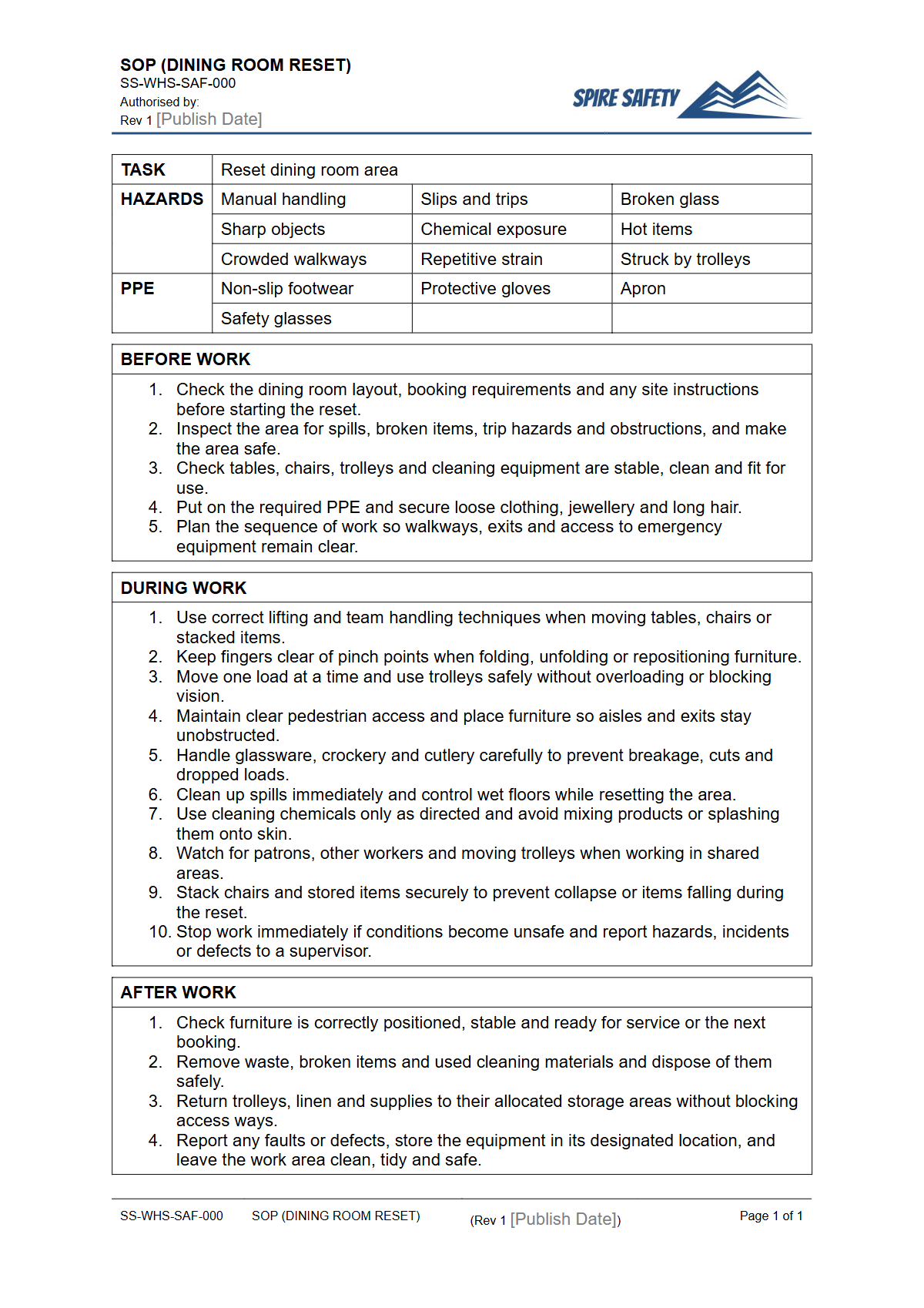
This Free Safe Operating Procedure (Dining Room Reset) Template provides a structured framework for outlining the steps to safely and efficiently clear, clean, and reset a dining area. Its purpose is to standardise the process, minimise risks to workers, and ensure a consistent level of cleanliness and presentation.
By clearly defining tasks, required personal protective equipment (PPE), and potential hazards, this SOP helps organisations meet their duty of care under Australian WHS laws.
Key hazards addressed in a dining room reset include manual handling injuries from lifting tables and chairs, slips and trips on wet floors during cleaning, and exposure to cleaning chemicals. Implementing a formal SOP helps control these risks.
It serves as a vital tool for training new staff and acts as a consistent reference for all employees. A robust SOP is a fundamental component of effective WHS management systems, demonstrating a proactive approach to workplace safety in the hospitality sector.
Video walkthrough
How to use the Free Safe Operating Procedure (Dining Room Reset) Template
This document is available for download as a customisable DOCX file or a print-ready PDF. It is designed as a comprehensive starting point, pre-filled with common tasks and safety considerations relevant to a dining room reset.
To adapt it for your workplace, you should consult with your team to identify specific hazards and control measures unique to your environment.
Important: This document is a template and is not a complete safety solution. We are not familiar with your specific venue, equipment, cleaning agents, or personnel.
You MUST customise this Safe Operating Procedure to reflect the actual risks and processes in your workplace. This involves a thorough risk assessment and consultation with your workers.
Steps for implementation:
- Download the DOCX template.
- Review the pre-filled sections and identify any gaps.
- Add details specific to your furniture, layout, cleaning chemicals, and equipment.
- Clearly outline the step-by-step process from clearing tables to the final readiness check.
- Specify the required PPE, such as non-slip footwear and gloves for handling chemicals.
- Have the final document reviewed and approved by a competent person (e.g., a manager or WHS representative).
- Train all relevant staff on the finalised SOP and document the training.
The complexity of your operation will dictate the level of detail required. A large hotel or function centre with automated systems, like a dish return line, may need to develop separate procedures for that equipment, drawing on principles found in resources like a FREE Conveyer System SOP (Safe Operating Procedure) Template.
When to use this Safe Operating Procedure
The Dining Room Reset SOP should be the primary reference document whenever this task is performed. It is not a document to be filed away; it should be an active part of your daily operations.
This ensures every reset is performed to the same safety standard, regardless of who is on shift.
Specific use cases include:
- End-of-service cleaning: Guiding the team through the full closing procedure.
- Function turnover: Ensuring a swift and safe reset between events.
- New employee induction: As a core training document for front-of-house staff.
- Refresher training: For periodic reinforcement of safe work practices.
- Incident investigations: To review whether established procedures were followed.
Adherence to this procedure should be monitored regularly. This can be done through informal supervision or as part of a scheduled WHS compliance auditing program to verify that safe work methods are consistently applied.
Who should use this Safe Operating Procedure
This template is designed for anyone responsible for creating, implementing, or overseeing safety protocols in a hospitality environment. While front-of-house staff are the primary end-users who follow the procedure, several other roles are involved in its development and management.
Key roles include:
- Restaurant and Cafe Managers: Responsible for customising the template and ensuring their team is trained.
- Venue and Function Supervisors: For overseeing the task and enforcing the procedure during service and events.
- WHS/OHS Coordinators: For integrating the SOP into the broader safety management system and ensuring it aligns with legislative requirements.
- Business Owners: To fulfil their primary duty of care by providing a safe system of work.
Developing comprehensive and effective safety documentation can be a detailed process. If your organisation requires assistance in tailoring this template or developing other critical safety documents, engaging professional WHS consulting services can provide expert guidance and ensure your systems are robust and practical.
You can also explore our extensive free WHS resources library for other useful templates and guides.
Common mistakes
Common mistakes to avoid
- Using a generic template without customising it for the specific venue, furniture, and cleaning products.
- Failing to adequately train all staff on the finalised procedure, especially casual or new employees.
- Neglecting to include safety data sheet (SDS) information and handling precautions for all cleaning chemicals used.
- Not scheduling regular reviews, causing the procedure to become outdated as equipment or practices change.
Legal references
Legal considerations
The following legal requirements may be relevant to this type of work.
- Work Health and Safety Act (Harmonised) — Provides the primary duties for protecting workers and other people from work health and safety risks.
- Work Health and Safety Regulations (Harmonised) — Sets out requirements supporting the management of workplace hazards and risks.
The following codes may be relevant to this type of work.
- Managing WHS Risks Code of Practice — Provides practical guidance on identifying hazards, assessing risks and applying effective controls.
- Work Health and Safety Consultation, Cooperation and Coordination Code of Practice — Provides practical guidance on consulting workers and coordinating with other duty holders.
- Managing the Work Environment and Facilities Code of Practice — Provides practical guidance on safe work environments, workplace facilities and related controls.
Did you know
Hospitality Hazards
The accommodation and food services industry has one of the highest rates of serious workers' compensation claims, with slips, trips, falls, and manual handling injuries being the most common causes.
FAQ
Frequently asked questions
01What should be included in a dining room reset SOP?
02Why is a Safe Operating Procedure necessary for resetting a dining room?
03How often should an SOP for dining room resets be reviewed?
04Who is responsible for training staff on this SOP?
Share this resource
Free Safe Operating Procedure (Dining Room Reset) Template
Browse Categories
How To Use It
- 1Download and open in Word or PDF.
- 2Replace the placeholders with your business details.
- 3Get it reviewed by a WHS specialist before rollout.
Need it customised?
Our WHS consultants can adapt this template to your site, run a gap analysis, or audit what you already have in place.
Book a Free Consultation WHS consulting servicesor call 1300 156 382
Related templates
- Free Safe Operating Procedure (Dirty Utility Cleaning) Template
- Free Safe Operating Procedure (Disability Van Loading) Template
- Free Safe Operating Procedure (Disease Plant Removal) Template
- Free Safe Operating Procedure (Dishwasher Glasswasher Operation) Template
- Free Safe Operating Procedure (Dispatch Area Cleanup) Template
- Free Safe Operating Procedure (Dispatch Documentation) Template