
Free Safe Operating Procedure (Disability Van Loading) Template
Document the safe process for loading and unloading disability vans with our template. Download this structured Safe Operating Procedure to refine your protocols.
Free Safe Operating Procedure (Disability Van Loading) Template
DOCX • 126 KB + PDF
Updated Oct 2026
No signup required
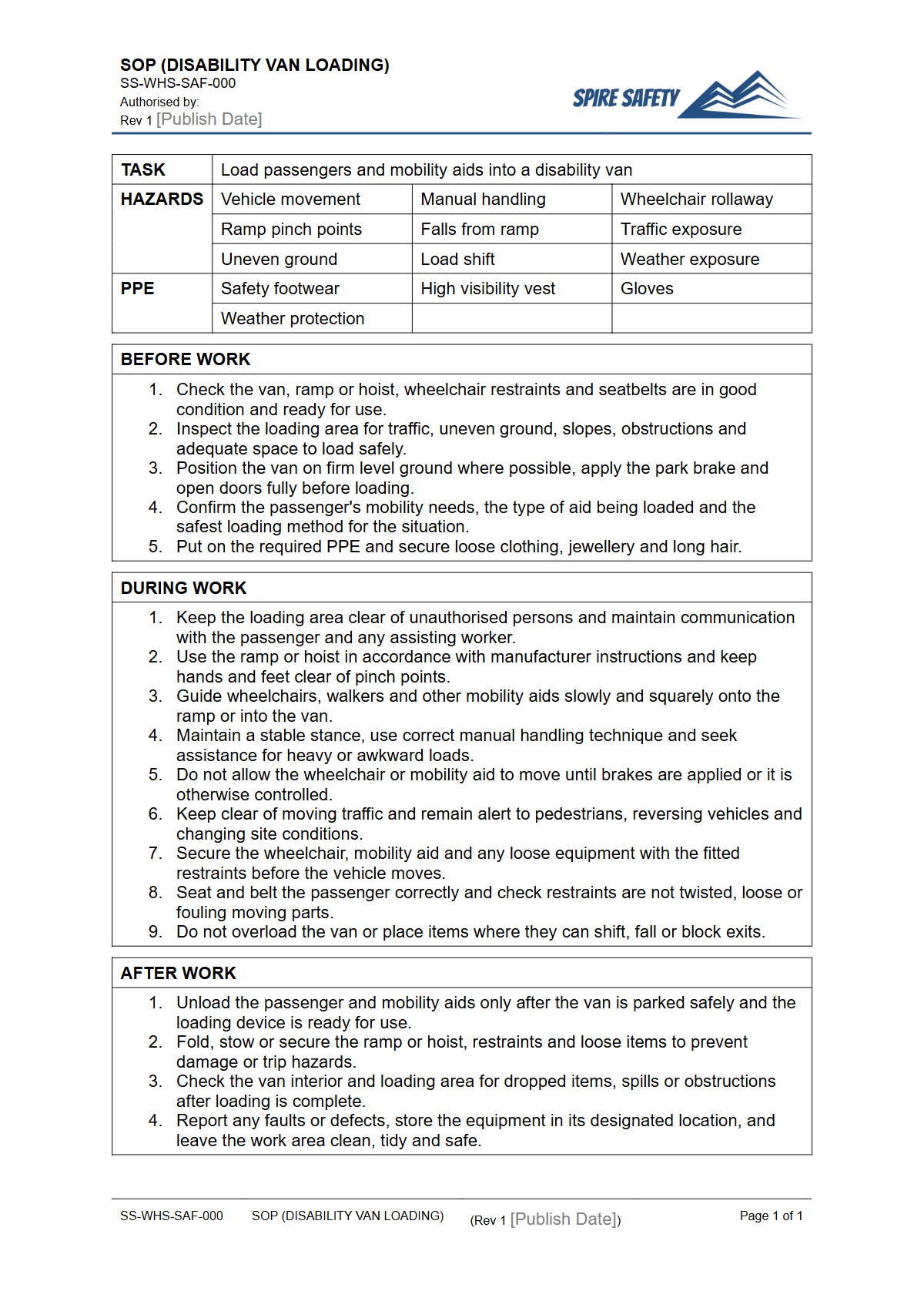
Purpose of the Free Safe Operating Procedure (Disability Van Loading) Template
Loading and unloading passengers with mobility challenges from a disability-accessible van is a high-risk activity that requires a clear, documented process. This Free Safe Operating Procedure (Disability Van Loading) Template provides a structured framework for organisations to outline the required steps, safety checks, and hazard controls.
Using a standardised SOP helps manage risks associated with manual tasks, vehicle-mounted lifts or ramps, and passenger safety. It serves as an essential tool for worker training, competency assessment, and demonstrating a commitment to health and safety in the community services, aged care, and disability support sectors.
A well-defined Safe Operating Procedure helps ensure every step of the process is performed consistently and safely, reducing the likelihood of injuries to both support workers and passengers. It formalises pre-operational checks, the sequence of actions for securing passengers and mobility aids, and emergency procedures.
This document is a key component of a functional safety management system, providing clarity for workers and assurance for your organisation.
Video walkthrough
How to use the Free Safe Operating Procedure (Disability Van Loading) Template
This template is designed as a comprehensive starting point, aligned with Australian WHS principles. To use it effectively, download the DOCX file and adapt it to the specific context of your workplace.
This involves a thorough risk assessment of your unique operations, vehicles, and the needs of the people you support.
Follow these steps to implement the SOP:
- Consultation: Involve the workers who perform the task daily. Their direct experience is invaluable for identifying practical hazards and effective controls. Consultation is also a legal requirement under WHS legislation.
- Customisation: Add specific details about your vehicles, such as the make and model of the van and the type of ramp or hoist used. Include instructions for the specific wheelchairs, restraints, and tie-down systems your organisation uses.
- Site-Specific Risks: Incorporate controls for environmental factors, such as loading on uneven ground, in bad weather, or in high-traffic areas.
- Integration: Once finalised, integrate this SOP into your comprehensive WHS management system. Use it as a basis for training new staff, conducting refresher courses, and verifying competency.
Important: This is a template, not a finished document. We have provided a structured guide, but you must populate it with the specific details of your equipment and operational risks to ensure it is effective for your workplace.
When to use this Safe Operating Procedure
A Safe Operating Procedure for disability van loading should be a living document, actively used in daily operations. It is not a document to be filed away after creation. It should be directly referenced during:
- Worker Training and Induction: All new drivers and support staff must be trained on the SOP before performing the task unsupervised.
- Daily Operations: Workers should be able to easily reference the SOP as a guide for correct procedure, especially for non-routine situations.
- Refresher Training: Use the SOP as the foundation for periodic refresher training to prevent procedural drift and reinforce safety standards.
- Incident Investigations: Following a near miss or incident, the SOP should be reviewed to determine if the procedure was followed and if it needs revision.
- Audits and Reviews: The procedure should be scheduled for regular review, typically annually, or whenever there is a change in equipment, processes, or relevant regulations. Regular WHS compliance audits can help identify gaps in procedural documentation.
Who should use it
This template is intended for use by anyone responsible for safety and operational management within organisations that provide transport for people with disabilities. Key users include:
- WHS/OHS Managers and Coordinators: To develop and implement formalised safety procedures as part of the overall safety system.
- Service Managers and Team Leaders: To train their teams and supervise the safe performance of van loading tasks.
- Support Workers and Drivers: As the end-users, they will follow the procedure to carry out their work safely and should be heavily involved in its development and review.
Developing a consistent format for all your procedural documents helps with training and compliance. Whether you're documenting complex machinery operations using our Telehandler SOP template or simpler tasks, a standardised layout is key.
For more procedural guides, you can explore our full free WHS resources library to find templates relevant to other equipment at your facility.
Common mistakes
Common mistakes to avoid
- Failing to check that the ramp and its safety latches are fully engaged before use.
- Not applying wheelchair brakes or using vehicle-provided restraints during loading and transit.
- Poor communication between the vehicle operator and the person in the wheelchair.
- Rushing the procedure, especially in poor weather conditions or when running behind schedule.
Legal references
Legal considerations
The following legal requirements may be relevant to this type of work.
- Work Health and Safety Act (Harmonised) — Provides the primary duties for protecting workers and other people from work health and safety risks.
- Work Health and Safety Regulations (Harmonised) — Sets out requirements supporting the management of workplace hazards and risks.
The following codes may be relevant to this type of work.
- Managing WHS Risks Code of Practice — Provides practical guidance on identifying hazards, assessing risks and applying effective controls.
- Work Health and Safety Consultation, Cooperation and Coordination Code of Practice — Provides practical guidance on consulting workers and coordinating with other duty holders.
- Managing the Work Environment and Facilities Code of Practice — Provides practical guidance on safe work environments, workplace facilities and related controls.
Did you know
Manual Task Risk
The healthcare and social assistance industry has one of the highest rates of serious workers' compensation claims in Australia, with hazardous manual tasks being a primary cause of injury.
Ramp Gradients
The gradient of a vehicle's access ramp significantly impacts the force required to move a wheelchair. A steeper ramp increases the risk of operator strain and loss of control.
FAQ
Frequently asked questions
01Is this SOP template enough to be compliant with WHS laws?
02How often should we review the Safe Operating Procedure for disability van loading?
03Who needs to be trained on this SOP?
04What are the main hazards to include in this Safe Operating Procedure?
Share this resource
Free Safe Operating Procedure (Disability Van Loading) Template
Browse Categories
How To Use It
- 1Download and open in Word or PDF.
- 2Replace the placeholders with your business details.
- 3Get it reviewed by a WHS specialist before rollout.
Need it customised?
Our WHS consultants can adapt this template to your site, run a gap analysis, or audit what you already have in place.
Book a Free Consultation WHS consulting servicesor call 1300 156 382
Related templates
- Free Safe Operating Procedure (Disease Plant Removal) Template
- Free Safe Operating Procedure (Dishwasher Glasswasher Operation) Template
- Free Safe Operating Procedure (Dispatch Area Cleanup) Template
- Free Safe Operating Procedure (Dispatch Documentation) Template
- Free Safe Operating Procedure (Dispatch Load Check) Template
- Free Safe Operating Procedure (Display Stand Setup) Template