
Free Safe Operating Procedure (Digital Thermometer) Template
Download our free Safe Operating Procedure for digital thermometers. This template provides a structured starting point for your workplace safety documents.
Free Safe Operating Procedure (Digital Thermometer) Template
DOCX • 126 KB + PDF
Updated Oct 2026
No signup required
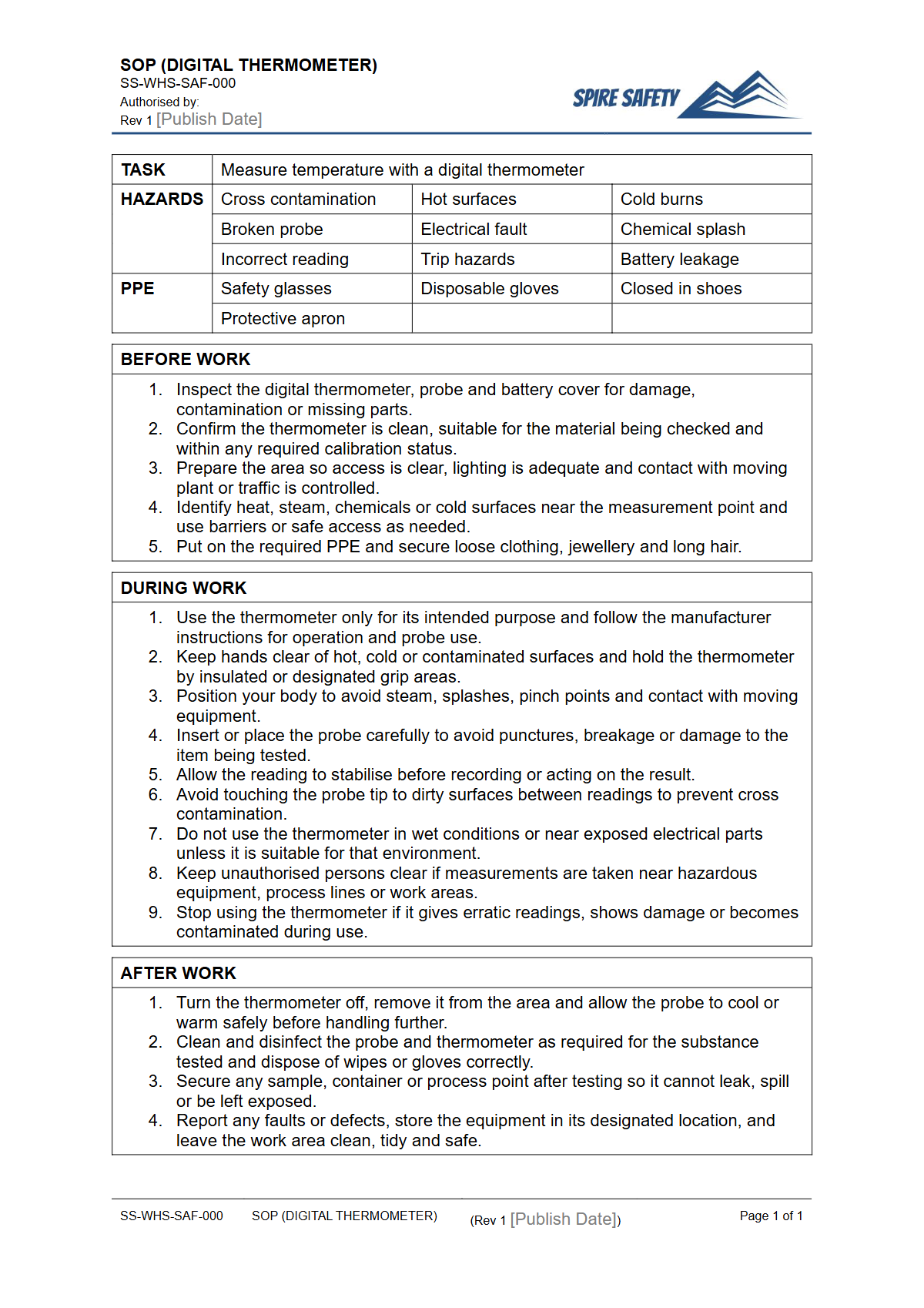
Purpose of the Free Safe Operating Procedure (Digital Thermometer) Template
Using a digital thermometer may seem straightforward, but consistent and safe operation is critical, especially in industries like food service, healthcare, and scientific research. This Free Safe Operating Procedure (Digital Thermometer) Template provides a documented process to guide workers.
The purpose of a Safe Operating Procedure (SOP) is to ensure tasks are performed safely, accurately, and consistently every time. It outlines the risks associated with using the equipment—such as incorrect readings, cross-contamination, or battery-related hazards—and details the control measures required to mitigate them.
Implementing a clear SOP supports your duty of care by providing essential information, instruction, and training to your team.
A well-drafted SOP for a digital thermometer formalises key steps including pre-use checks, calibration requirements, correct measurement technique, and post-use cleaning and storage. This not only promotes safety but also ensures the integrity of your processes, whether it's complying with food safety temperature controls or monitoring industrial equipment.
Documenting these procedures is a fundamental part of building robust WHS management systems that protect both your people and your business operations.
Video walkthrough
How to use the Free Safe Operating Procedure (Digital Thermometer) Template
This template is provided as a starting point in both DOCX and PDF formats. Download your preferred version and integrate it into your safety management system.
The document is structured to cover the key elements of a comprehensive SOP, including required personal protective equipment (PPE), risk assessment, operational steps, and emergency procedures. While it's based on Australian WHS principles, it is not a finished document.
Important: You must customise this template to reflect the specific hazards and work practices in your organisation. We have no way of knowing your unique operational context.
Review every section and add, remove, or modify content to suit the make and model of your digital thermometers, the environment they are used in, and your internal procedures. This includes detailing specific temperature thresholds, calibration frequencies recommended by the manufacturer, and any site-specific cleaning protocols.
Similar customisation is required for all equipment-specific procedures, such as our Free Air Compressor SOP template.
When to use it
A Safe Operating Procedure for a digital thermometer should be a living document that is used throughout the employment lifecycle. It is a primary training tool for new workers during their induction, ensuring they understand the correct and safe way to perform temperature checks from day one.
It should also be readily available in the work area as a quick reference guide for all employees.
The SOP should be formally reviewed during regular safety meetings or whenever there is a change in equipment, processes, or regulations. It serves as a benchmark during workplace inspections and safety observations.
Following an incident or near-miss involving temperature measurement or equipment handling, the SOP should be consulted and updated as part of the investigation process to prevent recurrence. A regular WHS compliance auditing program will verify that these procedures are being consistently applied and remain effective.
Who should use it
This SOP template is designed for use by multiple roles within an organisation. WHS managers, supervisors, and team leaders are the primary authors who will adapt the template to create a site-specific document.
They are responsible for ensuring the procedure accurately reflects the task and its associated risks. Once finalised, the SOP is a mandatory tool for all workers and operators who are required to use digital thermometers as part of their duties.
It acts as a critical source of truth, guiding employees to perform their jobs safely and to a consistent standard. In workplaces with diverse equipment, maintaining a library of SOPs is essential.
For example, a workshop might need this document alongside a FREE Circular Saw SOP to cover different types of tool-based risks. Ultimately, anyone involved in the lifecycle of the task—from performing it to supervising it and training others on it—should be familiar with the SOP.
Developing a comprehensive suite of safety documents can be a complex task. If your business uses integrated systems for production, you may need procedures that cover more than just a single tool.
For instance, a food production line might require this thermometer SOP in conjunction with a FREE Conveyer System SOP to manage safety across the entire process. If you need assistance in developing tailored documentation, our WHS consulting services can provide expert guidance.
Common mistakes
Common mistakes to avoid
- Forgetting to perform regular calibration checks, leading to inaccurate measurements.
- Using the wrong type of thermometer for the task (e.g., an infrared surface thermometer to measure internal food temperature).
- Improper or infrequent cleaning and sanitisation, creating a risk of cross-contamination.
- Ignoring low-battery indicators, which can cause the device to provide unreliable readings.
Legal references
Legal considerations
The following legal requirements may be relevant to this type of work.
- Work Health and Safety Act (Harmonised) — Provides the primary duties for protecting workers and other people from work health and safety risks.
- Work Health and Safety Regulations (Harmonised) — Sets out requirements supporting the management of workplace hazards and risks.
The following codes may be relevant to this type of work.
- Managing WHS Risks Code of Practice — Provides practical guidance on identifying hazards, assessing risks and applying effective controls.
- Work Health and Safety Consultation, Cooperation and Coordination Code of Practice — Provides practical guidance on consulting workers and coordinating with other duty holders.
- Managing the Work Environment and Facilities Code of Practice — Provides practical guidance on safe work environments, workplace facilities and related controls.
Did you know
A Matter of Degrees
The first recognisable thermometer was a thermoscope invented in the late 16th or early 17th century. Modern digital thermometers, which often use a thermistor (a resistor whose resistance changes with temperature), only became widely available in the late 20th century.
No-Touch Temperature
Infrared thermometers work by capturing and measuring the invisible infrared energy (thermal radiation) that all objects above absolute zero emit. A lens focuses this energy onto a detector, which converts it into a temperature reading.
FAQ
Frequently asked questions
01Why is a Safe Operating Procedure needed for a simple device like a digital thermometer?
02How often should a digital thermometer be calibrated?
03What key information should be included in a digital thermometer SOP?
04Is this template suitable for medical-grade thermometers?
Share this resource
Free Safe Operating Procedure (Digital Thermometer) Template
Browse Categories
How To Use It
- 1Download and open in Word or PDF.
- 2Replace the placeholders with your business details.
- 3Get it reviewed by a WHS specialist before rollout.
Need it customised?
Our WHS consultants can adapt this template to your site, run a gap analysis, or audit what you already have in place.
Book a Free Consultation WHS consulting servicesor call 1300 156 382
Related templates
- Free Safe Operating Procedure (Dining Aid Cleaning) Template
- Free Safe Operating Procedure (Dining Room Cleaning) Template
- Free Safe Operating Procedure (Dining Room Reset) Template
- Free Safe Operating Procedure (Dirty Utility Cleaning) Template
- Free Safe Operating Procedure (Disability Van Loading) Template
- Free Safe Operating Procedure (Disease Plant Removal) Template