
Free Safe Operating Procedure (Dining Aid Cleaning) Template
Standardise hygiene protocols in your workplace with our structured template. Download our free Safe Operating Procedure for dining aid cleaning to improve safety.
Free Safe Operating Procedure (Dining Aid Cleaning) Template
DOCX • 126 KB + PDF
Updated Oct 2026
No signup required
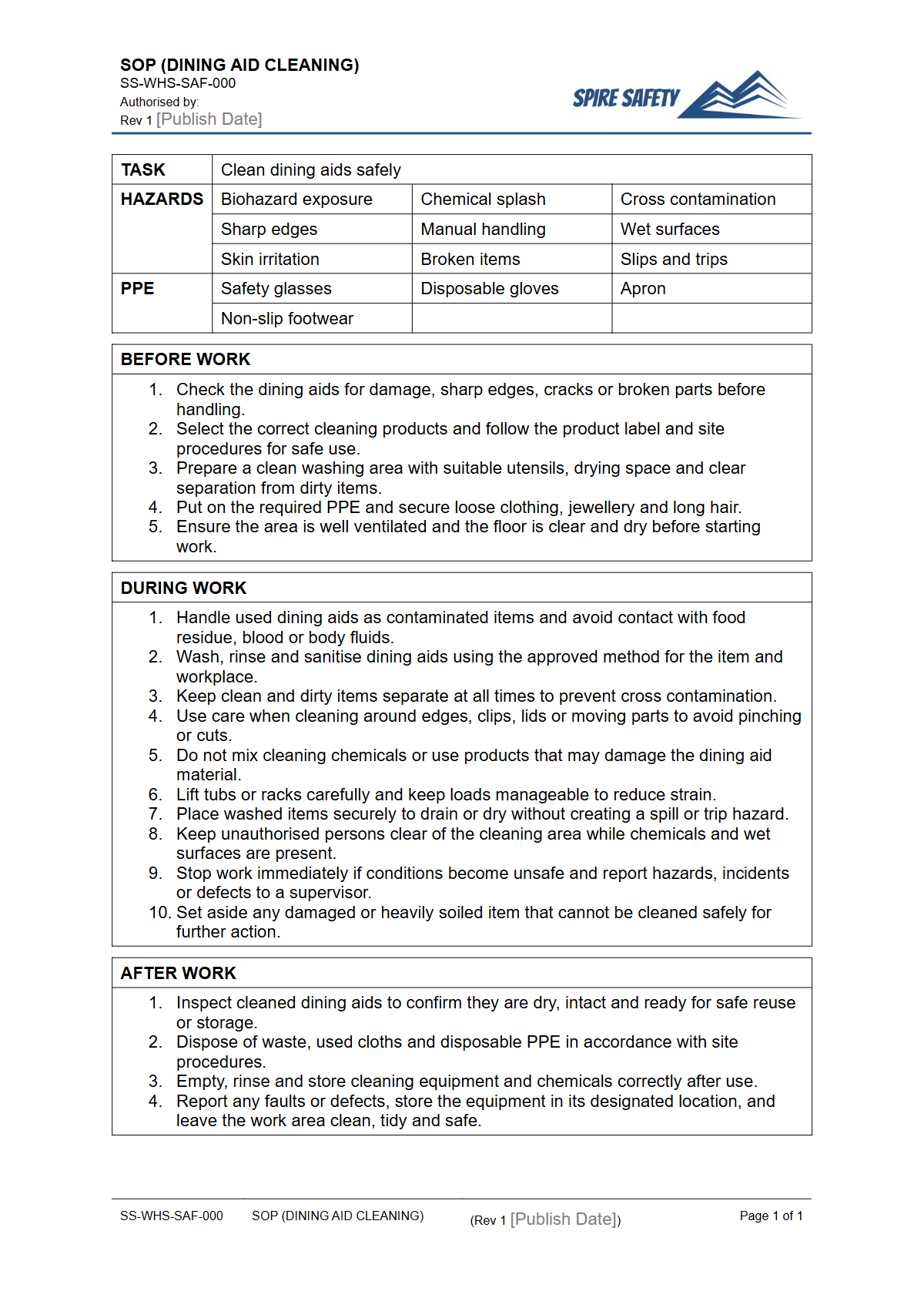
Purpose of the Free Safe Operating Procedure (Dining Aid Cleaning) Template
Maintaining high standards of hygiene is critical in any environment where food is served, particularly in healthcare, aged care, and hospitality settings. This Free Safe Operating Procedure (Dining Aid Cleaning) Template provides a structured framework for documenting the safe and hygienic cleaning of dining aids such as cutlery, crockery, cups, and specialised assistive equipment.
Implementing a formal SOP helps ensure consistency, reduces the risk of cross-contamination and foodborne illnesses, and demonstrates a commitment to health and safety. A documented procedure is a fundamental part of a robust safety management system, protecting both workers and the people they care for.
Video walkthrough
How to use the Free Safe Operating Procedure (Dining Aid Cleaning) Template
This template is available for instant download in both DOCX and PDF formats. The DOCX version can be easily edited to suit your organisation's specific needs.
To effectively use this resource, you should review each section and populate it with details relevant to your site, including the specific dining aids used, the cleaning agents and equipment available, and the required Personal Protective Equipment (PPE). Developing comprehensive procedures is a key part of building effective WHS management systems.
Important: We have designed this document as a foundational template. You must customise it to reflect the specific hazards, equipment, chemicals, and control measures relevant to your workplace.
Generic procedures are insufficient for managing site-specific risks.
When to use a Dining Aid Cleaning SOP
A Safe Operating Procedure for this task should be a core operational document. It is used to:
- Induct and train new employees, ensuring they understand the correct procedure from day one.
- Conduct refresher training for existing staff to maintain high standards.
- Serve as a reference point before starting the cleaning task.
- Form part of a risk assessment process to identify potential hazards like chemical exposure or ergonomic strain.
- Assist in incident investigations if a hygiene breach or injury occurs.
Who should use this SOP
This Safe Operating Procedure is designed for use by a range of personnel within an organisation to ensure a standardised approach to hygiene. This includes:
- Workers: Kitchen hands, care staff, hospitality workers, and cleaners who perform the task.
- Supervisors and Managers: To oversee training, supports your compliance efforts, and conduct workplace inspections.
- WHS Representatives and Officers: To integrate the procedure into the broader safety framework and use it for risk management activities.
Key Elements of a Dining Aid Cleaning Procedure
A comprehensive SOP for this task should cover several critical areas to be effective. When customising the template, ensure you address the following:
- Hazard Identification: List all potential hazards, such as exposure to hazardous chemicals (cleaning agents), slips from wet floors, manual handling injuries, and contact with biological hazards.
- Personal Protective Equipment (PPE): Specify the exact PPE required, such as chemical-resistant gloves, safety glasses, and waterproof aprons.
- Pre-operational Checks: Outline any checks for dishwashers or other cleaning equipment before use.
- Step-by-Step Instructions: Provide a clear, sequential guide from scraping and rinsing to washing, sanitising, and air-drying/storing. Include details on water temperatures and chemical dilution ratios.
- Waste Disposal: Describe the correct method for disposing of food scraps and chemical containers.
- Emergency Procedures: Detail the response for chemical splashes, first aid, and equipment malfunction.
Common mistakes
Common mistakes to avoid
- Using incorrect dilution ratios for cleaning chemicals, reducing their effectiveness or creating a chemical hazard.
- Failing to pre-scrape plates, which can clog dishwashers and reduce cleaning efficacy.
- Stacking wet items, which prevents them from air-drying properly and can promote bacterial growth.
- Not training staff on the difference between 'cleaning' (removing food) and 'sanitising' (killing microorganisms).
Legal references
Legal considerations
The following legal requirements may be relevant to this type of work.
- Work Health and Safety Act (Harmonised) — Provides the primary duties for protecting workers and other people from work health and safety risks.
- Work Health and Safety Regulations (Harmonised) — Sets out requirements supporting the management of workplace hazards and risks.
The following codes may be relevant to this type of work.
- Managing WHS Risks Code of Practice — Provides practical guidance on identifying hazards, assessing risks and applying effective controls.
- Work Health and Safety Consultation, Cooperation and Coordination Code of Practice — Provides practical guidance on consulting workers and coordinating with other duty holders.
- Managing the Work Environment and Facilities Code of Practice — Provides practical guidance on safe work environments, workplace facilities and related controls.
Did you know
The Danger Zone
The temperature range between 5°C and 60°C is known as the 'temperature danger zone,' where illness-causing bacteria can grow most rapidly on food and food-contact surfaces.
FAQ
Frequently asked questions
01What is considered a 'dining aid' in a WHS context?
02Why is a specific SOP for cleaning dining aids so important in aged care?
03What PPE is typically required for cleaning dining aids?
04How often should a Safe Operating Procedure be reviewed?
Share this resource
Free Safe Operating Procedure (Dining Aid Cleaning) Template
Browse Categories
How To Use It
- 1Download and open in Word or PDF.
- 2Replace the placeholders with your business details.
- 3Get it reviewed by a WHS specialist before rollout.
Need it customised?
Our WHS consultants can adapt this template to your site, run a gap analysis, or audit what you already have in place.
Book a Free Consultation WHS consulting servicesor call 1300 156 382
Related templates
- Free Safe Operating Procedure (Dining Room Cleaning) Template
- Free Safe Operating Procedure (Dining Room Reset) Template
- Free Safe Operating Procedure (Dirty Utility Cleaning) Template
- Free Safe Operating Procedure (Disability Van Loading) Template
- Free Safe Operating Procedure (Disease Plant Removal) Template
- Free Safe Operating Procedure (Dishwasher Glasswasher Operation) Template