
Free Safe Operating Procedure (Differential Oil Change) Template
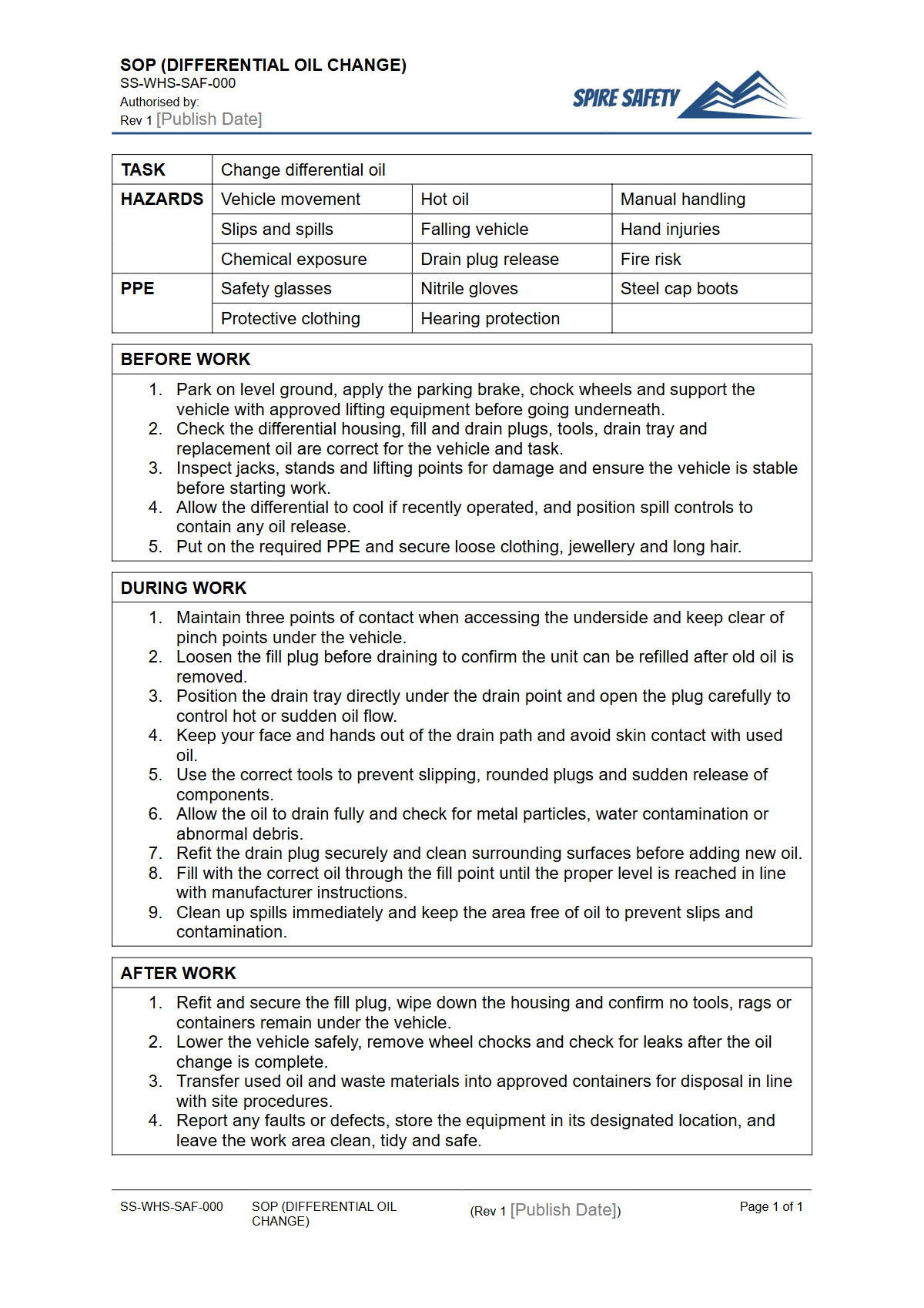
Download our free Safe Operating Procedure (Differential Oil Change) template. This structured document helps you define safe work steps for vehicle maintenance.
Free Safe Operating Procedure (Differential Oil Change) Template
DOCX • 126 KB + PDF
Updated Oct 2026
No signup required
Purpose of the Free Safe Operating Procedure (Differential Oil Change) Template
Performing maintenance on vehicle and machinery drivetrains, such as changing differential oil, involves significant risks including crush injuries, hazardous manual tasks, and exposure to chemicals. This Free Safe Operating Procedure (Differential Oil Change) Template provides a structured starting point for your business to document a safe, step-by-step process for the task.
A documented SOP ensures that the task is performed consistently and safely every time, minimising the risk of injury and equipment damage. It formalises risk controls, outlines required Personal Protective Equipment (PPE), and serves as a critical training tool for new or inexperienced workers.
Developing and implementing specific SOPs is a key component of a proactive safety culture. These procedures are practical, on-the-ground tools that support your broader WHS management systems by translating high-level policy into actionable instructions for your team.
Using this template helps demonstrate your commitment to providing a safe system of work, a primary duty for all Australian businesses.
Video walkthrough
How to use the Free Safe Operating Procedure (Differential Oil Change) Template
This document is a template and must be customised to your specific workplace. Download the DOCX or PDF file and adapt it to reflect the exact vehicles or machinery, tools, equipment, and chemicals used in your operations.
It is crucial that you consult with the workers who actually perform the task—their direct experience is invaluable for creating a practical and effective procedure.
To effectively implement this Safe Operating Procedure:
- Consultation: Involve your mechanics and workshop team in a consultation process to review and refine the draft.
- Site-Specific Details: Add make and model details for vehicles, specify the exact type of lifting equipment (e.g., four-post hoist, pit, vehicle jacks and stands), and list the specific gear oils and cleaning chemicals used.
- Risk Assessment: Use your existing WHS risk assessment to ensure all identified hazards are controlled within the SOP.
- Review and Approval: Have a competent person, such as a workshop manager or safety officer, formally review and approve the final document.
- Training: Use the approved SOP to train all relevant workers, ensuring they understand every step before undertaking the task. Keep records of this training.
Regular reviews are essential to keep your SOPs current and effective. This process can be integrated with your internal safety checks or more formal WHS compliance auditing to ensure procedures are being followed correctly and remain relevant to your operational risks.
When to use a Safe Operating Procedure for a Differential Oil Change
This SOP should be used every time a differential oil change is scheduled or required. It is not just for major services; it is designed to guide routine maintenance tasks to prevent complacency and ensure safety standards are consistently met.
It is particularly important when training new apprentices, inducting new mechanics into the workshop, or as a refresher for experienced staff. The SOP should be readily accessible in the work area, either as a printed, laminated copy or digitally on a workshop tablet.
For businesses operating heavy machinery, integrating this procedure into the overall maintenance schedule is critical for asset longevity and operator safety. The principles of safe maintenance apply across all heavy equipment, whether you are working on a truck, bus, or earthmoving plant like a bulldozer, which requires its own specific FREE Dozer SOP Template for safe operation.
Who should use this SOP?
This Safe Operating Procedure is intended for use by any person conducting, supervising, or managing vehicle and machinery maintenance tasks. This includes:
- Qualified Mechanics and Technicians
- Apprentice Mechanics
- Workshop Supervisors and Leading Hands
- Fleet Maintenance Managers
- Business owners (PCBUs) responsible for ensuring safe work systems
The procedure is designed to be clear and straightforward, making it a valuable resource for workers at all levels of experience. While aimed at light and heavy vehicle maintenance, the principles are applicable to any workshop environment where mechanical tasks are performed. The safe use of shared workshop equipment, such as an air compressor, is also often governed by its own procedure, like our Free Air Compressor SOP Template.
The structured format ensures that even if a worker is unfamiliar with a specific model, they have a clear guide to follow, promoting a consistent standard of safety across your entire operation. This standardisation is vital whether your team is servicing a commercial fleet, agricultural machinery, or heavy earthmoving equipment such as graders, which also require documented safe work methods like a FREE Grader SOP Template. For more documentation to support your safety framework, you can browse our complete free WHS resources library.
Common mistakes
Common mistakes to avoid
- Failing to properly secure the vehicle on hoists or stands before starting work.
- Using the incorrect grade or type of gear oil specified by the manufacturer.
- Not cleaning the fill and drain plugs before removal, allowing dirt to enter the differential housing.
- Forgetting to replace crush washers or seals, resulting in slow leaks after the service.
Legal references
Legal considerations
The following legal requirements may be relevant to this type of work.
- Work Health and Safety Act (Harmonised) — Provides the primary duties for protecting workers and other people from work health and safety risks.
- Work Health and Safety Regulations (Harmonised) — Sets out requirements supporting the management of workplace hazards and risks.
The following codes may be relevant to this type of work.
- Managing WHS Risks Code of Practice — Provides practical guidance on identifying hazards, assessing risks and applying effective controls.
- Work Health and Safety Consultation, Cooperation and Coordination Code of Practice — Provides practical guidance on consulting workers and coordinating with other duty holders.
- Managing the Work Environment and Facilities Code of Practice — Provides practical guidance on safe work environments, workplace facilities and related controls.
Did you know
Oil Viscosity
Gear oil has a much higher viscosity than engine oil to withstand the extreme pressure between gear teeth. Using the wrong type, such as an engine oil or incorrect gear oil grade, can quickly lead to catastrophic differential failure.
Environmental Impact
Used gear oil is classified as a hazardous waste. A single litre of oil can contaminate up to one million litres of water, making proper collection and disposal through a licensed waste facility an environmental and legal requirement.
FAQ
Frequently asked questions
01What should be included in an SOP for a differential oil change?
02Is a Safe Operating Procedure legally required for changing differential oil in Australia?
03How often should an SOP for vehicle maintenance be reviewed?
04What PPE is necessary for a differential oil change?
Share this resource
Free Safe Operating Procedure (Differential Oil Change) Template
Browse Categories
How To Use It
- 1Download and open in Word or PDF.
- 2Replace the placeholders with your business details.
- 3Get it reviewed by a WHS specialist before rollout.
Need it customised?
Our WHS consultants can adapt this template to your site, run a gap analysis, or audit what you already have in place.
Book a Free Consultation WHS consulting servicesor call 1300 156 382
Related templates
- Free Safe Operating Procedure (Digital Thermometer) Template
- Free Safe Operating Procedure (Dining Aid Cleaning) Template
- Free Safe Operating Procedure (Dining Room Cleaning) Template
- Free Safe Operating Procedure (Dining Room Reset) Template
- Free Safe Operating Procedure (Dirty Utility Cleaning) Template
- Free Safe Operating Procedure (Disability Van Loading) Template