
Free Safe Operating Procedure (Dense Media Plant) Template
Download our free Safe Operating Procedure (Dense Media Plant) Template to define safe work methods for your plant. Start building a safer workplace today.
Free Safe Operating Procedure (Dense Media Plant) Template
DOCX • 126 KB + PDF
Updated Oct 2026
No signup required
Purpose of the Free Safe Operating Procedure (Dense Media Plant) Template
A Dense Media Plant (DMP), also known as a Dense Media Separation (DMS) plant, is specialised fixed plant used in mining and quarrying to separate materials based on density. Operating this machinery involves significant risks, including entanglement in moving parts, exposure to high-pressure systems, noise, and hazardous substances like ferrosilicon.
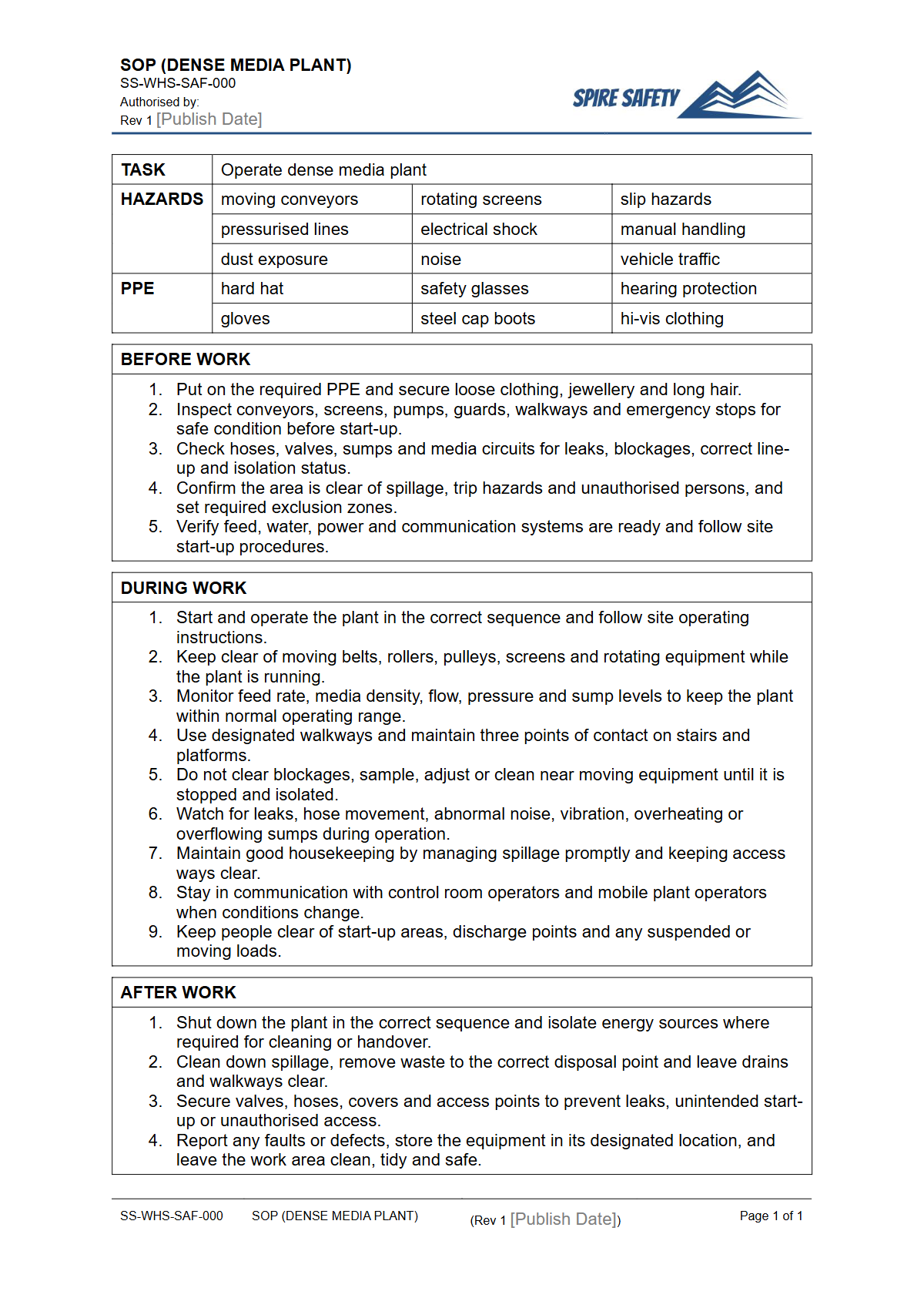
This free Safe Operating Procedure (Dense Media Plant) Template provides a structured framework for documenting the step-by-step processes required to operate the plant safely. It helps formalise safe work methods, control identified hazards, and establish a clear standard for worker training and competency assessment.
By clearly defining procedures for start-up, operation, shutdown, and emergency response, this SOP helps your organisation meet its primary duty of care under WHS legislation. The process equipment within a DMP often includes complex integrated machinery, making a detailed SOP crucial.
For individual components, you might also require a specific Conveyer System SOP to cover its unique hazards.
Video walkthrough
How to use the Free Safe Operating Procedure (Dense Media Plant) Template
This template is provided in both DOCX and PDF formats for your convenience. The DOCX version is fully editable, allowing you to tailor the content to your specific operational environment.
A comprehensive SOP is a critical component of your overall safety framework, which should be managed within your broader WHS management systems to ensure integration with other safety processes.
Important: This document is a template and must be customised to reflect the specific hazards and control measures at your workplace. We strongly recommend you consult with your team—including operators, supervisors, and safety personnel—and conduct a site-specific risk assessment for the dense media plant before finalising and implementing this procedure.
The information you gather will form the basis of a truly effective and relevant SOP.
Key Sections to Customise
- Pre-Operational Checks: Detail the specific inspections operators must perform before starting the plant. This includes checking guards on all moving parts, verifying emergency stop functionality, inspecting pipework and cyclones for wear, checking media density and viscosity, and testing communication systems.
- Operational Procedure: Outline the safe, sequential steps for running the plant. Cover the start-up sequence, how to monitor gauges and control panels, procedures for adding media, and the correct methods for sampling and testing. Include specific instructions on what to do if operational parameters deviate from the norm.
- Shutdown Procedure: Document the correct sequence for shutting down the plant under normal conditions. This section should also cover flushing and cleaning procedures to prevent blockages and prepare the plant for the next shift or a period of inactivity. It's also vital to include instructions for shift handovers.
- Emergency Procedures: Clearly define actions to be taken in an emergency, such as plant failure, blockages, or medical emergencies. This must include instructions on using emergency stops and the specific lockout/tagout procedures required before anyone attempts to access machinery for clearing blockages or maintenance.
When to use it
A Safe Operating Procedure for a dense media plant should be a core part of your operational documentation. It is used as a primary reference document during worker induction and task-specific training.
It should also be readily available at the operator's station for quick reference during operations. Furthermore, the SOP is an essential tool for supervisors conducting safety observations and for incident investigations to determine if procedures were followed.
Regularly reviewing SOPs is a key activity during a WHS compliance auditing program to ensure continuous improvement.
Who should use it
This SOP is designed for use by several key roles within an organisation to ensure a shared understanding of safe work practices. Primarily, it is for the plant operators who perform the work daily, providing them with clear, unambiguous instructions.
Supervisors and line managers use it to enforce safety standards, train their teams, and monitor performance. WHS advisors and safety managers will use this template as a basis for developing site-specific documentation that aligns with the organisation's safety management system.
It's also common for other ancillary equipment to be used nearby, so having documented procedures like an Air Compressor SOP can be just as important.
The development of the SOP should be a consultative process involving all these parties to ensure it is practical, accurate, and comprehensive. Operations on sites with DMPs often involve significant earthmoving and material handling, so your safety system may also require procedures for associated mobile plant, such as those covered in our Dozer SOP.
This document is just one example of the many templates available. You can browse our complete free WHS resources library for a wide range of procedures, checklists, and forms to support your safety management efforts.
Common mistakes
Common mistakes to avoid
- Failing to conduct a site-specific risk assessment before finalising the SOP.
- Writing generic steps that don't reflect the actual make and model of the plant machinery.
- Not involving experienced operators in the drafting and review process.
- Forgetting to include emergency shutdown and isolation procedures for clearing blockages.
Legal references
Legal considerations
The following legal requirements may be relevant to this type of work.
- Work Health and Safety Act (Harmonised) — Provides the primary duties for protecting workers and other people from work health and safety risks.
- Work Health and Safety Regulations (Harmonised) — Sets out requirements supporting the management of workplace hazards and risks.
The following codes may be relevant to this type of work.
- Managing WHS Risks Code of Practice — Provides practical guidance on identifying hazards, assessing risks and applying effective controls.
- Work Health and Safety Consultation, Cooperation and Coordination Code of Practice — Provides practical guidance on consulting workers and coordinating with other duty holders.
- Managing the Work Environment and Facilities Code of Practice — Provides practical guidance on safe work environments, workplace facilities and related controls.
Did you know
Separation Science
Dense media separation uses a fluid, like a slurry of ferrosilicon and water, with a density between that of the desired mineral and the waste rock. This allows valuable material to either sink or float for easy separation.
Common Hazard
One of the primary hazardous materials in a dense media plant is ferrosilicon, which can pose respiratory risks if its dust is inhaled. Proper ventilation and Personal Protective Equipment (PPE) are critical controls.
FAQ
Frequently asked questions
01What is a Dense Media Plant SOP for?
02Is this template compliant with Australian WHS laws?
03How often should a Dense Media Plant SOP be reviewed?
04Who should be involved in developing the SOP?
Share this resource
Free Safe Operating Procedure (Dense Media Plant) Template
Browse Categories
How To Use It
- 1Download and open in Word or PDF.
- 2Replace the placeholders with your business details.
- 3Get it reviewed by a WHS specialist before rollout.
Need it customised?
Our WHS consultants can adapt this template to your site, run a gap analysis, or audit what you already have in place.
Book a Free Consultation WHS consulting servicesor call 1300 156 382
Related templates
- Free Safe Operating Procedure (Dent Puller) Template
- Free Safe Operating Procedure (Depot Gate Check) Template
- Free Safe Operating Procedure (Depot Yard Inspection) Template
- Free Safe Operating Procedure (Descaling Equipment) Template
- Free Safe Operating Procedure (Dewatering Pump) Template
- Free Safe Operating Procedure (Dewatering Screen) Template