
Free Safe Operating Procedure (Depot Yard Inspection) Template
Download our free Safe Operating Procedure (Depot Yard Inspection) template to formalise your site safety checks.
Free Safe Operating Procedure (Depot Yard Inspection) Template
DOCX • 126 KB + PDF
Updated Oct 2026
No signup required
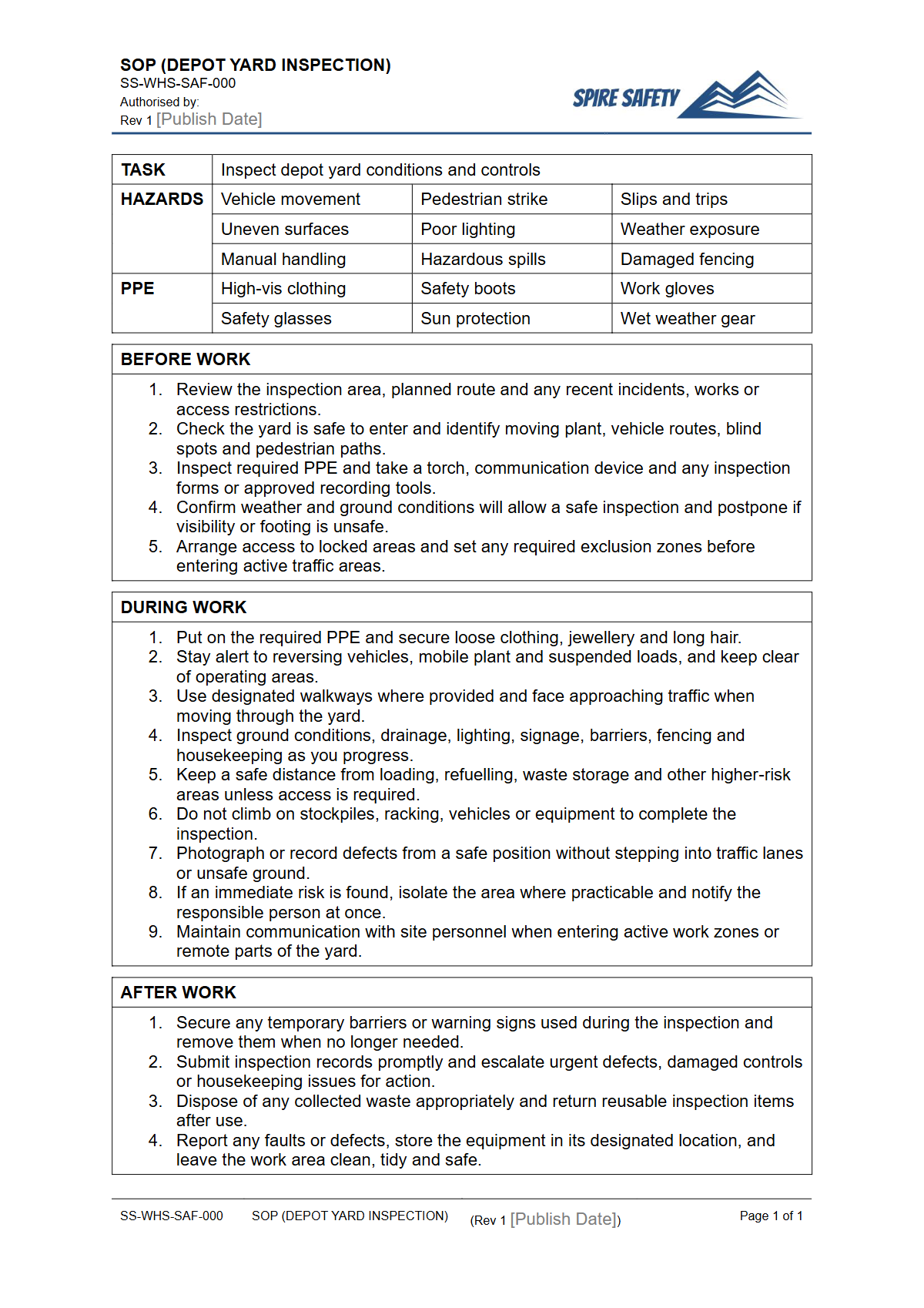
Purpose of the Free Safe Operating Procedure (Depot Yard Inspection) Template
Depot yards are dynamic environments with a high potential for incidents involving vehicles, pedestrians, and stored materials. This free Safe Operating Procedure (Depot Yard Inspection) template provides a structured framework for systematically identifying and controlling hazards within your depot or yard.
Using this SOP helps standardise your inspection process, ensuring that key safety elements like traffic management, storage, housekeeping, and emergency preparedness are checked regularly. It serves as a practical tool to demonstrate due diligence and maintain a safe working environment for all personnel.
A documented inspection process is a fundamental component of effective WHS management systems. By formalising your checks, you create a reliable record of your safety efforts, which can be used for training, incident investigation, and continuous improvement. This procedure helps you move beyond ad-hoc checks to a proactive system for managing workplace risks.
Video walkthrough
How to use the Free Safe Operating Procedure (Depot Yard Inspection) Template
This document is provided in an editable DOCX format, allowing for complete customisation. To use the template effectively, download the file and follow these steps:
- Customise Content: Add your company name, logo, and other relevant details. Review every section and adapt the content to reflect the specific layout, equipment, traffic flow, and hazards present in your depot yard.
- Consult with Workers: Involve your yard managers, supervisors, and workers in the customisation process. Their firsthand experience is invaluable for identifying practical risks and effective control measures.
- Finalise and Approve: Once customised, the SOP should be formally approved by management before being implemented.
- Train and Communicate: Ensure all personnel responsible for conducting inspections are trained on the finalised SOP. Make the document readily accessible to all relevant staff.
IMPORTANT: This is a template only. We cannot guarantee it covers every hazard specific to your operations.
You must consult with your team and adapt it to the unique requirements of your workplace. If you need assistance tailoring procedures to your site, our WHS consulting team can provide expert support.
The procedural logic in this SOP can be adapted for other high-risk tasks. For instance, if your depot uses specific heavy equipment, you might require separate procedures, such as our Telehandler SOP template, to manage those specific machinery risks.
When to conduct a Depot Yard Inspection
Regular inspections are essential for maintaining safety. The frequency should be determined by a risk assessment but typically includes:
- Daily: Quick pre-start visual checks of key areas like entry/exit points and high-traffic zones.
- Weekly: A more thorough walk-through inspection covering all areas detailed in the SOP.
- Monthly: A comprehensive review that may also include checking records and documentation.
- Post-Incident: An immediate inspection is required after any incident, accident, or near miss to identify contributing factors and prevent recurrence.
- After Changes: An inspection should be performed whenever there are changes to the yard layout, traffic management plan, or types of equipment used.
These documented inspections provide crucial evidence for internal and external safety reviews, including formal WHS compliance auditing activities, by demonstrating a proactive approach to hazard management.
Who should use this Safe Operating Procedure
This Safe Operating Procedure is designed for use by personnel with responsibility for workplace safety and operational management. This typically includes:
- Yard Managers or Supervisors: Responsible for the day-to-day safety of the depot and for ensuring inspections are completed correctly and on schedule.
- WHS/HSE Officers: Responsible for overseeing the implementation of safety procedures and reviewing inspection findings.
- Workers and Operators: While not always leading the inspection, their participation and feedback are critical. They should be familiar with the procedure and know how to report hazards they identify.
The development of this procedure should be a collaborative effort. Documenting procedures for all high-risk plant is equally important; if your depot uses heavy earthmoving equipment for maintenance or other tasks, consider using a specific Dozer SOP template as part of your safety system.
Key Areas to Inspect in a Depot Yard
A comprehensive depot yard inspection should cover multiple facets of the work environment. Your customised SOP should guide the inspector through a logical sequence, checking for hazards in areas including:
- Traffic Management: Clear signage, line marking, designated pedestrian walkways, exclusion zones, and intersection visibility.
- Storage and Racking: Stability of pallet racking, safe stacking limits, clear access to stored goods, and condition of storage containers.
- Loading and Unloading Zones: Level ground, clear of obstructions, adequate lighting, and procedures for securing vehicles.
- Housekeeping: Tidy work areas, proper waste disposal, and management of spills or leaks.
- Plant and Equipment: Condition of fixed plant like a workshop free Air Compressor SOP, and checks for mobile plant pre-start areas.
- Emergency Equipment: Accessibility and serviceability of fire extinguishers, first aid kits, and spill kits.
- Lighting and Visibility: Adequate lighting for all operational hours, especially around pedestrian routes and work areas.
This template is just one of many available in our free WHS resources library, which offers a wide range of documents to help you build out your safety management system.
Common mistakes
Common mistakes to avoid
- Using a generic template without customising it for site-specific hazards and layout.
- Failing to review and update the SOP after an incident, near miss, or change in operations.
- Conducting the inspection as a 'tick-and-flick' exercise without genuine observation or follow-up actions.
- Not training relevant personnel on how to use the SOP and what to look for during inspections.
Legal references
Legal considerations
The following legal requirements may be relevant to this type of work.
- Work Health and Safety Act (Harmonised) — Provides the primary duties for protecting workers and other people from work health and safety risks.
- Work Health and Safety Regulations (Harmonised) — Sets out requirements supporting the management of workplace hazards and risks.
The following codes may be relevant to this type of work.
- Managing WHS Risks Code of Practice — Provides practical guidance on identifying hazards, assessing risks and applying effective controls.
- Work Health and Safety Consultation, Cooperation and Coordination Code of Practice — Provides practical guidance on consulting workers and coordinating with other duty holders.
- Managing the Work Environment and Facilities Code of Practice — Provides practical guidance on safe work environments, workplace facilities and related controls.
Did you know
Traffic is the Top Risk
According to Safe Work Australia data, incidents involving vehicles are the leading cause of fatalities in depot and warehouse environments. A robust traffic management plan, enforced by regular inspections, is one of the most critical controls you can implement.
Consultation is a Legal Duty
Under Australian WHS laws, employers have a legal duty to consult with workers on matters affecting their health and safety. Involving your team in creating and reviewing inspection procedures not only improves the document but also fulfills this key legal obligation.
FAQ
Frequently asked questions
01What is a Safe Operating Procedure for a depot yard inspection?
02How often should depot yard inspections be conducted?
03Who is responsible for creating a Depot Yard Inspection SOP?
04Can I use this template for any type of depot?
Share this resource
Free Safe Operating Procedure (Depot Yard Inspection) Template
Browse Categories
How To Use It
- 1Download and open in Word or PDF.
- 2Replace the placeholders with your business details.
- 3Get it reviewed by a WHS specialist before rollout.
Need it customised?
Our WHS consultants can adapt this template to your site, run a gap analysis, or audit what you already have in place.
Book a Free Consultation WHS consulting servicesor call 1300 156 382
Related templates
- Free Safe Operating Procedure (Descaling Equipment) Template
- Free Safe Operating Procedure (Dewatering Pump) Template
- Free Safe Operating Procedure (Dewatering Screen) Template
- Free Safe Operating Procedure (Diamond Core Drill) Template
- Free Safe Operating Procedure (Diaphragm Pump) Template
- Free Safe Operating Procedure (Diesel Refuelling) Template