
Free Safe Operating Procedure (Demolition Hammer) Template
Effectively manage high-risk demolition work with our free Safe Operating Procedure (Demolition Hammer) template. Download your DOCX or PDF copy today.
Free Safe Operating Procedure (Demolition Hammer) Template
DOCX • 126 KB + PDF
Updated Oct 2026
No signup required
Purpose of the Free Safe Operating Procedure (Demolition Hammer) Template
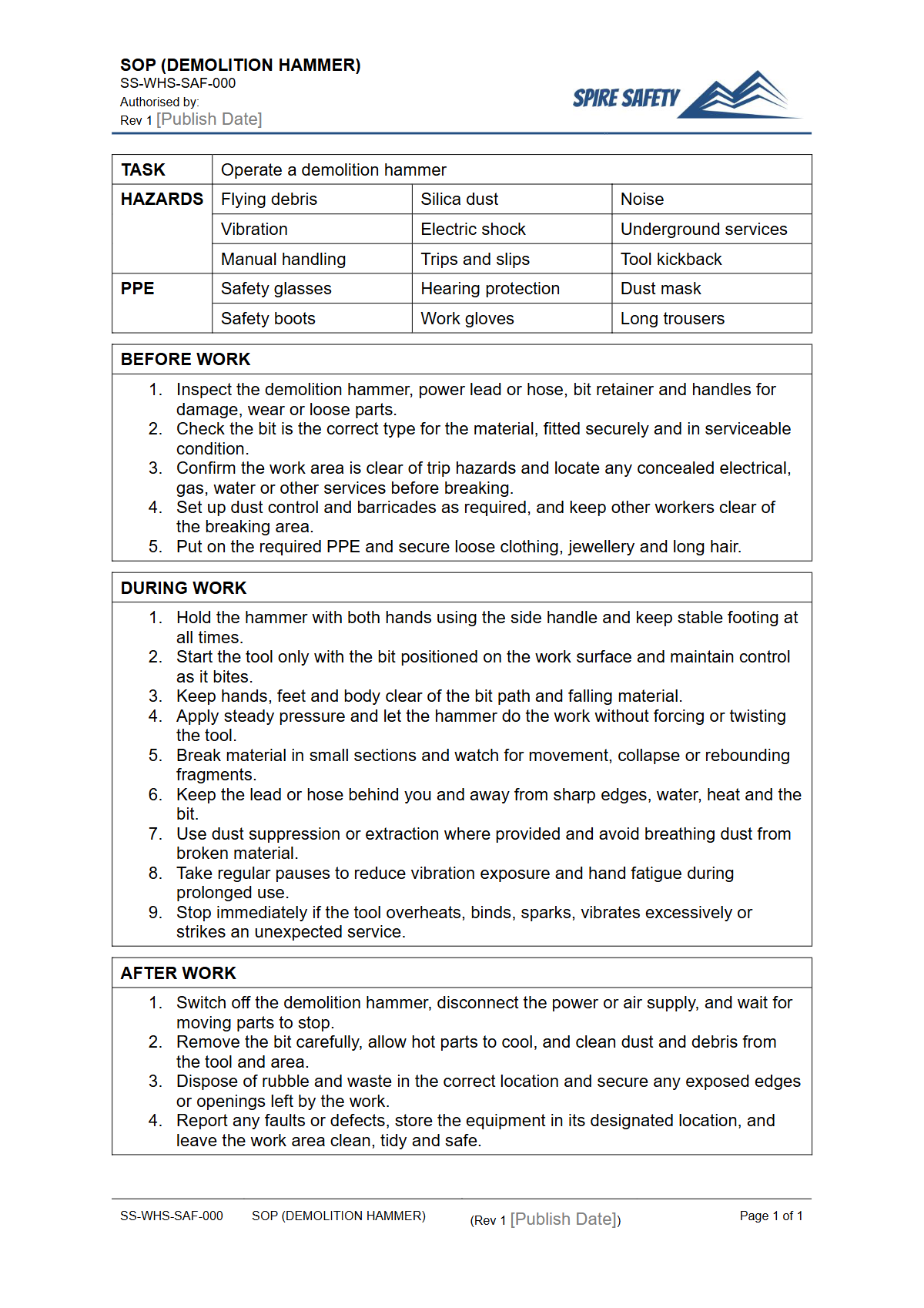
Operating a demolition hammer, or jackhammer, introduces significant workplace hazards. This free Safe Operating Procedure (Demolition Hammer) template provides a structured starting point for documenting the approved, step-by-step process for using this powerful tool safely.
A well-developed SOP is a critical control measure that helps your organisation meet its duties under WHS legislation. It provides clear, accessible instructions to workers, reducing the risk of injuries associated with vibration, noise, hazardous dust, and manual handling.
A specific SOP for demolition hammers is essential for managing severe long-term health risks like Hand-Arm Vibration Syndrome (HAVS) and silicosis from concrete dust. By formally documenting pre-start checks, required personal protective equipment (PPE), and correct operating techniques, you establish a consistent standard of safety.
Integrating this procedure into your broader WHS management systems ensures that the risks associated with high-energy power tools are systematically controlled and that all safety documentation is cohesive and effective.
What's in the template?
Our template is formatted for clarity and practicality, providing sections to cover:
- Designated responsible persons
- Required training and competency
- A comprehensive list of potential hazards and risks
- Control measures, including required PPE
- Pre-start inspection checks
- Step-by-step operating instructions
- Post-operation and cleanup procedures
- Emergency response protocols
Video walkthrough
How to use the Free Safe Operating Procedure (Demolition Hammer) Template
This document is provided in both DOCX and PDF formats for your convenience. The DOCX file is fully editable, allowing you to tailor the content directly to your operational needs and specific equipment.
It is designed as a foundational document, aligned with the model WHS framework, to be built upon.
Important: This is a template, not a finished document. You must customise this Safe Operating Procedure to reflect the unique circumstances of your workplace.
This involves conducting a site-specific risk assessment for the task, consulting with your workers and health and safety representatives, and incorporating details of the specific makes and models of demolition hammers you use. We have provided prompts within the document to guide you through this customisation process.
Similar to our FREE Circular Saw SOP Template, the value comes from adapting it to your exact environment.
When to use a Demolition Hammer SOP
A Safe Operating Procedure for a demolition hammer should be used consistently as a core part of your safety process. It is not a document to be filed away and forgotten. It should be actively used:
- During worker induction and training: To ensure new operators understand the approved safe method before they ever touch the tool.
- For pre-task planning: As a reference for supervisors and workers before commencing any demolition work.
- In toolbox talks: To refresh knowledge on specific hazards like vibration or dust control.
- During incident investigations: As a benchmark to determine if procedures were followed and if they need revision.
- For auditing and review: To check that work is being performed as specified and that the procedure remains effective.
Regularly reviewing your SOPs is a key activity in maintaining safety standards. Professional WHS compliance auditing can help identify gaps between your documented procedures and actual work practices, ensuring your system is not just compliant on paper but also effective in reality.
Who should use it
This Safe Operating Procedure is intended for use by multiple roles within an organisation to create a holistic approach to safety.
- Persons Conducting a Business or Undertaking (PCBUs): To help meet their primary duty of care to ensure the health and safety of workers.
- WHS Managers and Safety Officers: As a tool for implementing and monitoring risk controls for high-risk plant and equipment.
- Site Supervisors and Forepersons: To train workers, lead pre-start meetings, and enforce safe work practices on the ground.
- Workers/Operators: As a clear guide on how to perform their tasks safely and a reference for their rights and responsibilities.
Demolition hammers are often used alongside other site equipment. For a comprehensive approach to safety, consider implementing procedures for all plant, such as this Free Air Compressor SOP, which often powers larger pneumatic breakers.
Having clear SOPs for all equipment, including trenching machinery like in our FREE Trencher SOP Template, creates a robust and predictable safety environment across the entire worksite.
Common mistakes
Common mistakes to avoid
- Using a generic template without customising it for the specific model and worksite.
- Neglecting to include control measures for secondary hazards like silica dust or noise.
- Failing to consult with the actual operators when drafting or reviewing the procedure.
- Treating the SOP as a one-time document, not a live procedure to be used for training and review.
Legal references
Legal considerations
The following legal requirements may be relevant to this type of work.
- Work Health and Safety Act (Harmonised) — Provides the primary duties for protecting workers and other people from work health and safety risks.
- Work Health and Safety Regulations (Harmonised) — Sets out requirements supporting the management of workplace hazards and risks.
The following codes may be relevant to this type of work.
- Managing WHS Risks Code of Practice — Provides practical guidance on identifying hazards, assessing risks and applying effective controls.
- Work Health and Safety Consultation, Cooperation and Coordination Code of Practice — Provides practical guidance on consulting workers and coordinating with other duty holders.
- Managing the Work Environment and Facilities Code of Practice — Provides practical guidance on safe work environments, workplace facilities and related controls.
Did you know
Vibration Risk
Prolonged use of jackhammers and demolition hammers is a leading cause of Hand-Arm Vibration Syndrome (HAVS), a permanent and painful condition affecting blood vessels, nerves, and joints.
Noise Exposure
The noise from a typical demolition hammer can exceed 100 decibels. At this level, permanent hearing damage can occur in less than 15 minutes of unprotected exposure.
FAQ
Frequently asked questions
01What PPE is required when using a demolition hammer?
02How does a Safe Operating Procedure differ from a SWMS?
03Is this demolition hammer SOP a legal document?
04How often should an SOP for a demolition hammer be reviewed?
Share this resource
Free Safe Operating Procedure (Demolition Hammer) Template
Browse Categories
How To Use It
- 1Download and open in Word or PDF.
- 2Replace the placeholders with your business details.
- 3Get it reviewed by a WHS specialist before rollout.
Need it customised?
Our WHS consultants can adapt this template to your site, run a gap analysis, or audit what you already have in place.
Book a Free Consultation WHS consulting servicesor call 1300 156 382
Related templates
- Free Safe Operating Procedure (Dense Media Plant) Template
- Free Safe Operating Procedure (Dent Puller) Template
- Free Safe Operating Procedure (Depot Gate Check) Template
- Free Safe Operating Procedure (Depot Yard Inspection) Template
- Free Safe Operating Procedure (Descaling Equipment) Template
- Free Safe Operating Procedure (Dewatering Pump) Template