
Free Safe Operating Procedure (Deli Counter Cleaning) Template
Establish clear, safe steps for cleaning your deli counter to ensure food safety and prevent injuries. Download our free, editable template to get started.
Free Safe Operating Procedure (Deli Counter Cleaning) Template
DOCX • 126 KB + PDF
Updated Oct 2026
No signup required
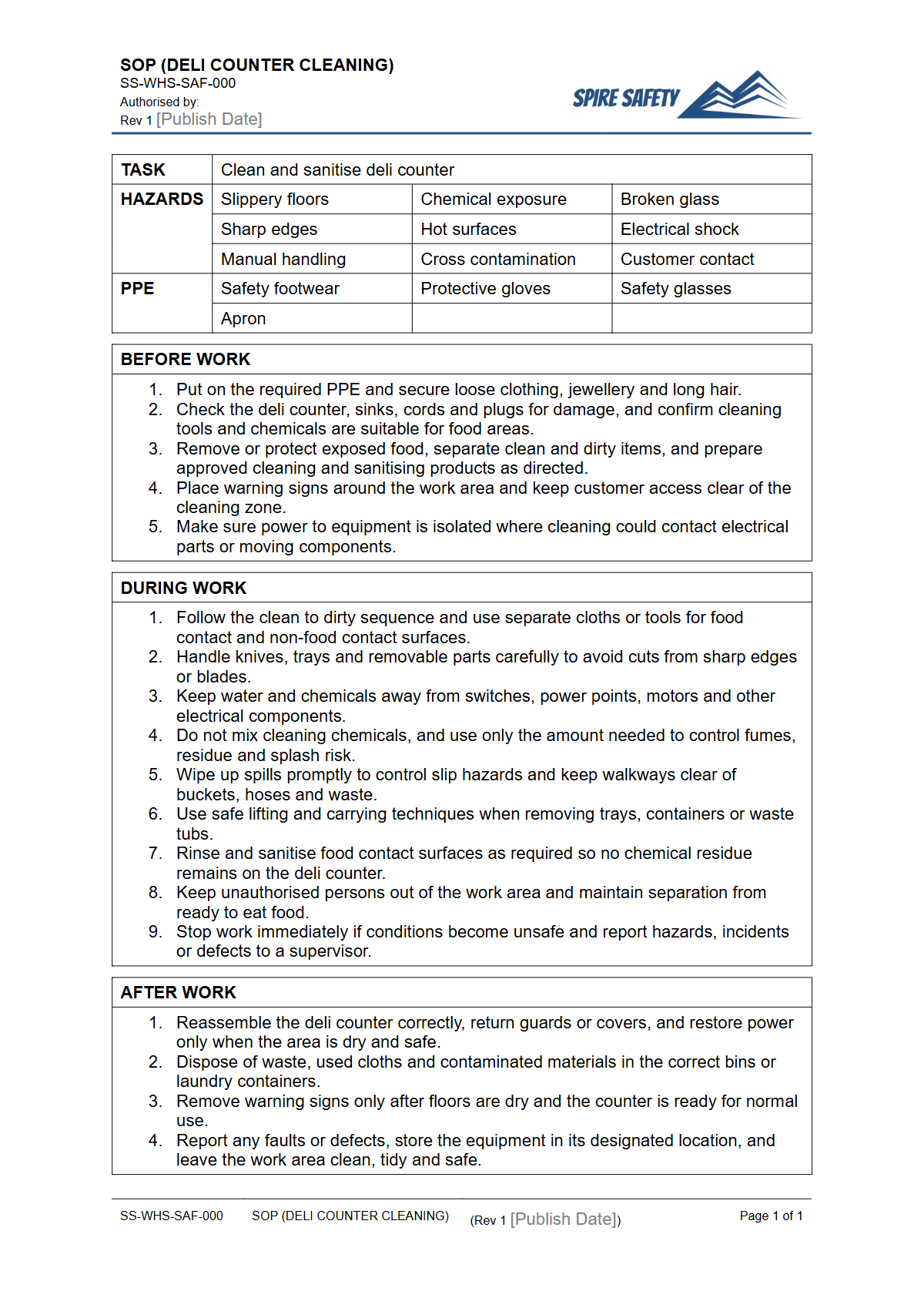
Purpose of the Free Safe Operating Procedure for Deli Counter Cleaning
A deli counter is a high-contact area where food safety and worker safety are paramount. This Free Safe Operating Procedure (Deli Counter Cleaning) Template provides a structured framework for documenting the required steps to clean and sanitise display cases, surfaces, and associated equipment effectively and safely.
Implementing a clear SOP helps prevent cross-contamination, control foodborne pathogens, and protect workers from hazards such as chemical exposure, slips, trips, and ergonomic injuries. It standardises the process across all staff and shifts, forming a crucial part of your food safety program and demonstrating due diligence in managing workplace health and safety risks.
Using a standardised procedure ensures that every cleaning task, from pre-cleaning to final sanitisation, is performed correctly every time. This consistency is vital for meeting food safety regulations and building customer trust.
A well-documented SOP also serves as an essential training tool for new employees and a reference for experienced staff, reinforcing correct practices and expectations. It clarifies responsibilities, required personal protective equipment (PPE), and the specific cleaning agents to be used, leaving no room for guesswork.
Video walkthrough
How to Use the Free Safe Operating Procedure (Deli Counter Cleaning) Template
This template is a starting point designed to be adapted to your specific operational needs. To use it, download the DOCX or PDF file and systematically work through each section, adding details relevant to your deli's layout, equipment, and approved cleaning chemicals.
Effective customisation is key to creating a useful and relevant document.
Please note: We have provided a comprehensive framework aligned with Australian WHS practice. However, you must customise this document with your specific site details.
This includes inserting your company name, specifying the exact models of your deli counters, listing the approved chemical products and their dilution rates, and detailing the PPE required based on your chemical Safety Data Sheets (SDS). A generic procedure is not sufficient; it must reflect the reality of your workplace.
Your complete system should be integrated into your broader WHS management systems for maximum effectiveness.
Key Elements to Customise in Your SOP
To make this Safe Operating Procedure effective, you need to add specific details from your workplace. Pay close attention to the following sections:
- PPE Requirements: List the exact PPE workers must wear, such as specific types of gloves (e.g., nitrile), safety glasses or goggles, and non-slip footwear. This should be determined by a risk assessment and the SDS for your cleaning chemicals.
- Chemicals and Equipment: Name the specific food-safe detergents and sanitisers used. Include correct dilution ratios, contact times for sanitisers, and the tools required (e.g., colour-coded cloths, squeegees, buckets).
- Step-by-Step Procedure: Break down the process logically. This should include pre-cleaning (removing food debris), washing with detergent, rinsing, applying sanitiser, and air-drying. Be explicit about the sequence and technique.
- Frequency: Define how often tasks should be performed (e.g., 'after each service', 'daily', 'weekly'). Differentiate between routine cleaning and deep cleaning schedules.
- Emergency Procedures: Outline steps to take in case of a chemical splash, slip, or other incident.
Training and Competency
Once customised, every worker responsible for cleaning the deli counter must be trained on the procedure. Training should cover not only the steps involved but also the 'why' behind them, including the food safety implications and the specific hazards they are being protected from.
Keep records of this training. Competency should be verified by observing staff performing the task correctly and safely without supervision.
This documented SOP is the foundation for that training, ensuring every team member has a clear and consistent reference for safe work practices. While this SOP covers a specific task, many food service businesses use a range of equipment that also require documented procedures; for example, a detailed Conveyer System SOP is vital for any automated food handling lines.
Reviewing and Improving Your Procedure
A Safe Operating Procedure is a living document. It should be reviewed regularly—at least annually, or whenever there is a change in equipment, chemicals, processes, or regulations.
It should also be reviewed after any incident or near-miss to identify and correct any shortcomings. Involving your workers in the review process is a valuable way to get practical feedback and improve the procedure's effectiveness and usability.
If you require expert assistance in developing or auditing your safety documents, consider engaging professional WHS consulting services.
This template is one of many tools available to help you build a safer workplace. For more templates and checklists, browse our complete free WHS resources library to find documents that suit your business needs.
Common mistakes
Common mistakes to avoid
- Using the wrong chemicals (e.g., non-food-safe) or incorrect dilutions, which can be ineffective or leave harmful residues.
- Forgetting to clean and sanitise hard-to-reach areas like under scales, slicer components, or along glass edges.
- Not allowing for sufficient contact time for sanitisers to work effectively before wiping or air-drying.
- Failing to train staff on the specific procedure or verifying they understand and follow it correctly.
Legal references
Legal considerations
The following legal requirements may be relevant to this type of work.
- Work Health and Safety Act (Harmonised) — Provides the primary duties for protecting workers and other people from work health and safety risks.
- Work Health and Safety Regulations (Harmonised) — Sets out requirements supporting the management of workplace hazards and risks.
The following codes may be relevant to this type of work.
- Managing WHS Risks Code of Practice — Provides practical guidance on identifying hazards, assessing risks and applying effective controls.
- Work Health and Safety Consultation, Cooperation and Coordination Code of Practice — Provides practical guidance on consulting workers and coordinating with other duty holders.
- Managing the Work Environment and Facilities Code of Practice — Provides practical guidance on safe work environments, workplace facilities and related controls.
Did you know
Cleaning vs. Sanitising
Cleaning involves using detergent and water to remove physical soil, grease, and food matter. Sanitising uses chemicals or heat to reduce the number of microorganisms to a safe level. A surface must be cleaned before it can be effectively sanitised.
Contact Time is Key
For a sanitiser to work, it must remain on a surface for a specific period, known as 'contact time'. This can range from 30 seconds to several minutes and must be followed exactly as per the manufacturer's instructions to ensure pathogens are killed.
FAQ
Frequently asked questions
01What chemicals are safest for cleaning a deli counter?
02How often should a deli counter be cleaned and sanitised?
03Is this deli counter cleaning SOP a legal document?
04What PPE is required for cleaning a deli counter?
Share this resource
Free Safe Operating Procedure (Deli Counter Cleaning) Template
Browse Categories
How To Use It
- 1Download and open in Word or PDF.
- 2Replace the placeholders with your business details.
- 3Get it reviewed by a WHS specialist before rollout.
Need it customised?
Our WHS consultants can adapt this template to your site, run a gap analysis, or audit what you already have in place.
Book a Free Consultation WHS consulting servicesor call 1300 156 382
Related templates
- Free Safe Operating Procedure (Deli Scale Cleaning) Template
- Free Safe Operating Procedure (Demolition Hammer) Template
- Free Safe Operating Procedure (Dense Media Plant) Template
- Free Safe Operating Procedure (Dent Puller) Template
- Free Safe Operating Procedure (Depot Gate Check) Template
- Free Safe Operating Procedure (Depot Yard Inspection) Template