
Free Safe Operating Procedure (Degreasing Bay) Template
Effectively manage hazards associated with degreasing bays with our structured template. Download your free Safe Operating Procedure (Degreasing Bay) today.
Free Safe Operating Procedure (Degreasing Bay) Template
DOCX • 126 KB + PDF
Updated Oct 2026
No signup required
Purpose of the Free Safe Operating Procedure (Degreasing Bay) Template
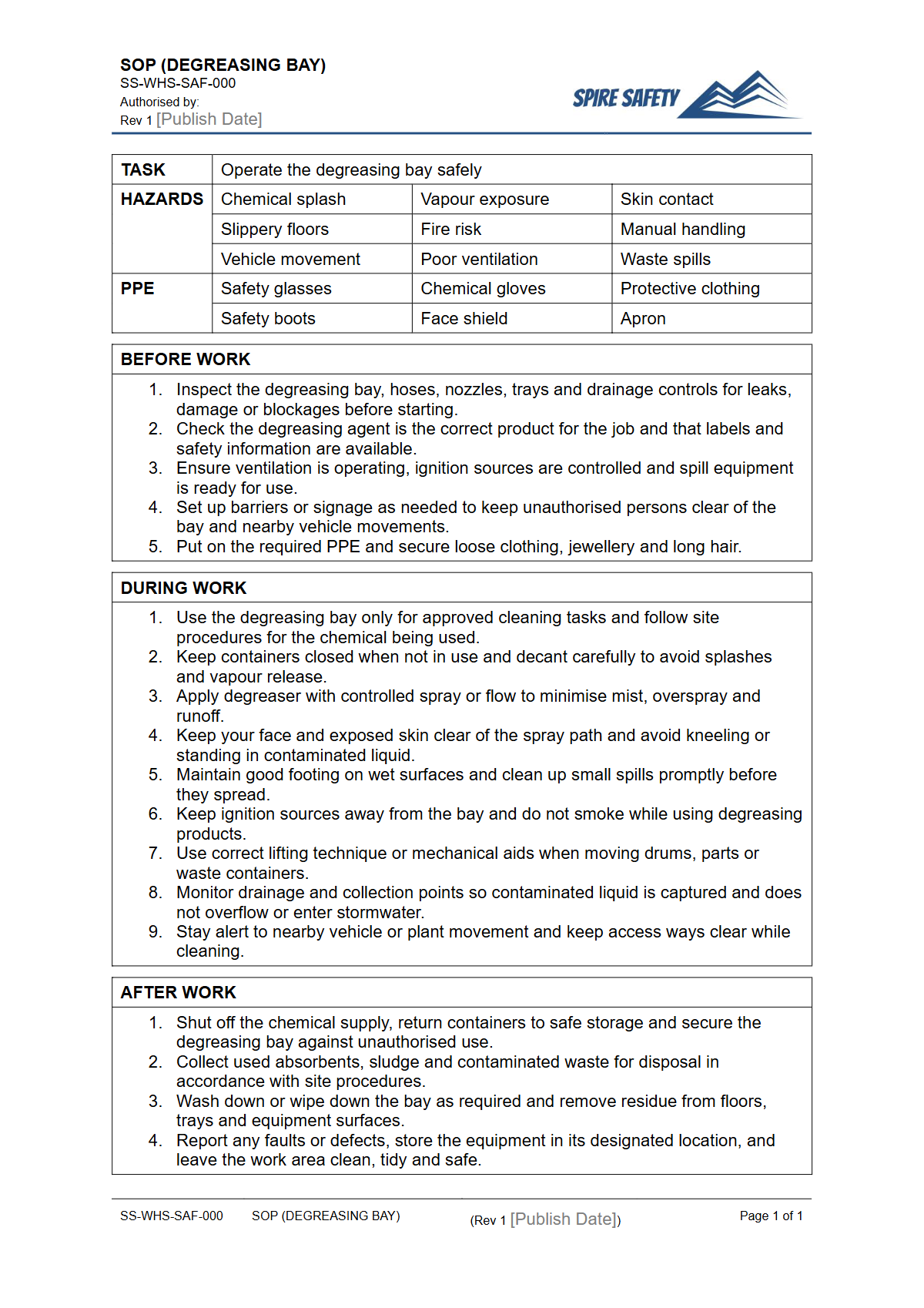
A degreasing bay is essential in many mechanical, automotive, and manufacturing workshops for cleaning parts, but it also presents significant health and safety risks. This Free Safe Operating Procedure (Degreasing Bay) Template provides a structured framework to help your organisation document the step-by-step process for operating this equipment safely.
The primary purpose of a Safe Operating Procedure (SOP) is to provide clear, consistent instructions that minimise the risk of injury or illness to workers.
This template is designed as a starting point, aligned with Australian WHS principles, to help you identify hazards and implement control measures. It prompts you to consider risks such as chemical exposure (inhalation, skin contact), fire and explosion from flammable solvents, electrical hazards from the equipment, and ergonomic risks from manual handling of parts.
By systematically documenting controls like required personal protective equipment (PPE), ventilation requirements, and emergency procedures, this SOP helps standardise safe work practices and supports your duty of care.
Video walkthrough
How to use the Free Safe Operating Procedure (Degreasing Bay) Template
This document is a template and is not a completed Safe Operating Procedure. To be effective and useful, it must be thoroughly customised to reflect the specific degreasing bay equipment, chemicals, tasks, and unique environmental conditions at your workplace.
We recommend that a competent person completes this customisation in consultation with the workers who will be using the equipment and their supervisors.
When customising the template, ensure you replace the placeholder text with details relevant to your site. This includes specifying the exact make and model of the degreasing unit, the names and Safety Data Sheets (SDS) for all chemicals used, and site-specific emergency contacts.
For complex operations or high-risk chemical use, engaging external WHS consulting experts can provide valuable insight to ensure all risks are adequately controlled.
In facilities where parts move through a production line, the degreasing process may integrate with other machinery. It is crucial that the procedures for all associated equipment are clear and consistent, such as those detailed in a free Conveyer System SOP.
When to use a Safe Operating Procedure
An SOP for a degreasing bay should be used as a core part of your safety management system. It is a critical document that should be readily accessible to all relevant personnel. Key times to use the SOP include:
- Worker Training and Induction: Before any employee is permitted to operate the degreasing bay, they must be trained on the procedures outlined in the SOP.
- Refresher Training: The SOP should be used as a basis for periodic refresher training to reinforce safe work practices and introduce any procedural updates.
- Pre-Task Reference: Workers should be encouraged to review the SOP before starting work, especially if the task is performed infrequently.
- Incident Investigation: Following an incident or near-miss, the SOP should be reviewed to determine if the procedure was followed and if any amendments are needed to prevent recurrence.
This SOP should also form part of your broader safety documentation. A robust approach involves integrating specific procedures into your overall WHS management systems to ensure a holistic and documented view of workplace safety.
Who should use this Safe Operating Procedure
This SOP is intended for several key groups within an organisation:
- Operators: The primary users are the workers who directly operate the degreasing bay. The SOP provides them with the essential instructions to perform their tasks safely.
- Supervisors and Managers: Line managers and supervisors must use the SOP to oversee work, enforce safe practices, and ensure operators are trained and competent.
- WHS/OHS Personnel: Safety professionals use the SOP to conduct risk assessments, deliver training, and perform workplace inspections and audits.
- Maintenance Staff: Personnel responsible for servicing and repairing the degreasing bay must be familiar with the SOP, particularly sections on isolation, lock-out tag-out, and handling of residual chemicals.
Workshops are dynamic environments with multiple hazards. Alongside chemical safety, operators must be aware of risks from other common equipment, which should also be covered by specific SOPs like our Free Air Compressor SOP (Safe Operating Procedure) Template. Regular reviews of all safety procedures are vital.
A periodic WHS compliance auditing program can help identify gaps in your SOPs and their implementation, ensuring they remain effective and relevant. This document is one of many tools available to help you build a safer workplace.
You can explore our entire free WHS resources library for more templates and guides.
Common mistakes
Common mistakes to avoid
- Using an SOP that has not been customised for the specific chemicals, equipment, and tasks at the workplace.
- Providing inadequate ventilation, leading to a build-up of hazardous vapours in the work area.
- Selecting the wrong type of Personal Protective Equipment (PPE), such as using gloves that are not resistant to the specific solvent.
- Improper storage of flammable solvents near ignition sources or incorrect disposal of waste chemicals and contaminated rags.
Legal references
Legal considerations
The following legal requirements may be relevant to this type of work.
- Work Health and Safety Act (Harmonised) — Provides the primary duties for protecting workers and other people from work health and safety risks.
- Work Health and Safety Regulations (Harmonised) — Sets out requirements supporting the management of workplace hazards and risks.
The following codes may be relevant to this type of work.
- Managing WHS Risks Code of Practice — Provides practical guidance on identifying hazards, assessing risks and applying effective controls.
- Work Health and Safety Consultation, Cooperation and Coordination Code of Practice — Provides practical guidance on consulting workers and coordinating with other duty holders.
- Managing the Work Environment and Facilities Code of Practice — Provides practical guidance on safe work environments, workplace facilities and related controls.
Did you know
Exposure Standards
Safe Work Australia sets mandatory workplace exposure standards (WES) for hundreds of airborne chemicals. These legal limits define the maximum concentration of a substance a worker can be exposed to over an 8-hour day.
Solvent Substitution
Many traditional degreasing solvents are being phased out due to health and environmental concerns. Modern alternatives include citrus-based (d-Limonene) or aqueous alkaline cleaners, which can be effective and significantly less hazardous.
FAQ
Frequently asked questions
01What hazards are associated with a degreasing bay?
02Is a Safe Operating Procedure legally required for a degreasing bay in Australia?
03What kind of chemicals are used in degreasing and what are their risks?
04How often should a degreasing bay SOP be reviewed?
Share this resource
Free Safe Operating Procedure (Degreasing Bay) Template
Browse Categories
How To Use It
- 1Download and open in Word or PDF.
- 2Replace the placeholders with your business details.
- 3Get it reviewed by a WHS specialist before rollout.
Need it customised?
Our WHS consultants can adapt this template to your site, run a gap analysis, or audit what you already have in place.
Book a Free Consultation WHS consulting servicesor call 1300 156 382
Related templates
- Free Safe Operating Procedure (Dehumidifier) Template
- Free Safe Operating Procedure (Deli Counter Cleaning) Template
- Free Safe Operating Procedure (Deli Scale Cleaning) Template
- Free Safe Operating Procedure (Demolition Hammer) Template
- Free Safe Operating Procedure (Dense Media Plant) Template
- Free Safe Operating Procedure (Dent Puller) Template