
Free Safe Operating Procedure (Heat Treatment Blanket) Template
Download our free Safe Operating Procedure for heat treatment blankets. This customisable template helps you document safe work practices and control thermal hazards.
Free Safe Operating Procedure (Heat Treatment Blanket) Template
DOCX • 126 KB + PDF
Updated Oct 2026
No signup required
Purpose of the Free Safe Operating Procedure (Heat Treatment Blanket) Template
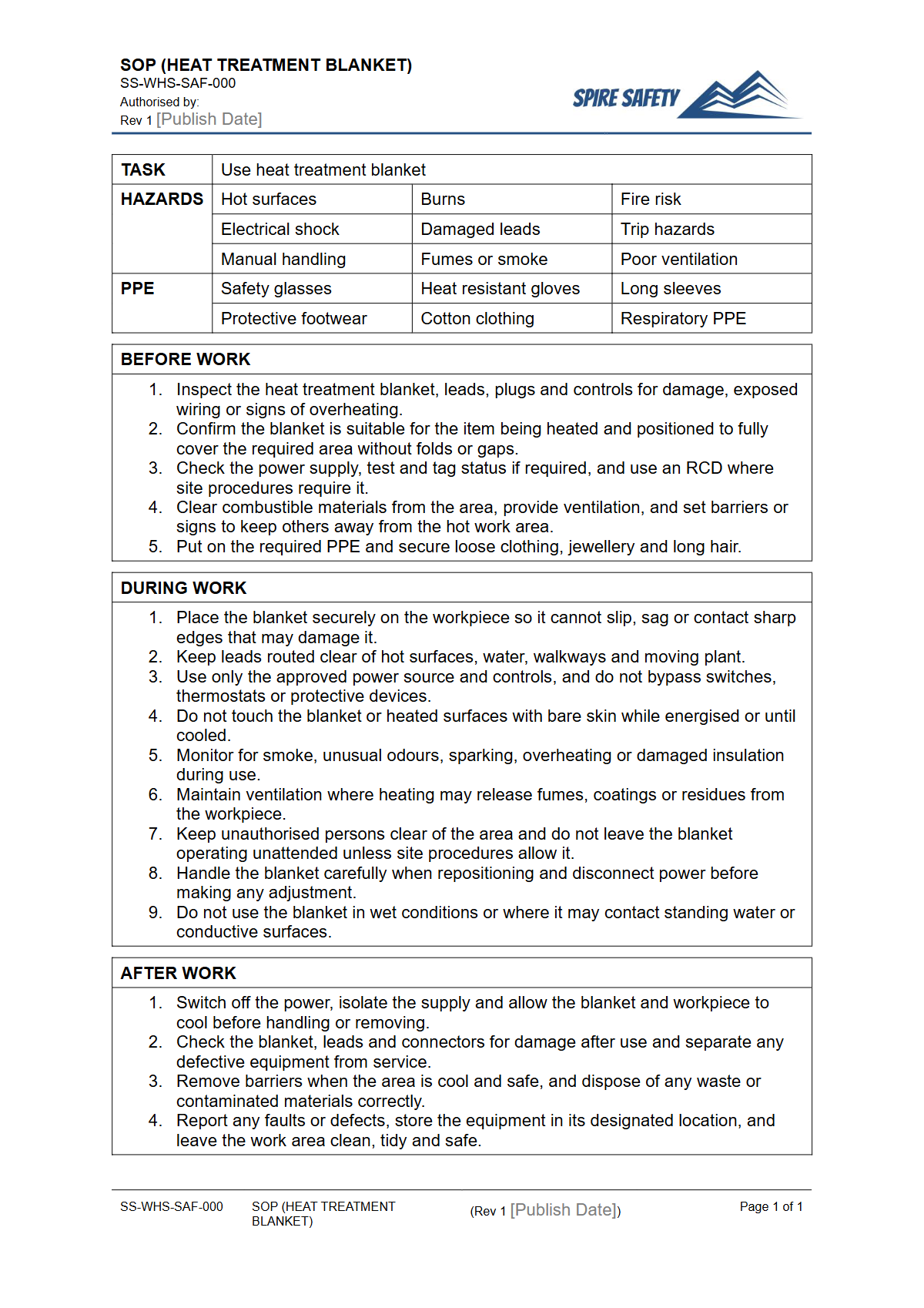
This Free Safe Operating Procedure (Heat Treatment Blanket) Template provides a structured framework for documenting the safe use of electric heat treatment blankets in your workplace. These devices are essential for tasks like post-weld heat treatment (PWHT), pre-heating metals, and composite curing, but they also introduce significant hazards, including severe burns, electric shock, and fire.
A documented SOP is a critical control measure that outlines step-by-step instructions for operators to follow, ensuring tasks are performed consistently and safely every time.
By implementing a formal SOP, you establish clear expectations for pre-use inspections, setup, operation, and shutdown procedures. This helps your organisation meet its primary duty of care under Australian WHS legislation by actively managing risks associated with thermal and electrical energy.
Similar to managing other high-temperature equipment, as detailed in a deep fryer SOP, controlling thermal and electrical hazards is a fundamental safety requirement.
Video walkthrough
How to use the Free Safe Operating Procedure (Heat Treatment Blanket) Template
Our Safe Operating Procedure for heat treatment blankets is designed for easy customisation. Simply download the DOCX file and open it in your preferred word processor.
The document is logically structured with sections for responsibilities, required personal protective equipment (PPE), risk controls, and a step-by-step operational guide. You will need to review each section and adapt the content to reflect the specific equipment, processes, and environment at your worksite.
This involves adding details about your specific blanket models, temperature controllers, site-specific emergency contacts, and any unique environmental hazards. A well-defined SOP forms a cornerstone of effective WHS management systems, providing auditable evidence that processes have been formally assessed and controlled.
Consulting with the workers who will use the procedure during the drafting phase is crucial for ensuring it is practical and effective.
A Note on Customisation
Please note: this template provides a starting point aligned with Australian WHS principles. We have designed it to be comprehensive, but you must customise it with your specific site details, equipment models, emergency procedures, and personnel roles to ensure it is suitable for your operations.
A generic procedure is not sufficient; it must be made site-specific to be effective.
When to Use This Safe Operating Procedure
A Safe Operating Procedure for heat treatment blankets should be developed and implemented before any worker is permitted to operate the equipment. It serves as a primary training document for new operators and a reference for experienced personnel.
The SOP should be readily accessible in the work area where heat treatment tasks are performed. It is a critical part of the planning phase for any job involving PWHT, pre-heating, or other applications, ensuring all safety checks and precautions are considered before work begins.
These procedures are vital not just for specialised thermal tasks, but for a wide range of high-risk plant found in industrial settings. For example, our Air Compressor SOP outlines similar structured controls for managing hazards associated with pressurised systems.
The SOP should also be reviewed as part of any risk assessment process when changes to equipment, materials, or work environments occur.
Who Should Use It
This SOP is intended for several key roles within an organisation. Primarily, it is for the operators who physically set up and run the heat treatment blankets.
They must understand and follow every step to protect themselves and others. Supervisors and managers are responsible for ensuring operators are trained on the SOP and that the procedures are being followed correctly.
They also use the SOP to conduct workplace inspections and verify competency.
Maintenance personnel should also be familiar with the SOP, particularly the sections on equipment inspection and isolation for servicing. Regular reviews of SOPs, often conducted as part of internal or external WHS compliance audits, ensure they remain relevant and effective.
WHS advisors can use this template as a basis for developing a comprehensive safety plan for thermal treatment processes across the business. You can explore more procedural templates for various types of plant in our full library of free WHS resources.
Common mistakes
Common mistakes to avoid
- Using damaged, frayed, or wet blankets, which dramatically increases the risk of electric shock and fire.
- Overlapping the blanket on itself or failing to secure it properly, leading to hot spots and premature failure.
- Neglecting to place warning signs and establish an exclusion zone around the work area during operation.
- Failing to have a suitable fire extinguisher (e.g., CO2 or Dry Powder) immediately available.
Legal references
Legal considerations
The following legal requirements may be relevant to this type of work.
- Work Health and Safety Act (Harmonised) — Provides the primary duties for protecting workers and other people from work health and safety risks.
- Work Health and Safety Regulations (Harmonised) — Sets out requirements supporting the management of workplace hazards and risks.
The following codes may be relevant to this type of work.
- Managing WHS Risks Code of Practice — Provides practical guidance on identifying hazards, assessing risks and applying effective controls.
- Work Health and Safety Consultation, Cooperation and Coordination Code of Practice — Provides practical guidance on consulting workers and coordinating with other duty holders.
- Managing the Work Environment and Facilities Code of Practice — Provides practical guidance on safe work environments, workplace facilities and related controls.
Did you know
Extreme Temperatures
Post-weld heat treatment blankets can reach temperatures exceeding 750°C to relieve stresses in welded steel, making controlled operation and exclusion zones critical safety measures.
Insulation is Key
The ceramic fibre insulation used in heat treatment blankets is crucial not only for directing heat into the workpiece but also for protecting the internal heating elements and preventing external short circuits.
FAQ
Frequently asked questions
01What hazards are associated with heat treatment blankets?
02How often should a Safe Operating Procedure for heat treatment blankets be reviewed?
03Is an SOP a legal requirement for heat treatment blankets in Australia?
04What should be included in training for using a heat treatment blanket?
Share this resource
Free Safe Operating Procedure (Heat Treatment Blanket) Template
Browse Categories
How To Use It
- 1Download and open in Word or PDF.
- 2Replace the placeholders with your business details.
- 3Get it reviewed by a WHS specialist before rollout.
Need it customised?
Our WHS consultants can adapt this template to your site, run a gap analysis, or audit what you already have in place.
Book a Free Consultation WHS consulting servicesor call 1300 156 382
Related templates
- Free Safe Operating Procedure (Hedge Hand Trimming) Template
- Free Safe Operating Procedure (Hedge Trimmer) Template
- Free Safe Operating Procedure (HEPA Vacuum) Template
- Free Safe Operating Procedure (Herbicide Mixing) Template
- Free Safe Operating Procedure (Hoist Sling Inspection) Template
- Free Safe Operating Procedure (Hoist Sling Laundering) Template