
Free Safe Operating Procedure (Hoist Sling Inspection) Template
Ensure the safety of your lifting operations with our detailed hoist sling inspection template. Download your free, customisable Safe Operating Procedure now.
Free Safe Operating Procedure (Hoist Sling Inspection) Template
DOCX • 126 KB + PDF
Updated Oct 2026
No signup required
Purpose of the Free Safe Operating Procedure (Hoist Sling Inspection) Template
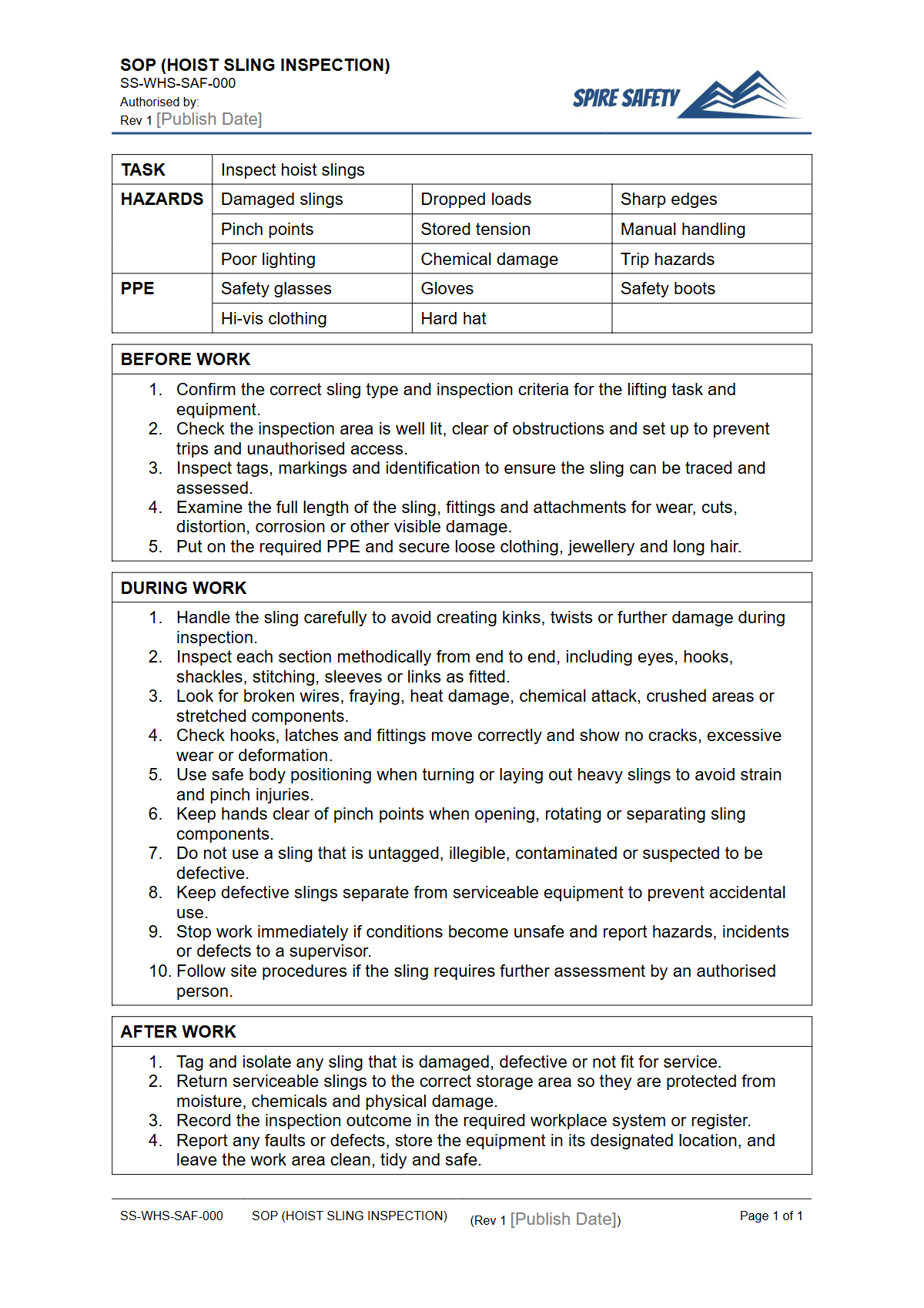
Lifting operations are inherently high-risk, and the failure of a hoist sling can have catastrophic consequences, including serious injury or fatality, and significant damage to equipment and property. This Free Safe Operating Procedure (Hoist Sling Inspection) Template provides a structured framework for conducting and documenting regular inspections of synthetic, chain, and wire rope slings.
Implementing a robust inspection process is a critical control measure for identifying wear, damage, or defects before they lead to failure. This SOP helps your organisation formalise its inspection process, ensuring every check is thorough, consistent, and recorded.
A well-documented SOP is a cornerstone of an effective safety program. It demonstrates a commitment to proactively managing risks associated with lifting gear.
This procedure outlines the steps for visual and tactile inspection, criteria for removing a sling from service, and record-keeping requirements. Formalising this process helps meet duties under WHS legislation and supports the development of safer workplace behaviours.
Integrating such procedures into your overarching safety framework is key; they should form part of your broader WHS management systems to ensure comprehensive risk control.
What this Safe Operating Procedure covers:
- Pre-use, periodic, and post-incident inspection requirements
- Specific inspection points for different sling types (synthetic, chain, wire rope)
- Clear criteria for sling rejection and removal from service
- Responsibilities of personnel conducting inspections
- Documentation and record-keeping protocols
Video walkthrough
How to use the Free Safe Operating Procedure (Hoist Sling Inspection) Template
This document is a downloadable template in both DOCX and PDF formats, designed as a solid starting point for your organisation. It is not a complete, ready-to-use document.
You must customise it to reflect the specific types of slings you use, the lifting equipment on your site, your operational environment, and your state or territory's WHS regulations. Effective safety procedures are never 'one size fits all'.
Important: We have drafted this template to align with the model WHS framework and common Australian industry practices. However, to make it effective and relevant, you must add your company name, specific site details, and the makes and models of equipment used.
You should also review it in consultation with your workers, supervisors, and any health and safety representatives. This collaborative approach ensures the final SOP is practical, understood, and followed by those performing the task. Just as this SOP is specific to slings, you'll need distinct procedures for major plant, which you can develop using resources like our FREE Telehandler SOP Template.
When to conduct hoist sling inspections
Regular and consistent inspection is the only way to ensure the ongoing integrity of lifting slings. The frequency and type of inspection should be based on risk and usage patterns. This SOP should be used in three main scenarios:
- Pre-use Checks: Before every lifting operation, the person using the sling must perform a quick visual and tactile inspection to identify any obvious damage or defects that may have occurred since its last use. This is a critical final check.
- Periodic Inspections: A competent person must conduct detailed, documented inspections at regular intervals. The frequency (e.g., monthly, quarterly) depends on factors like the frequency of use, the severity of service conditions, and regulatory requirements. These documented checks are often reviewed during WHS compliance auditing to verify that plant is being maintained correctly.
- Post-incident or Repair: If a sling has been involved in a shock-loading event, has been repaired, or is suspected of being damaged, it must be thoroughly inspected by a competent person and recertified before being returned to service.
Who should use this Safe Operating Procedure
This SOP is intended for several key roles within an organisation that performs lifting operations:
- Workers and Operators: Personnel who rig loads and operate hoisting equipment (e.g., crane operators, doggers, riggers) must be trained on this procedure to correctly perform pre-use checks.
- Supervisors and Team Leaders: Managers responsible for overseeing lifting operations must ensure that operators are following the SOP and that periodic inspections are being completed and documented as required.
- Competent Persons: Individuals with the knowledge and experience to conduct detailed periodic inspections will use this SOP as their guide. They are responsible for making the final call on whether a sling is safe for continued use or must be discarded.
- WHS Managers and Advisors: Safety professionals will use this template to develop and integrate a formalised inspection program into the company's overall safety management system, ensuring it aligns with other procedures for material handling, such as a Conveyer System SOP. They also use the documented outcomes for risk assessment and trend analysis.
By standardising your inspection process with this SOP, you empower your team to proactively identify hazards and maintain a safer work environment. For more templates and safety guides, browse our complete free WHS resources library.
Common mistakes
Common mistakes to avoid
- Using a damaged sling for 'one last lift', which is a leading cause of incidents.
- Failing to read and follow the manufacturer's specific instructions for inspection and use.
- Performing inspections but failing to create and retain a clear, dated record of the findings.
- Using the wrong type of sling for the load characteristics, such as using a webbing sling on a load with sharp edges without proper protection.
Legal references
Legal considerations
The following legal requirements may be relevant to this type of work.
- Work Health and Safety Act (Harmonised) — Provides the primary duties for protecting workers and other people from work health and safety risks.
- Work Health and Safety Regulations (Harmonised) — Sets out requirements supporting the management of workplace hazards and risks.
The following codes may be relevant to this type of work.
- Managing WHS Risks Code of Practice — Provides practical guidance on identifying hazards, assessing risks and applying effective controls.
- Work Health and Safety Consultation, Cooperation and Coordination Code of Practice — Provides practical guidance on consulting workers and coordinating with other duty holders.
- Managing the Work Environment and Facilities Code of Practice — Provides practical guidance on safe work environments, workplace facilities and related controls.
Did you know
Sling Angles Matter
The angle at which a sling is used in a multi-leg bridle lift significantly impacts its working load limit (WLL). A sling's capacity is rated for a vertical lift; as the angle from vertical increases, the actual capacity decreases dramatically.
Colour Coding for Capacity
While not universal for all sling types, many flat synthetic webbing slings follow a colour code to indicate their Working Load Limit (WLL). For example, a purple sling often indicates a 1-tonne WLL, green a 2-tonne WLL, and yellow a 3-tonne WLL.
FAQ
Frequently asked questions
01What should be included in a hoist sling inspection checklist?
02How often should lifting slings be inspected in Australia?
03Who is considered a competent person to inspect hoist slings?
04What are the common rejection criteria for synthetic webbing slings?
Share this resource
Free Safe Operating Procedure (Hoist Sling Inspection) Template
Browse Categories
How To Use It
- 1Download and open in Word or PDF.
- 2Replace the placeholders with your business details.
- 3Get it reviewed by a WHS specialist before rollout.
Need it customised?
Our WHS consultants can adapt this template to your site, run a gap analysis, or audit what you already have in place.
Book a Free Consultation WHS consulting servicesor call 1300 156 382
Related templates
- Free Safe Operating Procedure (Hoist Sling Laundering) Template
- Free Safe Operating Procedure (Holiday Detector) Template
- Free Safe Operating Procedure (Hopper Cleaning) Template
- Free Safe Operating Procedure (Horizontal Lifeline) Template
- Free Safe Operating Procedure (Horse Feeding) Template
- Free Safe Operating Procedure (Horse Stable Cleaning) Template