
Free Safe Operating Procedure (Holiday Detector) Template
Download our Free Safe Operating Procedure for Holiday Detectors. This template helps document the safe work methods for non-destructive coating inspection.
Free Safe Operating Procedure (Holiday Detector) Template
DOCX • 126 KB + PDF
Updated Oct 2026
No signup required
Purpose of the Free Safe Operating Procedure (Holiday Detector) Template
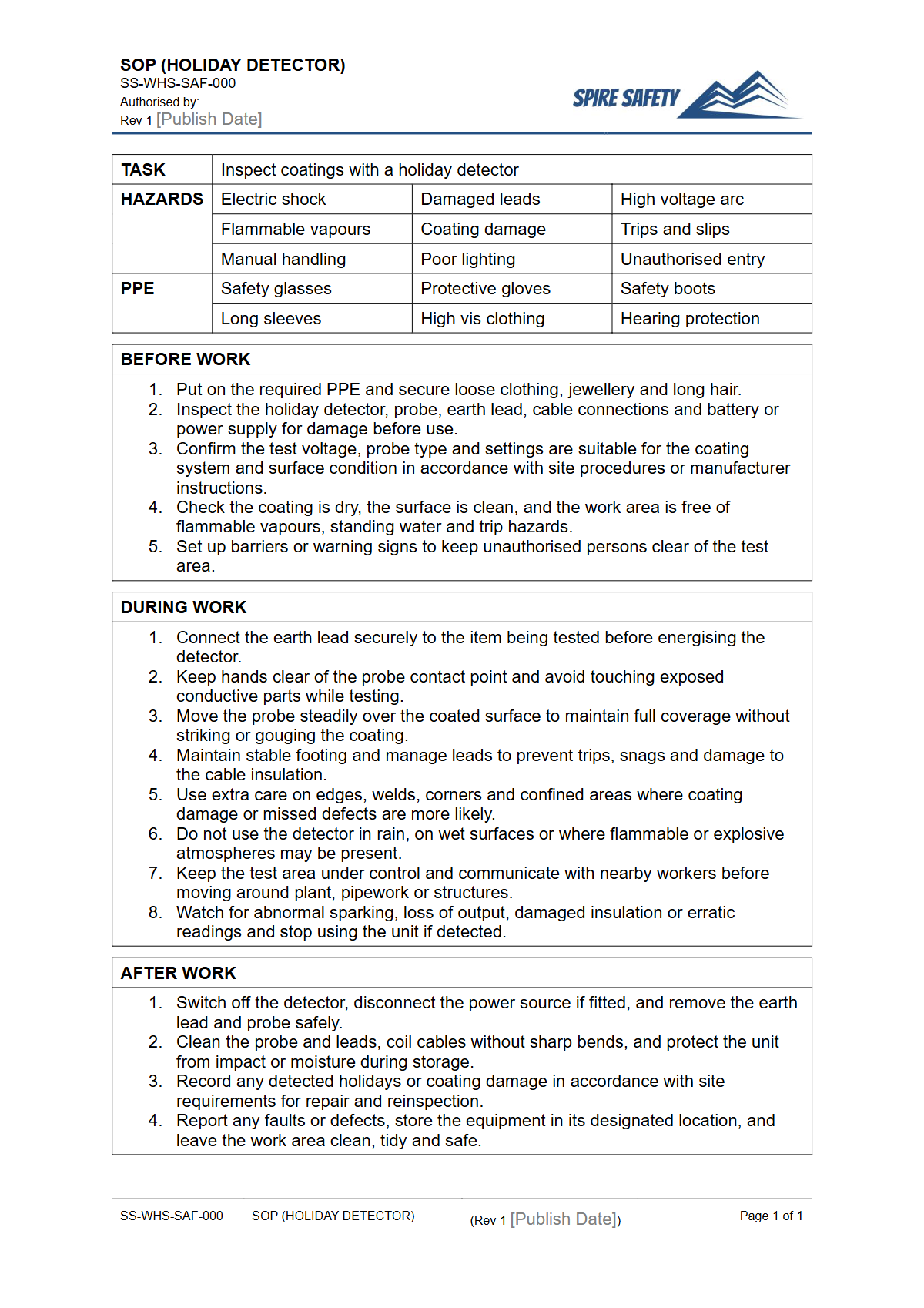
This Free Safe Operating Procedure (Holiday Detector) Template provides a structured framework for documenting the safe use of high-voltage holiday detectors. These devices are essential for quality assurance in the protective coatings industry, used to identify pinholes, voids, or 'holidays' in non-conductive coatings applied to conductive substrates like steel.
Operating a holiday detector involves exposure to high-voltage electricity, making a formal, documented procedure a critical control measure. This SOP is designed to help you outline key safety requirements, from pre-start checks and correct personal protective equipment (PPE) to operational steps and emergency procedures.
A Safe Operating Procedure (SOP) is a vital administrative control that forms part of a broader safety framework. By clearly defining the approved method for performing a task, you standardise safe work practices and provide a clear reference for training and supervision.
Integrating this document into a comprehensive WHS management system helps demonstrate your organisation's commitment to managing risks and ensuring worker safety.
Video walkthrough
How to use the Free Safe Operating Procedure (Holiday Detector) Template
This document is provided as a starting point. To make it effective, you must customise it to reflect the specific equipment, environment, and processes in your workplace.
Download the DOCX file and adapt the sections to align with your site's risk assessments, the manufacturer's instructions for your specific holiday detector model, and relevant Australian Standards.
When customising, involve workers who operate the equipment. Their practical experience is invaluable for creating a procedure that is both safe and workable.
Pay close attention to specifying the exact types of PPE required, such as electrically insulated gloves and footwear, and detail the procedure for verifying the tester's voltage output. Remember, this document must be reviewed and approved by a competent person within your organisation before being implemented.
A well-written SOP for a specific tool, similar to our free Circular Saw SOP, ensures that all operators follow the same verified, safe process.
Important: This is a template only. We are not a law firm and the information is not legal advice.
You must adapt this document to your specific circumstances. A generic template cannot cover all hazards or control measures relevant to your business.
Regular reviews and updates are essential, especially if processes or equipment change. Undertaking a WHS compliance audit can help identify gaps in your documentation and safety systems.
When to use a Safe Operating Procedure
A Safe Operating Procedure for a holiday detector should be used consistently whenever the equipment is in operation. It serves several key functions throughout the equipment's lifecycle at a workplace.
It is a primary training document for new operators, ensuring they learn the correct, safe methodology from the outset. It also acts as a crucial reference tool for experienced workers, helping to prevent complacency and procedural drift over time.
This SOP should be readily accessible in the work area, whether as a hard copy or digitally. It is particularly important during tasks involving the quality control of new coatings on pipelines, tanks, structural steel, or other assets where coating integrity is critical for corrosion protection.
Having clear procedures is essential for high-risk equipment, just as it is for other machinery on site; you can find other examples like our free Air Compressor SOP in our resources library.
Who should use this Safe Operating Procedure
This Safe Operating Procedure should be used by several key roles within an organisation. The primary users are the operators themselves—the individuals tasked with performing holiday detection tests.
They must be trained on the contents of the SOP and deemed competent before operating the equipment unsupervised. Supervisors and team leaders must also be familiar with the procedure to effectively oversee work, supports your compliance efforts, and intervene if they observe unsafe practices.
WHS managers and safety officers will use this document as part of their safety management system. They are often responsible for developing, reviewing, and updating SOPs in consultation with workers and management.
Finally, trainers can use the SOP as a foundational text for their training programs, ensuring all workers receive consistent and accurate safety information. The development of robust SOPs for specialised equipment, like those detailed in this document or our free Trencher SOP template, is a cornerstone of proactive risk management.
If you require assistance in developing customised, site-specific documentation, our WHS consulting services can provide expert guidance.
You can browse our complete free WHS resources library for more templates and checklists to support your safety management system.
Common mistakes
Common mistakes to avoid
- Setting an incorrect test voltage (too high or too low) for the coating thickness, leading to coating damage or missed defects.
- Failing to ensure the instrument and the substrate under test are properly earthed, creating a significant electric shock hazard.
- Moving the electrode probe too quickly across the surface, which can miss small pinhole defects.
- Neglecting to wear or inspect appropriate PPE, particularly electrically-rated insulating gloves and footwear.
Legal references
Legal considerations
The following legal requirements may be relevant to this type of work.
- Work Health and Safety Act (Harmonised) — Provides the primary duties for protecting workers and other people from work health and safety risks.
- Work Health and Safety Regulations (Harmonised) — Sets out requirements supporting the management of workplace hazards and risks.
The following codes may be relevant to this type of work.
- Managing WHS Risks Code of Practice — Provides practical guidance on identifying hazards, assessing risks and applying effective controls.
- Work Health and Safety Consultation, Cooperation and Coordination Code of Practice — Provides practical guidance on consulting workers and coordinating with other duty holders.
- Managing the Work Environment and Facilities Code of Practice — Provides practical guidance on safe work environments, workplace facilities and related controls.
Did you know
What's in a Name?
The term 'holiday' in this context dates back to when painters would take a day off, leaving a spot unfinished. In coating inspection, a 'holiday' is a missed spot or discontinuity in the protective film.
Voltage vs. Thickness
The test voltage for a holiday detector isn't arbitrary. It's calculated based on the coating's thickness and insulating properties, often using formulas like the one found in Australian Standard AS 3894.1 to ensure an accurate test without damaging the coating.
FAQ
Frequently asked questions
01What is a holiday detector used for in a WHS context?
02What are the main hazards of using a high-voltage holiday detector?
03Is specific training required to operate a holiday detector?
04How do you set the correct voltage on a holiday detector?
Share this resource
Free Safe Operating Procedure (Holiday Detector) Template
Browse Categories
How To Use It
- 1Download and open in Word or PDF.
- 2Replace the placeholders with your business details.
- 3Get it reviewed by a WHS specialist before rollout.
Need it customised?
Our WHS consultants can adapt this template to your site, run a gap analysis, or audit what you already have in place.
Book a Free Consultation WHS consulting servicesor call 1300 156 382
Related templates
- Free Safe Operating Procedure (Hopper Cleaning) Template
- Free Safe Operating Procedure (Horizontal Lifeline) Template
- Free Safe Operating Procedure (Horse Feeding) Template
- Free Safe Operating Procedure (Horse Stable Cleaning) Template
- Free Safe Operating Procedure (Horticultural Grafting) Template
- Free Safe Operating Procedure (Hose Blowout) Template