
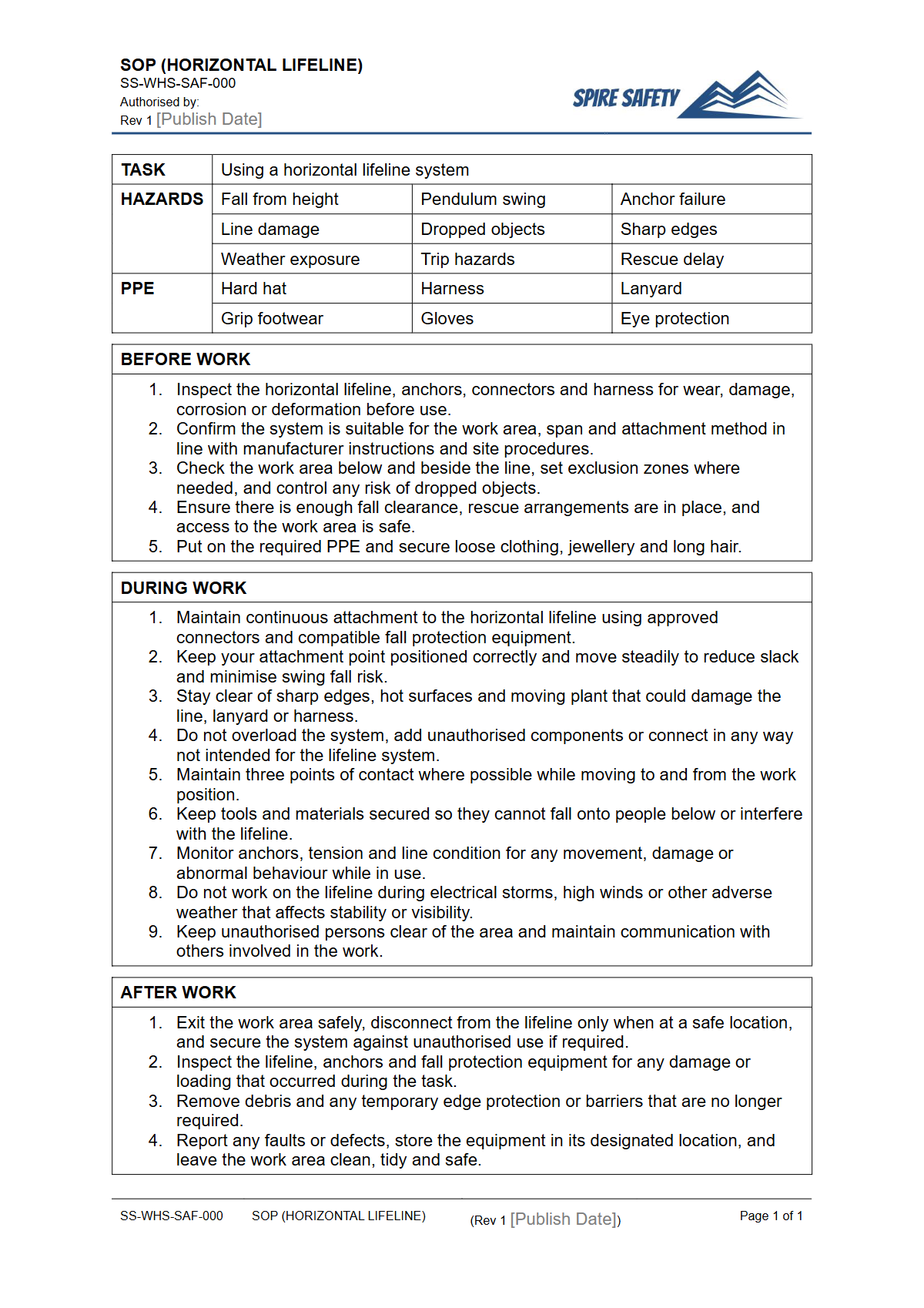
Free Safe Operating Procedure (Horizontal Lifeline) Template
Download our free Safe Operating Procedure (Horizontal Lifeline) template to manage risks associated with working at heights. Get your customisable DOCX now.
Free Safe Operating Procedure (Horizontal Lifeline) Template
DOCX • 126 KB + PDF
Updated Oct 2026
No signup required
Purpose of the Free Safe Operating Procedure (Horizontal Lifeline) Template
Working at heights is a high-risk activity that requires robust safety controls. This free Safe Operating Procedure (Horizontal Lifeline) template provides a structured starting point for documenting the safe use of temporary horizontal lifeline systems in your workplace.
It guides you in outlining key steps for installation, pre-use checks, safe operation, and dismantling, helping to ensure a consistent and safe approach every time. Using a clear SOP helps workers and supervisors identify potential hazards, understand their responsibilities, and implement the necessary control measures to prevent falls.
A well-defined SOP is a critical tool for any organisation that performs tasks requiring horizontal mobility at height. It serves as a practical guide for training and competency verification, and forms an essential part of your site's safety documentation.
Integrating this procedure into your operations demonstrates a commitment to proactively managing one of the most significant risks in construction and maintenance industries. It is a fundamental part of a hierarchy of controls and should be supported by broader WHS management systems that govern all high-risk work.
Video walkthrough
How to use the Free Safe Operating Procedure (Horizontal Lifeline) Template
This template is available for immediate download in both DOCX and PDF formats. The DOCX version is fully editable, allowing you to tailor it to your specific operational needs.
Simply download the file and open it in your preferred word processor to add, remove, or modify sections to align with your equipment and environment.
Important: This document is a template, not a finished procedure. To be effective, you must customise it to reflect the unique conditions of your workplace.
We have provided a comprehensive framework, but it is your responsibility to incorporate site-specific information, including the makes and models of lifeline systems used, specific anchor point details, unique environmental hazards, and emergency rescue plans. The final document should be reviewed and approved by a competent person within your organisation before being implemented.
When to use a Horizontal Lifeline SOP
A Safe Operating Procedure for horizontal lifelines should be developed and used before any work begins that involves this type of fall protection system. It is essential for tasks where workers need to move across a horizontal plane at height and where continuous attachment is required. Common scenarios include:
- Roof installation, inspection, and maintenance
- Working on top of large vehicles, aircraft, or plant
- Structural steel erection and construction
- Maintenance on overhead cranes or gantries
- Leading-edge work on commercial and industrial building sites
The SOP should be a core part of the pre-start process for such tasks, reviewed by all team members involved to ensure everyone understands the required safety protocols. As with other high-risk tasks, such as those requiring an SOP for a telehandler, having a documented procedure is key to managing risk.
Who should use this Safe Operating Procedure
This SOP is intended for use by multiple roles within an organisation to ensure a holistic approach to safety.
- Workers: Individuals who install, use, or dismantle horizontal lifeline systems must be trained on the procedure and follow it strictly. They are responsible for conducting pre-use checks and reporting any defects.
- Supervisors and Team Leaders: These individuals are responsible for ensuring that the SOP is implemented on-site, that workers are competent to perform the task, and that all required equipment is available and in good condition.
- WHS Managers and Safety Officers: They are responsible for developing, reviewing, and updating the SOP. This includes ensuring it aligns with current regulations, codes of practice, and Australian Standards. Regular reviews can be supported by periodic WHS compliance auditing.
Ultimately, anyone involved in the planning, supervision, or execution of work using horizontal lifelines should be familiar with this procedure. Its effectiveness depends on consistent application by competent personnel.
Similar to how an Air Compressor SOP requires specific knowledge, working with fall protection systems demands specialised training. For more examples, you can explore our full library of free WHS resources.
Common mistakes
Common mistakes to avoid
- Using non-rated or makeshift components instead of a complete, engineered system.
- Failing to correctly calculate the total fall clearance distance, including lifeline sag.
- Attaching more users to the lifeline than it is rated for.
- Neglecting regular documented inspections by a competent person as per manufacturer requirements.
Legal references
Legal considerations
The following legal requirements may be relevant to this type of work.
- Work Health and Safety Act (Harmonised) — Provides the primary duties for protecting workers and other people from work health and safety risks.
- Work Health and Safety Regulations (Harmonised) — Sets out requirements supporting the management of workplace hazards and risks.
The following codes may be relevant to this type of work.
- Managing WHS Risks Code of Practice — Provides practical guidance on identifying hazards, assessing risks and applying effective controls.
- Work Health and Safety Consultation, Cooperation and Coordination Code of Practice — Provides practical guidance on consulting workers and coordinating with other duty holders.
- Managing the Work Environment and Facilities Code of Practice — Provides practical guidance on safe work environments, workplace facilities and related controls.
Did you know
System Deflection
Horizontal lifelines are designed to stretch or deflect during a fall to absorb energy. This sag must be calculated and factored into the required fall clearance to prevent the worker from hitting a lower level or obstruction.
Engineered Systems
Unlike a single anchor point, a temporary horizontal lifeline is a complex engineered system. Its safety depends on precise calculations for span distance, anchor point strength, number of users, and potential sag to ensure it performs correctly during a fall.
FAQ
Frequently asked questions
01What should be included in a horizontal lifeline SOP?
02How often should a horizontal lifeline system be inspected?
03Is a Safe Operating Procedure a legal requirement for horizontal lifelines in Australia?
04Can any worker install a temporary horizontal lifeline?
Share this resource
Free Safe Operating Procedure (Horizontal Lifeline) Template
Browse Categories
How To Use It
- 1Download and open in Word or PDF.
- 2Replace the placeholders with your business details.
- 3Get it reviewed by a WHS specialist before rollout.
Need it customised?
Our WHS consultants can adapt this template to your site, run a gap analysis, or audit what you already have in place.
Book a Free Consultation WHS consulting servicesor call 1300 156 382
Related templates
- Free Safe Operating Procedure (Horse Feeding) Template
- Free Safe Operating Procedure (Horse Stable Cleaning) Template
- Free Safe Operating Procedure (Horticultural Grafting) Template
- Free Safe Operating Procedure (Hose Blowout) Template
- Free Safe Operating Procedure (Hose Crimp Machine) Template
- Free Safe Operating Procedure (Hose Cutoff Saw) Template