
Free Safe Operating Procedure (Hose Cutoff Saw) Template
Download our free Safe Operating Procedure (Hose Cutoff Saw) template. This customisable document helps outline safe work practices for your team.
Free Safe Operating Procedure (Hose Cutoff Saw) Template
DOCX • 126 KB + PDF
Updated Oct 2026
No signup required
Purpose of the Free Safe Operating Procedure (Hose Cutoff Saw) Template
A hose cutoff saw is a powerful tool used in many workshops for cutting hydraulic, industrial, and other types of reinforced hoses. While efficient, it presents significant hazards, including high-speed abrasive wheels, sparks, noise, and respiratory risks from dust and fumes.
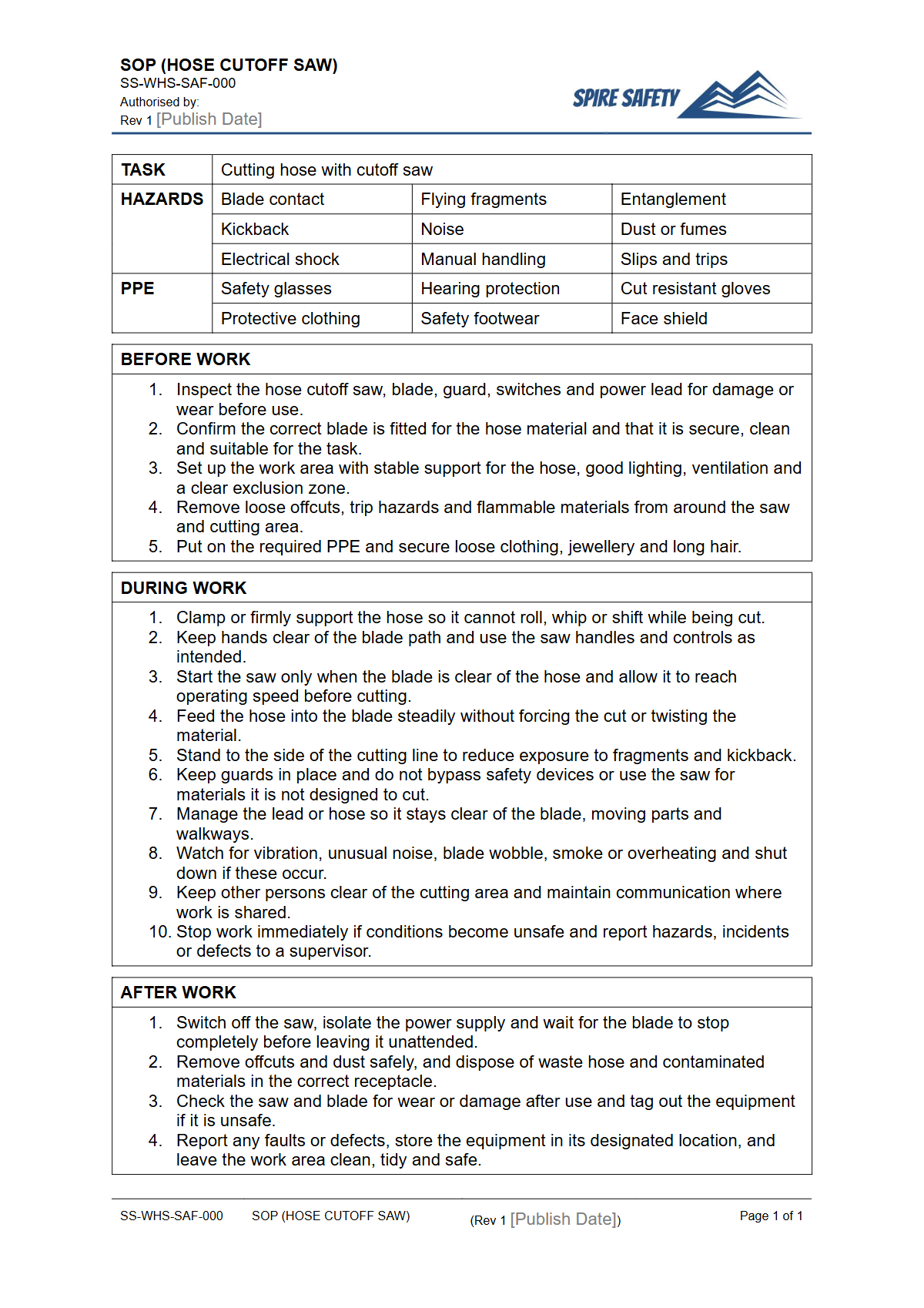
This free Safe Operating Procedure (Hose Cutoff Saw) template provides a structured starting point for documenting the required steps to operate this equipment safely. It is designed to help organisations control risks and guide workers through pre-operational checks, safe operation, and post-use shutdown processes.
Developing clear, task-specific SOPs is a fundamental aspect of effective workplace safety. These documents form a critical part of your overall WHS management systems, demonstrating a commitment to providing a safe work environment.
A well-drafted SOP for a hose cutoff saw helps ensure that all operators, regardless of experience, follow a consistent, approved method that minimises risk to themselves and others.
What's included in the template?
- A section for outlining required Personal Protective Equipment (PPE).
- A step-by-step pre-operational safety checklist.
- A sequence for the safe operation of the saw.
- Post-operational procedures for shutdown and cleaning.
- A field for emergency procedures.
Video walkthrough
How to use the Free Safe Operating Procedure (Hose Cutoff Saw) Template
This document is a template, not a finished procedure. To be effective, it must be customised to reflect the specific equipment and environment in your workplace.
Download the DOCX file and consult with operators, supervisors, and safety personnel to fill in the details. You should conduct a site-specific risk assessment for the task of cutting hoses and incorporate your findings and control measures directly into the SOP.
Important Note: We have developed this template as a guide based on the model WHS framework and common industry practices. You must adapt it to the unique context of your workplace, including the specific make and model of your saw, the types of hoses being cut, and your operational environment.
If you need assistance with risk assessments or implementing safety documentation, consider engaging professional WHS consulting services.
To ensure consistency across your documentation, it's good practice to review procedures for other workshop tools. For example, the principles of machine guarding and pre-start checks are also central to our FREE Circular Saw SOP template.
When to use it
A Safe Operating Procedure for a hose cutoff saw should be a readily accessible document used in several key situations. It serves as the primary training document for new operators, ensuring they learn the correct, safe method from the outset.
It is also an essential on-the-job reference for experienced workers to refresh their knowledge, particularly regarding pre-start checks and emergency responses. This SOP should also be reviewed during incident investigations or when a process is changed, such as the introduction of a new type of hose or saw blade.
Many workshops use a variety of powered equipment, and it's vital to have clear procedures for all of them. For instance, the energy source for many tools is managed through a documented process, similar to what is outlined in our Free Air Compressor SOP.
Who should use it
This SOP template is designed for use by several key roles within an organisation:
- PCBU/Employers: To meet their duty of care by providing a documented safe system of work.
- WHS Managers and Safety Officers: As a tool for standardising procedures, managing risk, and facilitating training and compliance activities.
- Supervisors and Team Leaders: To train workers, conduct competency assessments, and monitor that safe work practices are being followed consistently.
- Operators: As a clear, step-by-step guide for performing their work safely every time.
Supervisors responsible for a wide range of machinery, from workshop tools to mobile plant, can use these documents to build a comprehensive safety library. Having clear procedures for all equipment, including for items covered by our FREE Telehandler SOP Template, helps create a robust and proactive safety culture. You can browse our complete free WHS resources library for more templates to support your safety management system.
Common mistakes
Common mistakes to avoid
- Using a cracked, damaged, or incorrect type of abrasive wheel for the hose material.
- Failing to properly secure the hose in the clamp before starting the cut.
- Neglecting to inspect the saw before use, especially the condition and position of the guards.
- Operating the saw in a messy area or near flammable liquids, vapours, or combustible dusts.
Legal references
Legal considerations
The following legal requirements may be relevant to this type of work.
- Work Health and Safety Act (Harmonised) — Provides the primary duties for protecting workers and other people from work health and safety risks.
- Work Health and Safety Regulations (Harmonised) — Sets out requirements supporting the management of workplace hazards and risks.
The following codes may be relevant to this type of work.
- Managing WHS Risks Code of Practice — Provides practical guidance on identifying hazards, assessing risks and applying effective controls.
- Work Health and Safety Consultation, Cooperation and Coordination Code of Practice — Provides practical guidance on consulting workers and coordinating with other duty holders.
- Managing the Work Environment and Facilities Code of Practice — Provides practical guidance on safe work environments, workplace facilities and related controls.
Did you know
Abrasive Wheel Speed
Abrasive wheels on cutoff saws can spin at speeds exceeding 100 metres per second. A small, undetected crack can cause the wheel to explode violently, which is why pre-start inspection is critical.
Hot Work Risk
Sparks from a hose cutoff saw can travel several metres and easily ignite flammable materials. This classifies the task as 'hot work' in many environments, often requiring a specific permit and a fire watch.
FAQ
Frequently asked questions
01What are the main hazards of using a hose cutoff saw?
02Is specific PPE mandatory when operating a hose cutoff saw?
03How often should a Safe Operating Procedure for a hose cutoff saw be reviewed?
04Can this template be used for other types of cutting equipment like drop saws or angle grinders?
Share this resource
Free Safe Operating Procedure (Hose Cutoff Saw) Template
Browse Categories
How To Use It
- 1Download and open in Word or PDF.
- 2Replace the placeholders with your business details.
- 3Get it reviewed by a WHS specialist before rollout.
Need it customised?
Our WHS consultants can adapt this template to your site, run a gap analysis, or audit what you already have in place.
Book a Free Consultation WHS consulting servicesor call 1300 156 382
Related templates
- Free Safe Operating Procedure (Hose Flushing) Template
- Free Safe Operating Procedure (Hose Reel Use) Template
- Free Safe Operating Procedure (Hose Skiving Machine) Template
- Free Safe Operating Procedure (Hospital Bed Movement) Template
- Free Safe Operating Procedure (Hospital Cot Cleaning) Template
- Free Safe Operating Procedure (Hot Air Welder) Template