
Free Safe Operating Procedure (Hospital Bed Movement) Template
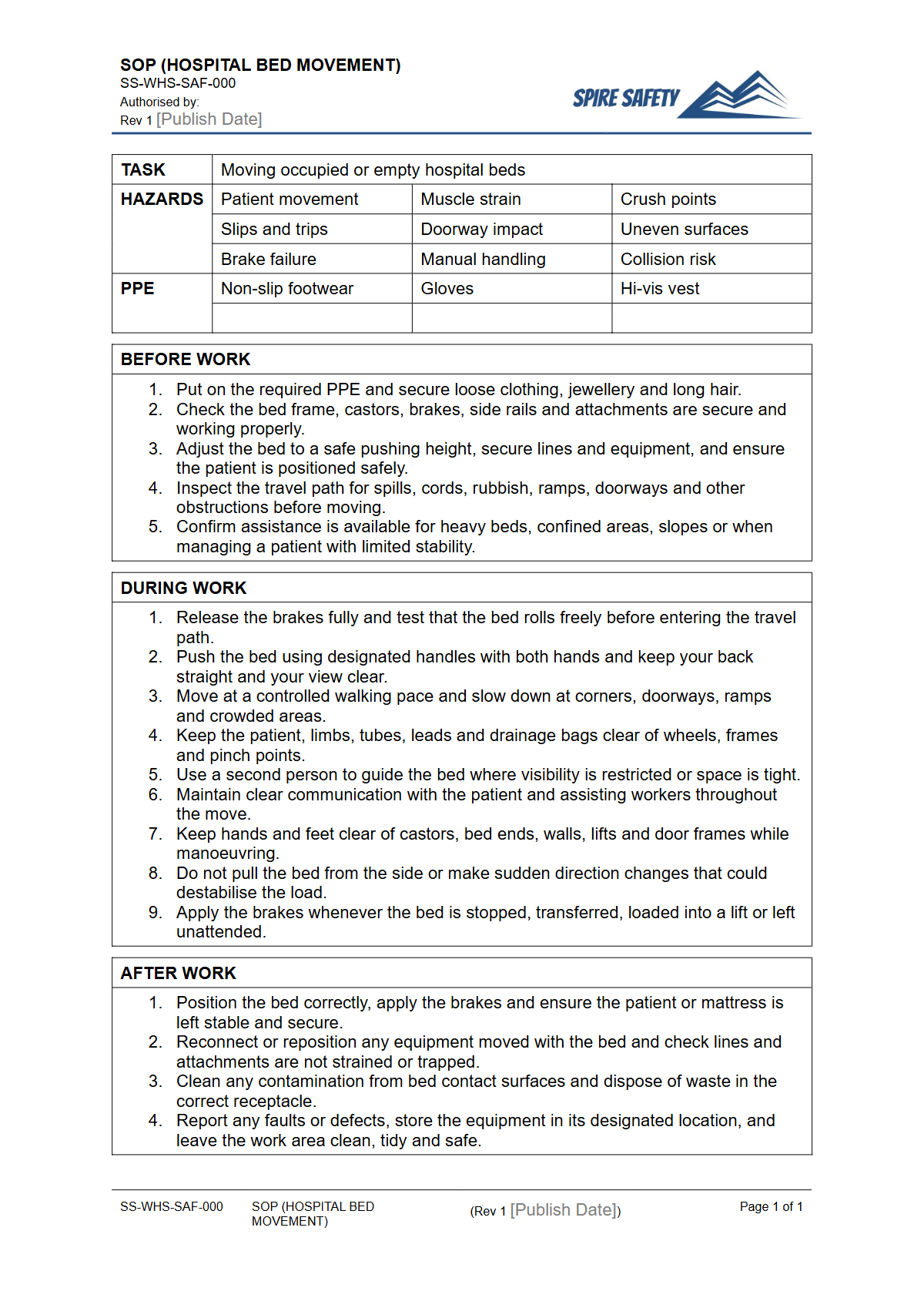
Standardise the safe movement of hospital beds to prevent musculoskeletal injuries. Download our free Safe Operating Procedure template to get started.
Free Safe Operating Procedure (Hospital Bed Movement) Template
DOCX • 126 KB + PDF
Updated Oct 2026
No signup required
Purpose of the Free Safe Operating Procedure (Hospital Bed Movement) Template
Moving hospital beds is a frequent yet high-risk task in any healthcare setting. This task exposes healthcare workers to significant manual handling hazards, leading to musculoskeletal injuries (MSIs) such as back, neck, and shoulder strains.
Our Free Safe Operating Procedure (Hospital Bed Movement) Template provides a structured framework for documenting the required steps to perform this task safely. By implementing a clear SOP, your organisation can standardise procedures, reduce the risk of injury to staff and patients, and ensure consistent training for all personnel.
A well-defined SOP is a critical component of effective WHS management systems. It demonstrates a commitment to managing foreseeable risks and provides a clear reference point for workers, supervisors, and managers. This template helps formalise pre-operational checks, the step-by-step process for moving the bed, and post-movement safety actions, creating a safer environment for everyone.
Video walkthrough
How to use the Free Safe Operating Procedure (Hospital Bed Movement) Template
This resource is available for download as both a DOCX file for easy editing and a PDF for straightforward printing and distribution. The template is designed as a comprehensive starting point, pre-filled with common steps and safety considerations aligned with Australian WHS principles.
To make it effective, you must adapt it to your specific operational context.
This template provides a solid foundation, but you must customise it to reflect the specific equipment, environment, and procedures in your workplace. We've included prompts to guide your input.
Consider factors like different types of hospital beds (e.g., electric, manual, bariatric), facility layout (including corridors, lifts, and ramps), patient conditions, and required personnel for each type of movement. If you require assistance with risk assessments or tailoring procedures, consider our expert WHS consulting services.
When to use this Safe Operating Procedure
This Safe Operating Procedure should be the standard protocol for any non-emergency movement of a hospital bed within your facility. It provides clear guidance for common scenarios and ensures that safety checks are consistently performed. Key situations where this SOP should be applied include:
- Transferring a patient from one room or ward to another.
- Moving a bed to or from a specialised department, such as radiology or surgery.
- Relocating an empty bed for cleaning, maintenance, or storage.
- Positioning a bed within a patient's room to facilitate care or access.
For some maintenance tasks, additional procedures may be required. For example, maintaining equipment that supports the bed or other facility assets might involve its own set of risks, similar to the process outlined in our free Air Compressor SOP.
Who should use this Safe Operating Procedure
This SOP is intended for all personnel who may be required to move a hospital bed as part of their duties. Proper training on the finalised procedure is essential to ensure its effectiveness. Individuals who should be familiar with and adhere to this SOP include:
- Nurses and Nursing Assistants
- Patient Care Assistants (PCAs)
- Orderlies and Porters
- Environmental Services (Cleaning) Staff
- Maintenance and Biomedical Engineering Personnel
- Any other worker tasked with bed transportation
Supervisors and managers are responsible for ensuring staff are trained, competent, and consistently follow the procedure. The effectiveness of this SOP and others should be reviewed periodically through processes like WHS compliance auditing to identify any gaps or opportunities for improvement. For more templates and safety guides, explore our complete free WHS resources library.
Common mistakes
Common mistakes to avoid
- Moving a bed alone when the risk assessment calls for two people.
- Forgetting to check and clear the entire travel path before starting.
- Failing to lock the bed and wheel brakes before and after movement.
- Pushing the bed from the side or pulling it from the front, rather than pushing from the headboard with good posture.
Legal references
Legal considerations
The following legal requirements may be relevant to this type of work.
- Work Health and Safety Act (Harmonised) — Provides the primary duties for protecting workers and other people from work health and safety risks.
- Work Health and Safety Regulations (Harmonised) — Sets out requirements supporting the management of workplace hazards and risks.
The following codes may be relevant to this type of work.
- Managing WHS Risks Code of Practice — Provides practical guidance on identifying hazards, assessing risks and applying effective controls.
- Work Health and Safety Consultation, Cooperation and Coordination Code of Practice — Provides practical guidance on consulting workers and coordinating with other duty holders.
- Managing the Work Environment and Facilities Code of Practice — Provides practical guidance on safe work environments, workplace facilities and related controls.
Did you know
A Heavy Toll
The Healthcare and Social Assistance industry has one of the highest rates of serious workers' compensation claims in Australia, with body stressing and manual handling being major causes.
FAQ
Frequently asked questions
01Why is an SOP specifically for moving hospital beds needed?
02What are the key hazards in hospital bed movement?
03Who is responsible for ensuring staff are trained on this SOP?
04How often should a hospital bed movement SOP be reviewed?
Share this resource
Free Safe Operating Procedure (Hospital Bed Movement) Template
Browse Categories
How To Use It
- 1Download and open in Word or PDF.
- 2Replace the placeholders with your business details.
- 3Get it reviewed by a WHS specialist before rollout.
Need it customised?
Our WHS consultants can adapt this template to your site, run a gap analysis, or audit what you already have in place.
Book a Free Consultation WHS consulting servicesor call 1300 156 382
Related templates
- Free Safe Operating Procedure (Hospital Cot Cleaning) Template
- Free Safe Operating Procedure (Hot Air Welder) Template
- Free Safe Operating Procedure (Hot Display Cabinet) Template
- Free Safe Operating Procedure (Hot Melt Applicator) Template
- Free Safe Operating Procedure (Hot Oil Filtering) Template
- Free Safe Operating Procedure (Hot Plate) Template