
Free Safe Operating Procedure (Hospital Cot Cleaning) Template
Establish a clear process for cleaning hospital cots to prevent cross-contamination and ensure patient safety. Download our free template to get started.
Free Safe Operating Procedure (Hospital Cot Cleaning) Template
DOCX • 126 KB + PDF
Updated Oct 2026
No signup required
Purpose of the Free Safe Operating Procedure (Hospital Cot Cleaning) Template
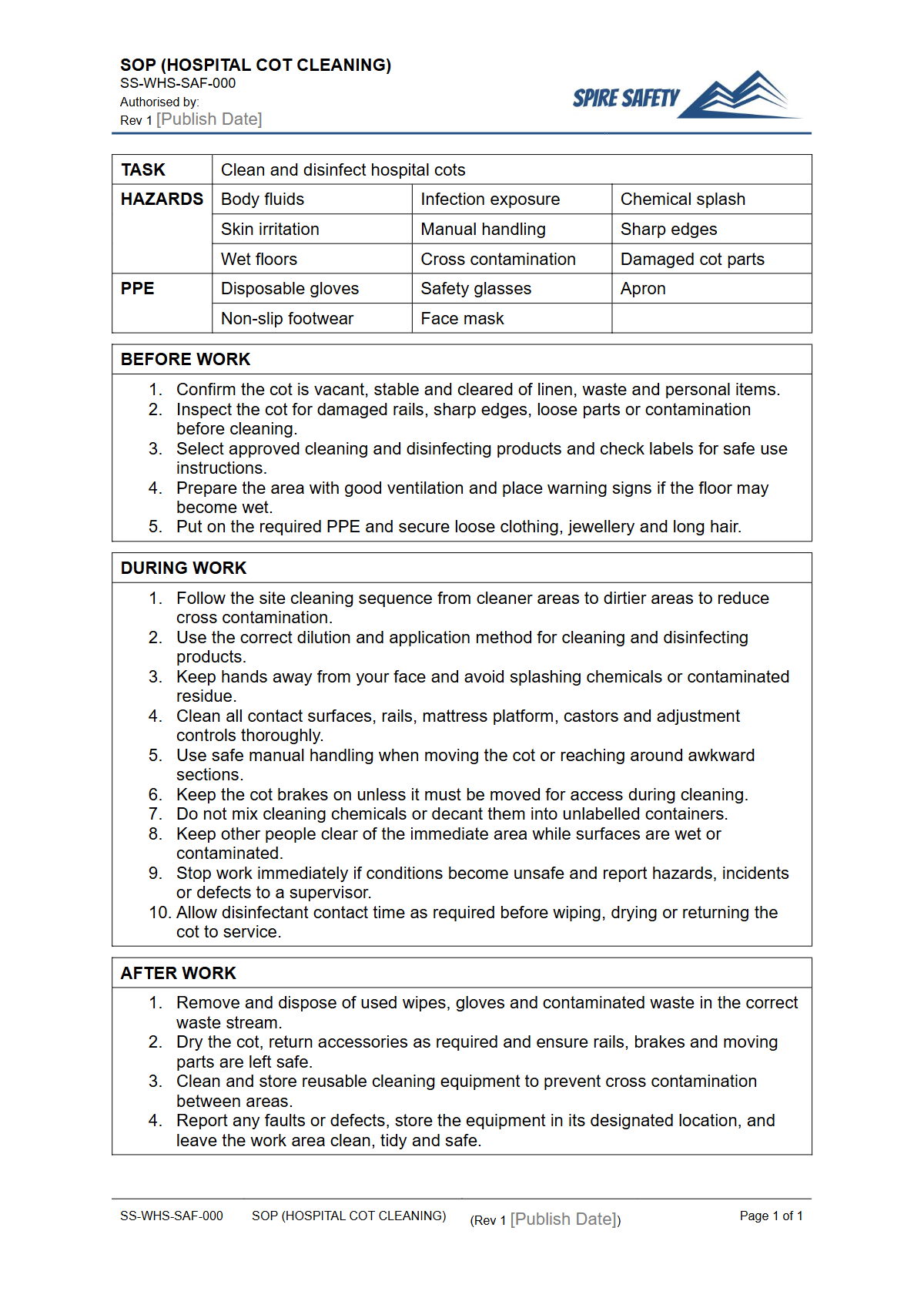
A structured approach to cleaning and disinfecting medical equipment is fundamental to patient and worker safety in any healthcare setting. This Free Safe Operating Procedure (Hospital Cot Cleaning) Template provides a clear, step-by-step framework for your organisation to follow.
The primary purpose is to standardise the cleaning process, minimising the risk of healthcare-associated infections (HAIs) by ensuring every cot is disinfected effectively between patients. It also addresses worker safety by outlining hazards associated with manual handling and the use of cleaning chemicals.
Implementing a formal SOP helps demonstrate your commitment to a safe environment and forms a critical part of your infection control program. By documenting the correct procedure, you create a reliable reference for training, competency assessment, and quality audits.
This document is an essential tool within broader comprehensive WHS management systems, helping to ensure consistent and safe work practices are maintained across all shifts and departments.
Video walkthrough
How to use the Free Safe Operating Procedure (Hospital Cot Cleaning) Template
This downloadable template is provided in both DOCX and PDF formats, designed for easy customisation. After downloading, you must adapt the document to reflect the specific context of your healthcare facility.
This involves consulting with environmental services staff, infection control practitioners, and WHS representatives to ensure the procedure is practical and effective for your workplace.
Important: You must customise this template to your specific workplace. We have no way of knowing your site's unique hazards, equipment, or chemical products.
Generic procedures are not sufficient to manage risk; your SOP must detail your exact processes and safety controls.
Key Customisation Steps:
- Identify Specific Equipment: List the models of hospital cots and beds the procedure applies to, noting any unique features or cleaning requirements.
- Specify Chemicals: Name the exact hospital-grade disinfectants and cleaning agents used. Include details from their Safety Data Sheets (SDS), such as dilution ratios, required contact (dwell) times, and first aid measures.
- Detail PPE Requirements: List the specific Personal Protective Equipment (PPE) required, such as gloves, eye protection, or gowns, based on a risk assessment of the task and chemicals involved.
- Outline the Step-by-Step Process: Methodically write out the entire process from preparing the area to final inspection of the cleaned cot. Use clear, simple language.
- Emergency Procedures: Include instructions for handling chemical spills, accidental exposure, or what to do if a cot is found to be heavily contaminated.
By following these steps, you can transform this template into a robust, site-specific document. This process is similar for developing procedures for other equipment, such as when creating a Safe Operating Procedure for a deep fryer in a hospital kitchen, where specific product and safety details are crucial.
When to use this Safe Operating Procedure
This Safe Operating Procedure should be the primary reference document for all routine and terminal cleaning of hospital cots. It is used whenever a patient is discharged or transferred, preparing the cot for the next admission.
It also applies during 'terminal cleans' when a room is fully disinfected after a patient with a known infectious condition has vacated it. Furthermore, the SOP should be integrated into your induction program for all new environmental services staff, nurses, and patient care assistants responsible for equipment cleaning.
It also serves as a benchmark for conducting regular workplace inspections and safety audits.
Who should use this Safe Operating Procedure
The primary users of this SOP are the frontline workers directly responsible for cleaning and disinfection tasks. This typically includes staff from environmental services or housekeeping departments, as well as porters, patient care assistants, and nursing staff in some facilities.
Supervisors and department managers must use the document to train their teams, monitor compliance, and ensure standards are met consistently. WHS managers and infection control practitioners will also use the SOP as a key control measure in risk assessments and incident investigations.
If your organisation requires assistance in adapting this document or developing others, our professional WHS consulting services can provide expert guidance.
A well-defined SOP is just one of many essential documents for managing workplace safety. Similar procedural documents are required for various plant and equipment.
For instance, many large hospitals use machinery for maintenance or logistics that also require documented procedures, such as a free Air Compressor SOP for the facilities management team. You can find more templates and checklists in our complete free WHS resources library to help build out your safety documentation.
Common mistakes
Common mistakes to avoid
- Using the template without customising it for specific hospital-approved disinfectants.
- Failing to train staff on the finalised SOP and verify their understanding of the steps.
- Neglecting to specify and enforce the correct contact (dwell) times for disinfectants.
- Not reviewing or updating the SOP after an infection control incident or a change in cleaning products.
Legal references
Legal considerations
The following legal requirements may be relevant to this type of work.
- Work Health and Safety Act (Harmonised) — Provides the primary duties for protecting workers and other people from work health and safety risks.
- Work Health and Safety Regulations (Harmonised) — Sets out requirements supporting the management of workplace hazards and risks.
The following codes may be relevant to this type of work.
- Managing WHS Risks Code of Practice — Provides practical guidance on identifying hazards, assessing risks and applying effective controls.
- Work Health and Safety Consultation, Cooperation and Coordination Code of Practice — Provides practical guidance on consulting workers and coordinating with other duty holders.
- Managing the Work Environment and Facilities Code of Practice — Provides practical guidance on safe work environments, workplace facilities and related controls.
Did you know
Infection Control
Healthcare-associated infections (HAIs) are a significant patient safety issue in Australia. Standardised environmental cleaning procedures are a primary and highly effective defence against the spread of pathogens.
Chemical Dwell Times
For a disinfectant to be effective, it must remain on a surface for a specific period, known as the 'contact' or 'dwell' time. Skipping this step is a common cleaning error that can render the disinfection process useless.
FAQ
Frequently asked questions
01What should be included in an SOP for cleaning hospital cots?
02How often does a hospital cot cleaning SOP need to be reviewed?
03Is this template suitable for all types of hospital beds?
04Who is responsible for enforcing the hospital cot cleaning SOP?
Share this resource
Free Safe Operating Procedure (Hospital Cot Cleaning) Template
Browse Categories
How To Use It
- 1Download and open in Word or PDF.
- 2Replace the placeholders with your business details.
- 3Get it reviewed by a WHS specialist before rollout.
Need it customised?
Our WHS consultants can adapt this template to your site, run a gap analysis, or audit what you already have in place.
Book a Free Consultation WHS consulting servicesor call 1300 156 382
Related templates
- Free Safe Operating Procedure (Hot Air Welder) Template
- Free Safe Operating Procedure (Hot Display Cabinet) Template
- Free Safe Operating Procedure (Hot Melt Applicator) Template
- Free Safe Operating Procedure (Hot Oil Filtering) Template
- Free Safe Operating Procedure (Hot Plate) Template
- Free Safe Operating Procedure (Hot Sugar Handling) Template