
Free Safe Operating Procedure (Hot Air Welder) Template
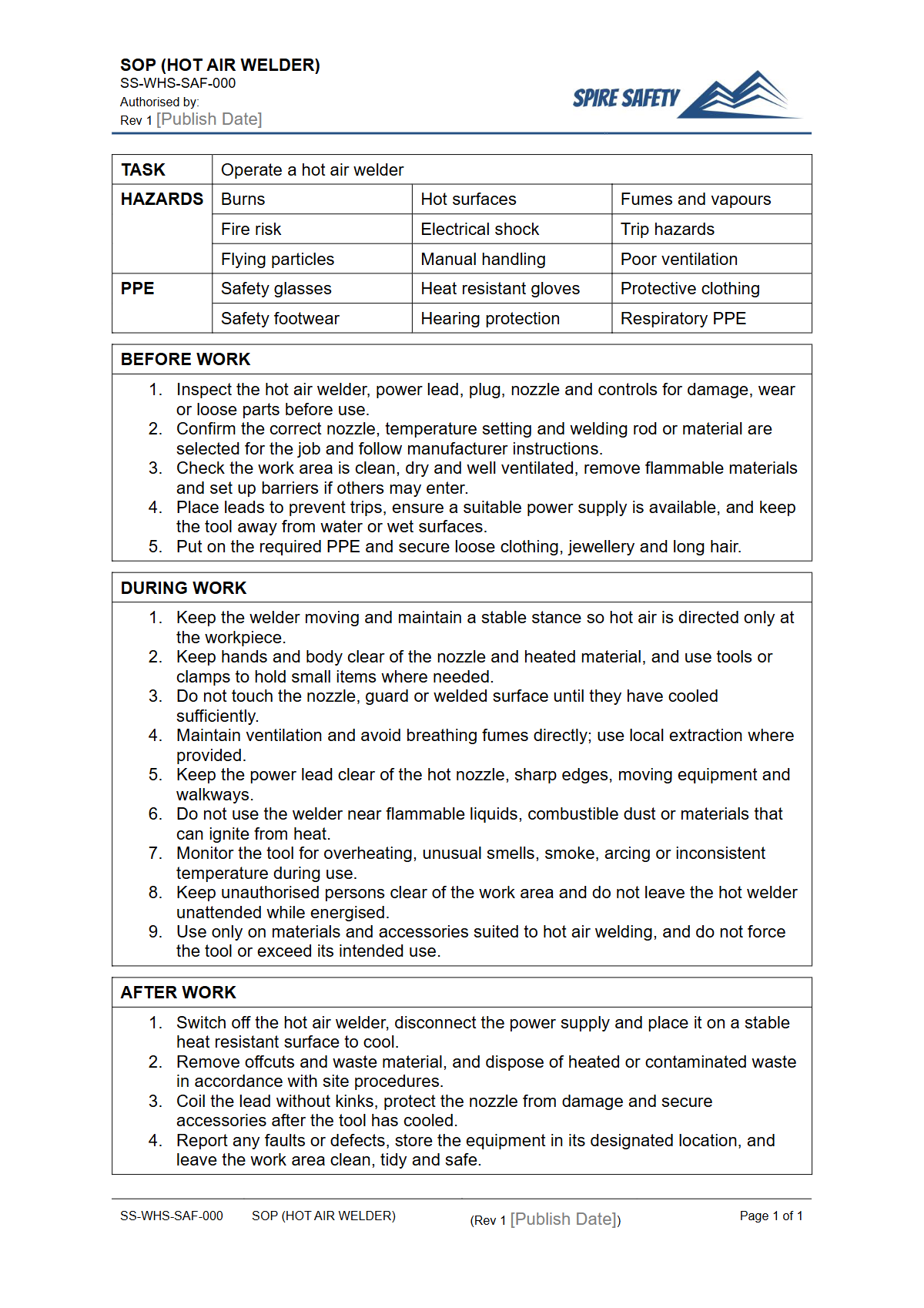
Manage risks associated with plastic welding tasks using our structured procedure template. Download your free Safe Operating Procedure for hot air welders now.
Free Safe Operating Procedure (Hot Air Welder) Template
DOCX • 126 KB + PDF
Updated Oct 2026
No signup required
Purpose of the Free Safe Operating Procedure (Hot Air Welder) Template
Operating a hot air welder introduces significant workplace hazards, including severe burns, electrical shock, and exposure to toxic fumes from heated plastics. A documented system of work is essential for managing these risks.
This Free Safe Operating Procedure (Hot Air Welder) Template provides a structured framework for outlining the required safety measures and operational steps for using this equipment safely.
Using a standardised SOP helps ensure all workers, regardless of experience level, follow a consistent, pre-approved process. This document serves as a critical training tool, a reference for daily operations, and evidence of your organisation's commitment to proactive risk management.
It is designed to be integrated into broader documented WHS management systems, forming a key part of your overall safety framework.
Video walkthrough
How to use the Free Safe Operating Procedure (Hot Air Welder) Template
This resource is available as a fully editable DOCX file for easy customisation and a print-ready PDF for immediate use. To get started, download the template and begin adapting it to your specific workplace conditions.
A comprehensive SOP should detail the exact make and model of the hot air welder used, the specific types of materials being welded, and the unique environmental conditions of the work area (e.g., indoor, outdoor, confined space). It must also list the required Personal Protective Equipment (PPE) and emergency procedures relevant to your site.
Important: This document is a template, not a finished procedure. To be effective and meet your duties, we recommend that you customise it to reflect the specific hazards and control measures present in your workplace.
This includes consulting with workers who operate the equipment during the drafting process.
When to use a Hot Air Welder SOP
A Safe Operating Procedure for a hot air welder should be developed and implemented before any worker is permitted to use the equipment. It is a foundational document that should be used in several key situations:
- Worker Training and Induction: As a primary training tool for new operators to ensure they understand the correct, safe method of operation from the outset.
- Pre-start Checks: As a checklist to guide operators through essential pre-operational inspections of the welder, power cords, and work area.
- Refresher Training: For periodic retraining sessions to reinforce safe work practices and introduce any updates to the procedure.
- Post-Incident Reviews: As a benchmark for reviewing operations after an incident or near-miss to identify any gaps in the procedure or worker understanding.
Just as you would require a specific procedure for other high-risk tools, such as the guidance found in a circular saw SOP, the hot air welder demands the same level of documented safety planning.
Who should use this Safe Operating Procedure
The development and implementation of an SOP involve several roles within an organisation. Persons Conducting a Business or Undertaking (PCBUs), managers, and supervisors are responsible for ensuring that such procedures are created, implemented, and enforced.
They must provide the necessary resources and training to support the SOP's use.
Workers and operators are the primary end-users of the finalised SOP. They must be trained on its contents and are required to follow the outlined steps to ensure their own safety and that of their colleagues.
The procedure empowers them to carry out their tasks with a clear understanding of the associated risks and controls. For complex sites, you may require expert WHS consulting to assist in developing and embedding these procedures effectively.
Regular reviews of SOPs and their practical application are a core component of safety assurance activities. These reviews are often a focus during a formal WHS compliance auditing process to verify that safe systems of work are both documented and consistently followed.
Common mistakes
Common mistakes to avoid
- Using a generic SOP without customising it for the specific welder and task.
- Failing to conduct a thorough pre-start inspection of the welder, nozzle, and power cord.
- Working in a poorly ventilated area, leading to the inhalation of toxic fumes from heated materials.
- Neglecting to wear appropriate PPE, particularly heat-resistant gloves and safety glasses.
Legal references
Legal considerations
The following legal requirements may be relevant to this type of work.
- Work Health and Safety Act (Harmonised) — Provides the primary duties for protecting workers and other people from work health and safety risks.
- Work Health and Safety Regulations (Harmonised) — Sets out requirements supporting the management of workplace hazards and risks.
The following codes may be relevant to this type of work.
- Managing WHS Risks Code of Practice — Provides practical guidance on identifying hazards, assessing risks and applying effective controls.
- Work Health and Safety Consultation, Cooperation and Coordination Code of Practice — Provides practical guidance on consulting workers and coordinating with other duty holders.
- Managing the Work Environment and Facilities Code of Practice — Provides practical guidance on safe work environments, workplace facilities and related controls.
Did you know
Extreme Temperatures
The nozzle of a professional hot air welder can reach temperatures exceeding 650°C (1200°F). This is hot enough to melt many plastics and cause severe, third-degree burns in an instant.
Not Just for Plastic
While commonly used for welding thermoplastics like PVC and TPO for roofing and flooring, hot air welders are also used for shrink-wrapping, paint stripping, and even soldering electronics in specialised applications.
FAQ
Frequently asked questions
01What is a Safe Operating Procedure for a hot air welder?
02Is using this hot air welder SOP template enough to be WHS-aligned?
03Who is responsible for writing and approving the SOP?
04How often should a hot air welder SOP be reviewed?
Share this resource
Free Safe Operating Procedure (Hot Air Welder) Template
Browse Categories
How To Use It
- 1Download and open in Word or PDF.
- 2Replace the placeholders with your business details.
- 3Get it reviewed by a WHS specialist before rollout.
Need it customised?
Our WHS consultants can adapt this template to your site, run a gap analysis, or audit what you already have in place.
Book a Free Consultation WHS consulting servicesor call 1300 156 382
Related templates
- Free Safe Operating Procedure (Hot Display Cabinet) Template
- Free Safe Operating Procedure (Hot Melt Applicator) Template
- Free Safe Operating Procedure (Hot Oil Filtering) Template
- Free Safe Operating Procedure (Hot Plate) Template
- Free Safe Operating Procedure (Hot Sugar Handling) Template
- Free Safe Operating Procedure (Hot Water Urn) Template