
Free Safe Operating Procedure (Hot Water Urn) Template
Effectively manage the risks of using a hot water urn with our structured procedure template. Download this free DOCX and PDF to formalise your safety steps.
Free Safe Operating Procedure (Hot Water Urn) Template
DOCX • 126 KB + PDF
Updated Oct 2026
No signup required
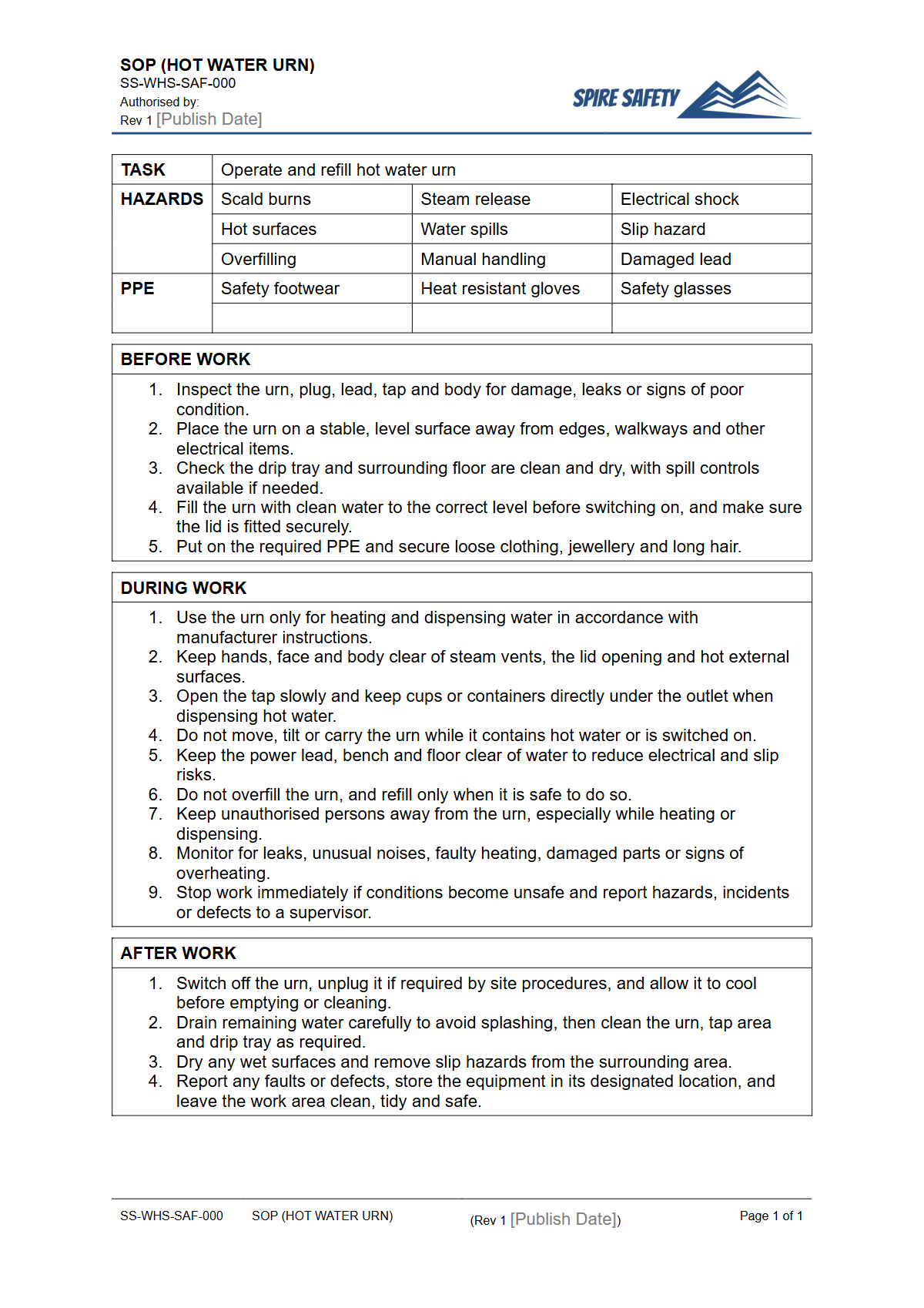
Purpose of the Free Safe Operating Procedure (Hot Water Urn) Template
A hot water urn is a common appliance in many Australian workplaces, from construction site lunchrooms to corporate kitchens and hospitality venues. While seemingly simple, it presents significant hazards, including severe burns from boiling water and steam, electrical shocks, and slips from spills.
This Free Safe Operating Procedure (Hot Water Urn) Template provides a structured framework for documenting the step-by-step process for safe use, helping your organisation meet its duty of care.
The primary purpose of this Safe Operating Procedure is to formalise instructions, ensuring every worker understands the required pre-operational checks, safe operating steps, and post-operational cleaning and shutdown tasks. It acts as a vital training tool and a clear reference point to minimise the risk of incidents. Implementing documented procedures for common equipment is a foundational element of a strong safety culture, similar to the structured approach outlined in our Safe Operating Procedure for deep fryers.
Video walkthrough
How to use the Free Safe Operating Procedure (Hot Water Urn) Template
This template is provided in both DOCX and PDF formats to serve as a comprehensive starting point for your workplace. To use it effectively, download the file and systematically work through each section, adapting the content to match the specific make and model of the hot water urn in use at your site, as well as your unique operational environment.
This includes adding site-specific details such as emergency contact information, the required Personal Protective Equipment (PPE), and the person responsible for maintenance.
Involving the workers who regularly use the equipment in the customisation process is crucial for creating a practical and effective document. Their direct experience can highlight specific risks or efficient steps that may not be obvious.
If you require assistance in tailoring safety documents to your specific operational needs, our WHS consulting team can provide expert guidance and support.
Please note: This document is a template and is not a complete or ready-to-use safety document. You must customise it to reflect the specific equipment, environment, and processes in your workplace. We recommend consulting with operators and relevant personnel during this process to ensure it is robust and fit for purpose.
When to use this Safe Operating Procedure
A Safe Operating Procedure for a hot water urn should be integrated into your daily safety practices. It is essential for the induction and training of any new employee or contractor who may need to use the appliance.
It should also be used as the basis for regular refresher training to reinforce safe work habits and prevent complacency. The SOP becomes an invaluable tool during incident investigations, helping to determine if procedures were followed and where improvements may be needed.
Furthermore, this document should be reviewed and referenced when conducting WHS compliance auditing to demonstrate that risks have been identified and controlled. It should be updated whenever the equipment is changed, the work environment is altered, or following a relevant safety alert or legislative update.
Maintaining and using SOPs consistently demonstrates a proactive approach to safety management.
Who should use this Safe Operating Procedure
This SOP is intended for a range of personnel within an organisation to ensure a consistent approach to safety:
- Workers and Operators: As a direct, step-by-step guide for safely setting up, operating, and cleaning the hot water urn.
- Supervisors and Managers: To train team members, supervise tasks, and enforce the established safety standards. They are responsible for ensuring the SOP is understood and followed.
- WHS/OHS Representatives and Committees: To assist in the development, review, and improvement of the procedure as part of their function in promoting workplace safety.
- Persons Conducting a Business or Undertaking (PCBUs): To fulfil their primary duty of care by ensuring safe systems of work are documented, implemented, and maintained.
By establishing clear procedures for common equipment, you reinforce the principles that underpin all your safety documentation. The logic applied here is scalable to other appliances, such as the process detailed in our free Air Compressor SOP template. This consistency helps build and maintain robust WHS management systems across the entire organisation. You can find more templates to support your safety framework in our free WHS resources library.
Common mistakes
Common mistakes to avoid
- Overfilling the urn, which can cause boiling water to spurt out.
- Leaving the lid off while heating, increasing the risk of steam burns and spills.
- Failing to regularly inspect the power cord and plug for damage.
- Placing the urn on an unstable surface or near flammable materials.
Legal references
Legal considerations
The following legal requirements may be relevant to this type of work.
- Work Health and Safety Act (Harmonised) — Provides the primary duties for protecting workers and other people from work health and safety risks.
- Work Health and Safety Regulations (Harmonised) — Sets out requirements supporting the management of workplace hazards and risks.
The following codes may be relevant to this type of work.
- Managing WHS Risks Code of Practice — Provides practical guidance on identifying hazards, assessing risks and applying effective controls.
- Work Health and Safety Consultation, Cooperation and Coordination Code of Practice — Provides practical guidance on consulting workers and coordinating with other duty holders.
- Managing the Work Environment and Facilities Code of Practice — Provides practical guidance on safe work environments, workplace facilities and related controls.
Did you know
The Danger of Steam
Steam from a boiling water urn is invisible but can cause severe burns faster than boiling water. The burn risk is highest in the few centimetres directly above the water surface and spout.
Electrical Safety First
A faulty power cord or internal wiring on an electrical appliance like a hot water urn is a leading cause of workplace electrical shocks and fires. Regular testing and tagging is a critical control measure.
FAQ
Frequently asked questions
01What is a Safe Operating Procedure (SOP)?
02Is an SOP legally required for a hot water urn in Australia?
03How often should we review our hot water urn SOP?
04Can I use this template for a standard household kettle?
Share this resource
Free Safe Operating Procedure (Hot Water Urn) Template
Browse Categories
How To Use It
- 1Download and open in Word or PDF.
- 2Replace the placeholders with your business details.
- 3Get it reviewed by a WHS specialist before rollout.
Need it customised?
Our WHS consultants can adapt this template to your site, run a gap analysis, or audit what you already have in place.
Book a Free Consultation WHS consulting servicesor call 1300 156 382
Related templates
- Free Safe Operating Procedure (Hotel Guest Room Setup) Template
- Free Safe Operating Procedure (Hotel Laundry Collection) Template
- Free Safe Operating Procedure (Hotel Linen Cart) Template
- Free Safe Operating Procedure (Hotel Luggage Handling) Template
- Free Safe Operating Procedure (Hotel Minibar Restock) Template
- Free Safe Operating Procedure (Hotel Room Minibar) Template