
Free Safe Operating Procedure (Hotel Minibar Restock) Template
Formalise your hotel's minibar restocking process with our structured Safe Operating Procedure template. Download the free DOCX and PDF to get started.
Free Safe Operating Procedure (Hotel Minibar Restock) Template
DOCX • 126 KB + PDF
Updated Oct 2026
No signup required
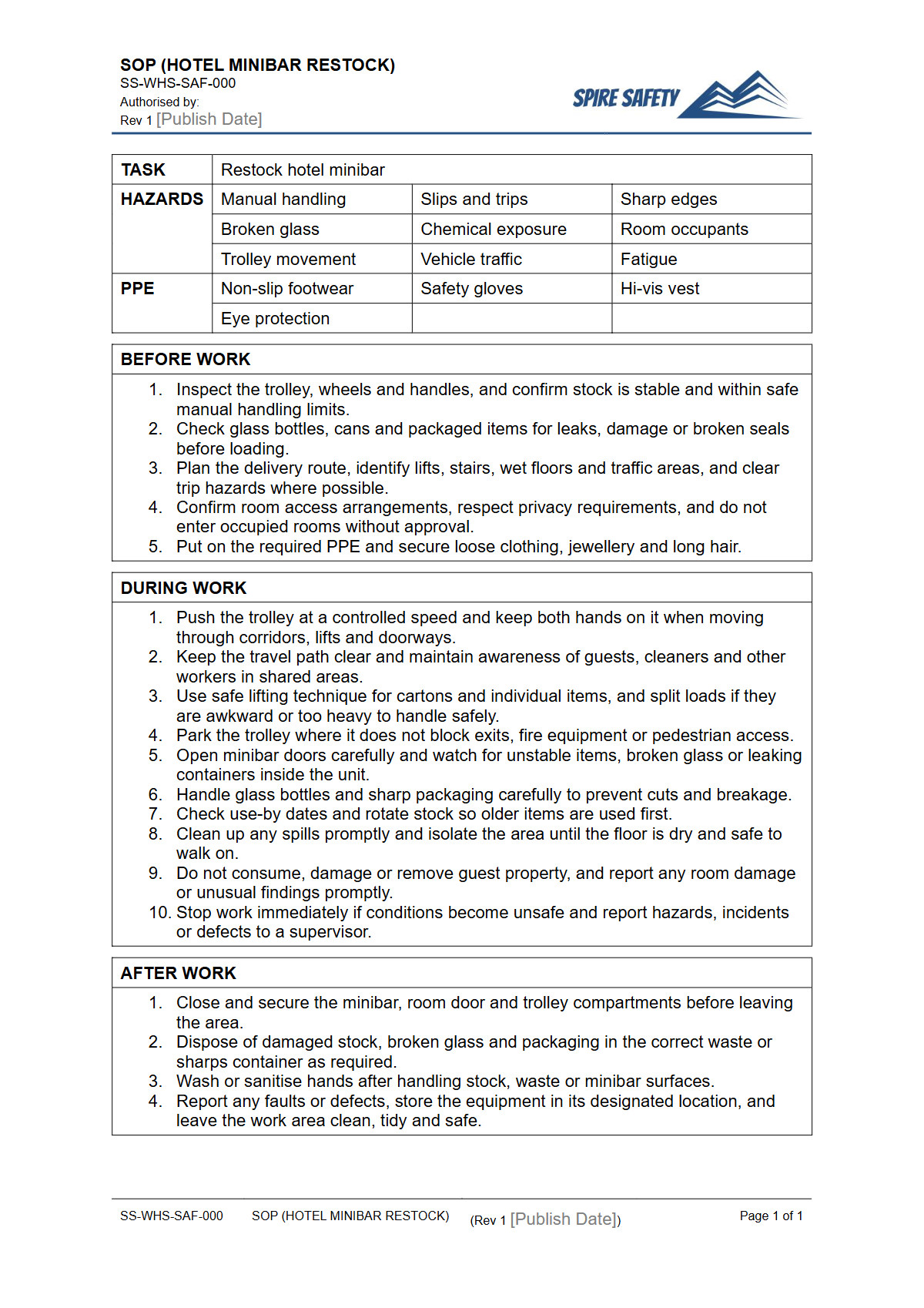
Formalising routine tasks is a cornerstone of effective workplace safety. Our Free Safe Operating Procedure (Hotel Minibar Restock) Template provides a structured starting point for hotels and accommodation providers to document the risks and controls for this common activity.
By outlining a step-by-step process, you can help protect your staff from hazards like manual handling injuries, slips and trips, and exposure to cleaning chemicals, while ensuring a consistent standard of service.
This template is designed as a foundation, aligned with Australian WHS principles, for you to build upon. It encourages a proactive approach to safety, moving beyond assumptions to create a clear, repeatable, and safe system of work for your team.
Video walkthrough
Purpose of the Free Safe Operating Procedure (Hotel Minibar Restock) Template
The primary purpose of this Safe Operating Procedure (SOP) is to provide a clear and documented process for restocking hotel minibars safely. This task, while seemingly simple, involves multiple hazards that must be managed.
The SOP helps your organisation meet its duty of care under WHS legislation by identifying risks and detailing the control measures required to mitigate them. Key hazards addressed include manual handling of stock, awkward postures when accessing low fridges, potential slips on wet floors, and the correct handling of cleaning agents.
A documented procedure ensures consistency across all staff and shifts, reducing the likelihood of incidents and injuries. It forms a critical component of a comprehensive safety framework, demonstrating a commitment to worker wellbeing. Integrating such procedures into your daily operations is a key function of effective WHS management systems.
How to use the Free Safe Operating Procedure (Hotel Minibar Restock) Template
This template is provided in both DOCX and PDF formats for your convenience. The DOCX file is fully editable, allowing you to tailor the content to the specific environment, equipment, and stock used in your hotel.
It is crucial to walk through the minibar restocking process at your site and update the template with your specific details, including room layouts, trolley types, chemical names, and emergency procedures.
Important: This is a template only. For it to be effective, you must customise it to reflect the unique risks and operational procedures of your workplace.
We strongly recommend you consult with your workers—the people who perform the task every day—during the drafting and review process to ensure the SOP is practical and reflects how the work is actually done. Once finalised, the procedure should be communicated to all relevant staff.
When to use this Safe Operating Procedure
A Safe Operating Procedure for minibar restocking should be used as a central reference document throughout the employment lifecycle. It is a vital tool for inducting and training new housekeeping or room attendant staff, ensuring they learn the correct, safe method from day one.
It also serves as an excellent resource for periodic refresher training to prevent complacency and reinforce safe work habits.
Furthermore, the SOP should be a key reference document following any incident or near-miss related to the task. It provides a baseline against which you can review what happened and make necessary improvements to the procedure. The document is also essential during safety reviews and formal assessments, such as WHS compliance auditing.
Who should use this document
This SOP is intended for a range of personnel within a hotel or accommodation setting. Hotel Managers and Department Heads are responsible for ensuring such procedures are developed, implemented, and maintained.
Supervisors use the SOP to train their teams and monitor day-to-day compliance. WHS Representatives and Committees use it as part of their function to review and improve workplace safety practices.
Most importantly, Workers (e.g., Room Attendants, Housekeeping Staff) should use the SOP as their guide for performing the task safely. They are the end-users and their input is invaluable for keeping the document relevant and effective.
For organisations needing assistance with developing a suite of tailored safety documents, engaging professional WHS consulting services can provide expert guidance.
Documenting procedures for all common hospitality tasks is best practice. For example, kitchen staff may require a Free Safe Operating Procedure (Deep Fryer - Standard Operation) Template to manage risks at their workstation. You can find a wide range of templates covering various industries and tasks in our free WHS resources library.
Common mistakes
Common mistakes to avoid
- Using the template without customising it for the hotel's specific trolleys, room layouts, and stock items.
- Failing to consult with housekeeping and room attendant staff during the development of the procedure.
- Not providing practical training on the finalised SOP, assuming staff will just read and follow it.
- Forgetting to schedule regular reviews of the SOP, allowing it to become outdated.
Legal references
Legal considerations
The following legal requirements may be relevant to this type of work.
- Work Health and Safety Act (Harmonised) — Provides the primary duties for protecting workers and other people from work health and safety risks.
- Work Health and Safety Regulations (Harmonised) — Sets out requirements supporting the management of workplace hazards and risks.
The following codes may be relevant to this type of work.
- Managing WHS Risks Code of Practice — Provides practical guidance on identifying hazards, assessing risks and applying effective controls.
- Work Health and Safety Consultation, Cooperation and Coordination Code of Practice — Provides practical guidance on consulting workers and coordinating with other duty holders.
- Managing the Work Environment and Facilities Code of Practice — Provides practical guidance on safe work environments, workplace facilities and related controls.
Did you know
A Leading Cause of Injury
According to Safe Work Australia, body stressing, which includes injuries from manual handling, is a leading cause of serious workers' compensation claims in the Accommodation and Food Services industry.
FAQ
Frequently asked questions
01What are the main hazards when restocking a hotel minibar?
02Is a Safe Operating Procedure legally required for minibar restocking in Australia?
03How often should our minibar restocking SOP be reviewed?
04Can this template be used for training new hotel staff?
Share this resource
Free Safe Operating Procedure (Hotel Minibar Restock) Template
Browse Categories
How To Use It
- 1Download and open in Word or PDF.
- 2Replace the placeholders with your business details.
- 3Get it reviewed by a WHS specialist before rollout.
Need it customised?
Our WHS consultants can adapt this template to your site, run a gap analysis, or audit what you already have in place.
Book a Free Consultation WHS consulting servicesor call 1300 156 382
Related templates
- Free Safe Operating Procedure (Hotel Room Minibar) Template
- Free Safe Operating Procedure (Household Chemical Drop) Template
- Free Safe Operating Procedure (Housekeeping Cart Clean) Template
- Free Safe Operating Procedure (Housekeeping Cart Use) Template
- Free Safe Operating Procedure (Hub Bearing Change) Template
- Free Safe Operating Procedure (Hull Cleaning) Template