
Free Safe Operating Procedure (Housekeeping Cart Clean) Template
Download our free Safe Operating Procedure (Housekeeping Cart Clean) template to formalise cleaning protocols and manage chemical handling risks.
Free Safe Operating Procedure (Housekeeping Cart Clean) Template
DOCX • 126 KB + PDF
Updated Oct 2026
No signup required
Purpose of the Free Safe Operating Procedure (Housekeeping Cart Clean) Template
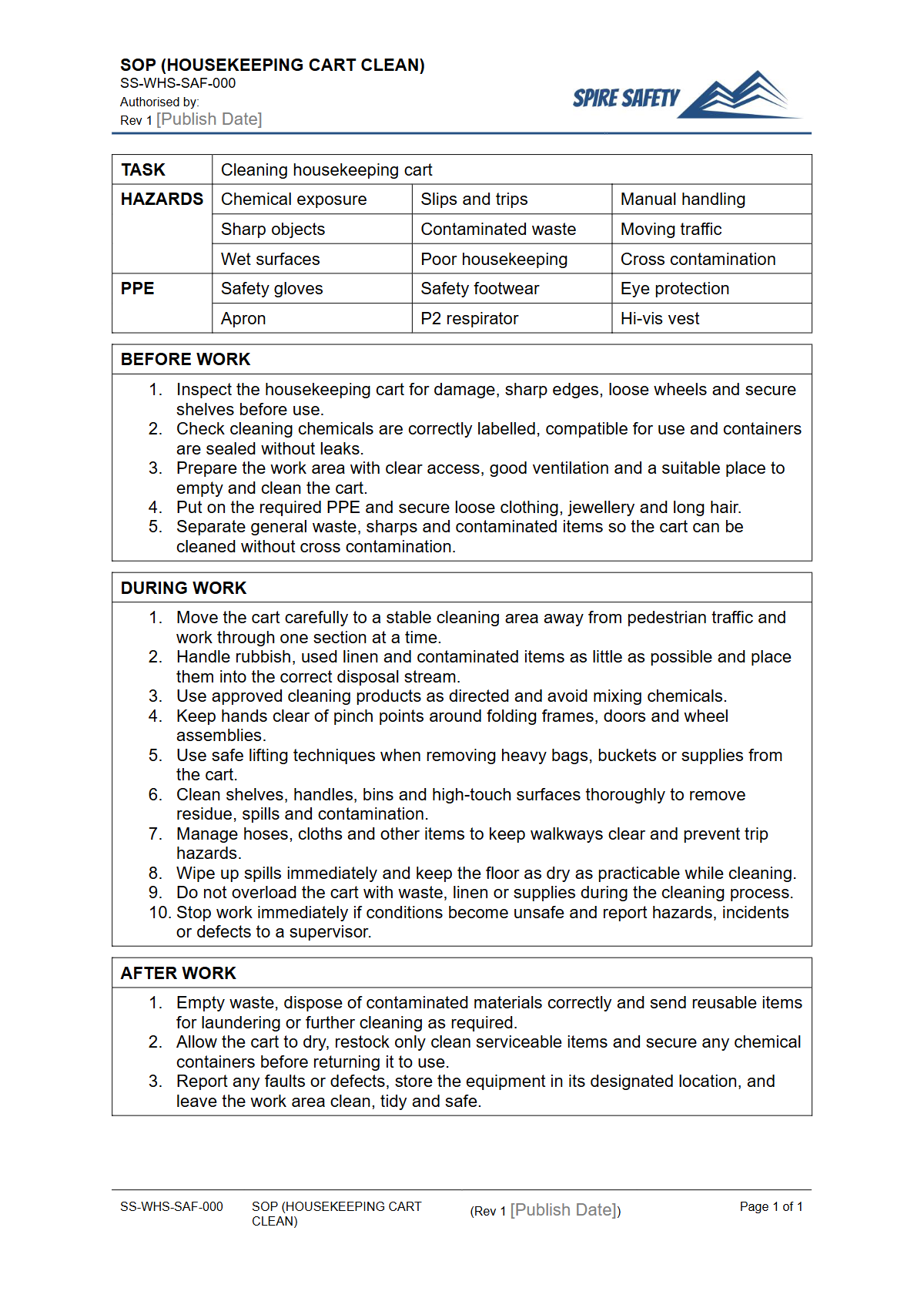
Maintaining a clean and well-organised housekeeping cart is fundamental to workplace hygiene, efficiency, and safety. This Free Safe Operating Procedure (Housekeeping Cart Clean) Template provides a structured framework for documenting the required steps to safely clean and restock a housekeeping or janitorial trolley.
A formal SOP ensures that every team member follows a consistent, safe, and effective process, minimising risks associated with chemical handling, cross-contamination, and manual tasks. It serves as a vital training tool for new employees and a reference point for experienced staff, reinforcing your organisation's commitment to a safe system of work.
By clearly defining procedures, you can control hazards at the source. This includes outlining the correct use of Personal Protective Equipment (PPE), specifying dilution ratios for cleaning agents, and detailing proper waste disposal methods.
Implementing this SOP is a practical step in building robust WHS management systems, demonstrating due diligence in managing foreseeable risks within cleaning and hospitality operations.
Video walkthrough
How to use the Free Safe Operating Procedure (Housekeeping Cart Clean) Template
This document is a comprehensive starting point, designed to be adapted to your specific operational needs. Upon downloading the DOCX or PDF file, you must review and customise each section to reflect the unique aspects of your workplace.
This includes listing the exact cleaning chemicals used, referencing their corresponding Safety Data Sheets (SDS), and detailing the specific models of housekeeping carts your team operates. You should also integrate any site-specific rules regarding storage, waste management, or emergency procedures.
Important: This is a template and must be customised to your specific workplace, equipment, and processes. We make no claims that this document is compliant for your workplace as-is.
A risk assessment should be conducted to ensure all identified hazards are controlled, and the final SOP should be reviewed and approved by a competent person before implementation.
The template is structured logically, guiding you from preparation and hazard identification through to the step-by-step cleaning process and post-cleaning checks. For organisations that use a wide range of documented procedures, this template can be a valuable addition to your existing document library.
You can explore our free WHS resources library for other templates that may support your operations.
When to use it
The Safe Operating Procedure for cleaning a housekeeping cart should be used as a daily reference guide. It is most critical at the end of a shift to ensure the cart is clean, disinfected, and properly restocked for the next user.
It should also be consulted before starting a shift to verify the cart is safe and ready for use. Additionally, the procedure is essential for guiding the response to specific events, such as cleaning up a chemical spill on the cart or after it has been used in an area requiring terminal cleaning, like in a healthcare setting.
Establishing a routine for equipment maintenance is a core principle of workplace safety. The structured cleaning process outlined in this SOP is conceptually similar to the hygiene protocols required for food service equipment, as detailed in our Safe Operating Procedure for deep fryers, where regular cleaning prevents hazards from accumulating.
Who should use it
This SOP is primarily intended for housekeeping staff, janitors, and cleaning personnel who use the carts daily. It provides them with clear, unambiguous instructions to perform their tasks safely and effectively.
Supervisors and team leaders should also use the document to conduct training, verify competency, and perform routine inspections to ensure the procedures are being followed correctly. WHS managers and coordinators will find the template useful for establishing and reviewing safety protocols as part of broader risk management activities.
Proper documentation is essential for all types of workplace equipment, not just complex machinery. Even simple powered tools require a clear set of instructions to ensure safe operation.
For example, our Free Air Compressor SOP provides a framework for a common piece of equipment that is often overlooked but still carries significant risks if used incorrectly.
If you require assistance integrating this SOP into your existing safety framework or need expert advice on developing customised procedures for your business, consider our professional WHS consulting services. Our experts can help you ensure your safety documentation is practical, effective, and aligned with Australian WHS standards.
Common mistakes
Common mistakes to avoid
- Using a generic procedure without customising it for specific chemicals and their Safety Data Sheets (SDS).
- Failing to provide or check the correct Personal Protective Equipment (PPE) before starting the task.
- Neglecting to train staff on the finalised SOP and document that the training occurred.
- Storing incompatible chemicals (e.g., ammonia-based and bleach-based cleaners) together on the cart, risking a hazardous chemical reaction.
Legal references
Legal considerations
The following legal requirements may be relevant to this type of work.
- Work Health and Safety Act (Harmonised) — Provides the primary duties for protecting workers and other people from work health and safety risks.
- Work Health and Safety Regulations (Harmonised) — Sets out requirements supporting the management of workplace hazards and risks.
The following codes may be relevant to this type of work.
- Managing WHS Risks Code of Practice — Provides practical guidance on identifying hazards, assessing risks and applying effective controls.
- Work Health and Safety Consultation, Cooperation and Coordination Code of Practice — Provides practical guidance on consulting workers and coordinating with other duty holders.
- Managing the Work Environment and Facilities Code of Practice — Provides practical guidance on safe work environments, workplace facilities and related controls.
Did you know
Chemical Dilution Errors
Incorrectly diluting concentrated cleaning chemicals is a common cause of workplace incidents. Over-diluting can render a disinfectant ineffective, while under-diluting can create hazardous fumes and risk chemical burns.
Musculoskeletal Risk
Cleaners and housekeepers have one of the highest rates of musculoskeletal injuries. A well-designed SOP that promotes good ergonomic practices for lifting supplies and pushing the cart can significantly reduce this risk.
FAQ
Frequently asked questions
01What hazards are associated with cleaning a housekeeping cart?
02How often should a housekeeping cart SOP be reviewed?
03Do I need a separate SOP for each different cleaning chemical?
04Is this template suitable for healthcare and hospitality settings?
Share this resource
Free Safe Operating Procedure (Housekeeping Cart Clean) Template
Browse Categories
How To Use It
- 1Download and open in Word or PDF.
- 2Replace the placeholders with your business details.
- 3Get it reviewed by a WHS specialist before rollout.
Need it customised?
Our WHS consultants can adapt this template to your site, run a gap analysis, or audit what you already have in place.
Book a Free Consultation WHS consulting servicesor call 1300 156 382
Related templates
- Free Safe Operating Procedure (Housekeeping Cart Use) Template
- Free Safe Operating Procedure (Hub Bearing Change) Template
- Free Safe Operating Procedure (Hull Cleaning) Template
- Free Safe Operating Procedure (HVAC Coil Cleaning) Template
- Free Safe Operating Procedure (HVAC Filter Change) Template
- Free Safe Operating Procedure (HVAC Grille Cleaning) Template