
Free Safe Operating Procedure (HVAC Coil Cleaning) Template
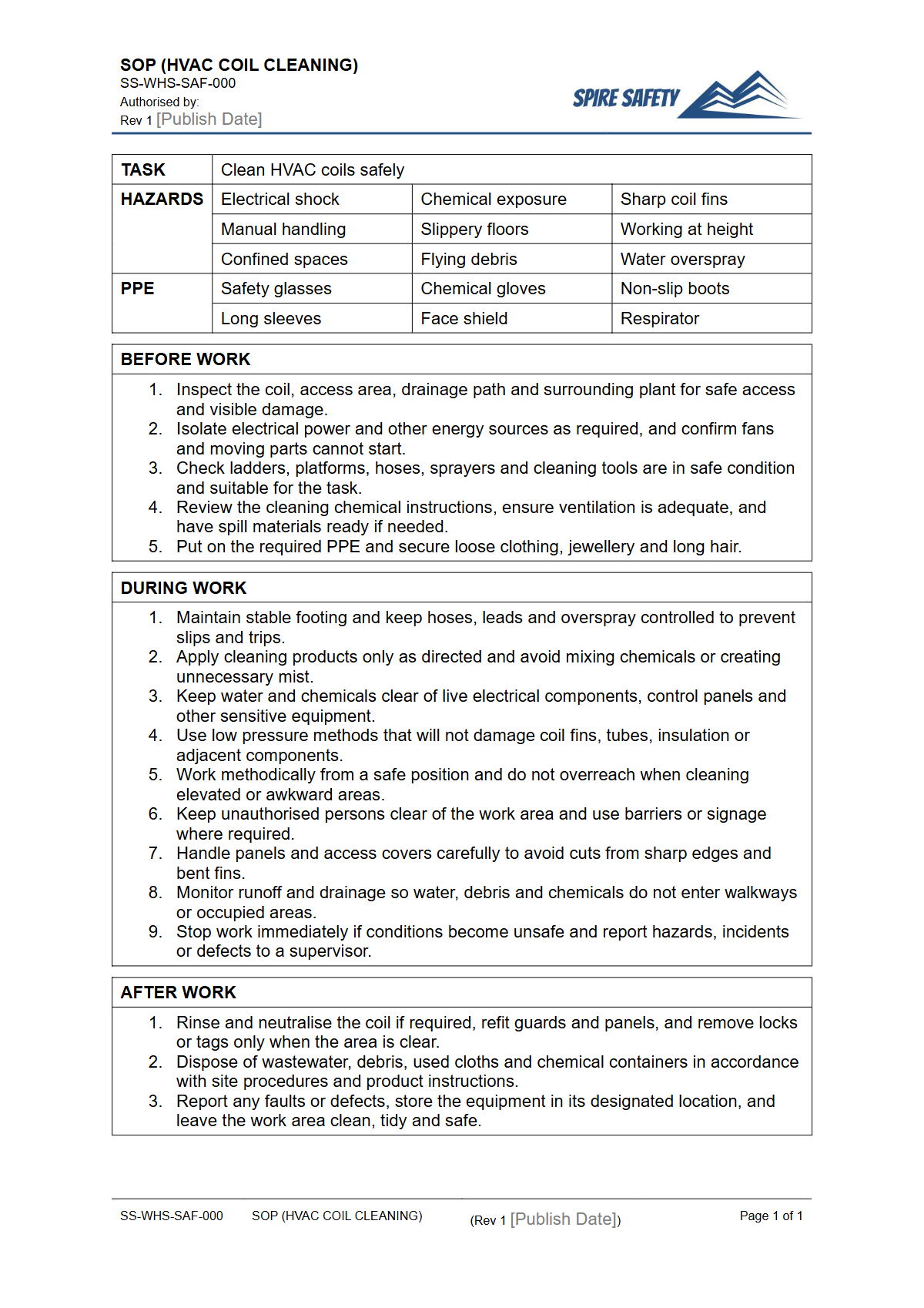
Download our free Safe Operating Procedure for HVAC coil cleaning. This customisable template helps you outline step-by-step safety controls for this common task.
Free Safe Operating Procedure (HVAC Coil Cleaning) Template
DOCX • 126 KB + PDF
Updated Oct 2026
No signup required
Purpose of the Free Safe Operating Procedure (HVAC Coil Cleaning) Template
This free Safe Operating Procedure (HVAC Coil Cleaning) template provides a structured framework for documenting a safe system of work for cleaning commercial and industrial HVAC coils. Regular cleaning is essential for maintaining energy efficiency and indoor air quality, but the task involves significant hazards, including electrical energy, hazardous chemicals, manual handling, and potential falls from height.
Using a formal SOP helps ensure that workers follow a consistent, safe process every time.
A well-developed SOP is a fundamental component of effective risk management. It demonstrates a commitment to workplace safety by clearly communicating hazards, control measures, and emergency procedures.
Documenting these processes is a critical part of building robust and comprehensive WHS management systems that protect workers and help organisations meet their safety obligations.
Video walkthrough
How to use the Free Safe Operating Procedure (HVAC Coil Cleaning) Template
To get started, download the template in your preferred format (DOCX for easy editing or PDF). The key to an effective SOP is customisation.
This document must be adapted to reflect the specific circumstances of your workplace. Generic procedures are insufficient for managing site-specific risks.
Follow these steps to customise the template:
- Consult your team: Involve the HVAC technicians and maintenance staff who perform the cleaning. Their direct experience is invaluable for identifying practical hazards and effective controls.
- Conduct a risk assessment: Before finalising the SOP, perform a thorough risk assessment for the task. Identify all potential hazards associated with your specific HVAC units, cleaning chemicals, tools, and work location.
- Be specific: Replace all placeholder text with details relevant to your site. This includes the exact make and model of the HVAC unit, the specific names of cleaning chemicals used (and references to their Safety Data Sheets), and the required Personal Protective Equipment (PPE). The process for maintaining other plant, such as documented in our free Air Compressor SOP, will have different specific hazards that must be addressed.
Important: This document is a template, not a finished safety procedure. We have provided a structured starting point aligned with Australian WHS principles, but you must complete and customise it with site-specific information.
Responsibility for ensuring the final SOP is accurate and adequate rests with the user and the Person Conducting a Business or Undertaking (PCBU).
When to use this Safe Operating Procedure
The HVAC Coil Cleaning SOP should be used before any cleaning work commences. It serves as a critical planning and training tool.
All workers assigned to the task must be trained on the contents of the SOP and have easy access to it in the work area. The procedure should be reviewed regularly as part of your safety management cycle, especially during scheduled WHS compliance auditing activities.
An SOP should also be reviewed and updated whenever:
- A new type of HVAC unit is installed.
- Different cleaning chemicals or equipment are introduced.
- An incident, near miss, or new hazard is identified.
- There are changes to relevant legislation or codes of practice.
- At minimum, a review should occur on an annual basis.
Who should use this Safe Operating Procedure
This template is designed for use by anyone responsible for ensuring the health and safety of workers involved in HVAC maintenance. This includes:
- WHS Managers and Advisors: To formalise procedures and integrate them into the broader safety management system.
- Facility and Maintenance Managers: To ensure their teams have clear, standardised instructions for a high-risk task.
- HVAC Technicians and Contractors: As a step-by-step guide to performing the job safely.
- Business Owners and PCBUs: To fulfil their duty of care by providing and maintaining a safe system of work.
If you require assistance in developing or implementing task-specific SOPs or need guidance on complex risk assessments, our expert WHS consulting services can provide tailored support. For more templates and safety resources, feel free to browse our complete free WHS resources library.
Common mistakes
Common mistakes to avoid
- Forgetting to de-energise and lock out the electrical supply before starting.
- Using incorrect or incompatible cleaning chemicals that can damage coils or create toxic fumes.
- Failing to use appropriate Personal Protective Equipment (PPE), such as chemical-resistant gloves and safety glasses.
- Not ensuring adequate ventilation in the work area when using chemical cleaners.
Legal references
Legal considerations
The following legal requirements may be relevant to this type of work.
- Work Health and Safety Act (Harmonised) — Provides the primary duties for protecting workers and other people from work health and safety risks.
- Work Health and Safety Regulations (Harmonised) — Sets out requirements supporting the management of workplace hazards and risks.
The following codes may be relevant to this type of work.
- Managing WHS Risks Code of Practice — Provides practical guidance on identifying hazards, assessing risks and applying effective controls.
- Work Health and Safety Consultation, Cooperation and Coordination Code of Practice — Provides practical guidance on consulting workers and coordinating with other duty holders.
- Managing the Work Environment and Facilities Code of Practice — Provides practical guidance on safe work environments, workplace facilities and related controls.
Did you know
Indoor Air Quality
Dirty HVAC coils can become a breeding ground for mould and bacteria, significantly impacting a building's indoor air quality and potentially leading to respiratory issues for occupants.
Energy Efficiency
According to the Australian government's YourHome guide, regular maintenance, including cleaning coils and filters, can improve an air conditioner's efficiency by 5% to 15%.
FAQ
Frequently asked questions
01What are the main hazards involved in HVAC coil cleaning?
02Is a Safe Operating Procedure a legal requirement for coil cleaning in Australia?
03How often should an HVAC coil cleaning SOP be reviewed?
04Can I use a generic SOP for all different HVAC units?
Share this resource
Free Safe Operating Procedure (HVAC Coil Cleaning) Template
Browse Categories
How To Use It
- 1Download and open in Word or PDF.
- 2Replace the placeholders with your business details.
- 3Get it reviewed by a WHS specialist before rollout.
Need it customised?
Our WHS consultants can adapt this template to your site, run a gap analysis, or audit what you already have in place.
Book a Free Consultation WHS consulting servicesor call 1300 156 382
Related templates
- Free Safe Operating Procedure (HVAC Filter Change) Template
- Free Safe Operating Procedure (HVAC Grille Cleaning) Template
- Free Safe Operating Procedure (HVAC Intake Cleaning) Template
- Free Safe Operating Procedure (HVAC Return Cleaning) Template
- Free Safe Operating Procedure (HVAC Vent Cleaning) Template
- Free Safe Operating Procedure (Hydrant Testing) Template