
Free Safe Operating Procedure (HVAC Return Cleaning) Template
Formalise your safety protocols for maintaining HVAC systems with our structured template. Download your free Safe Operating Procedure to get started.
Free Safe Operating Procedure (HVAC Return Cleaning) Template
DOCX • 126 KB + PDF
Updated Oct 2026
No signup required
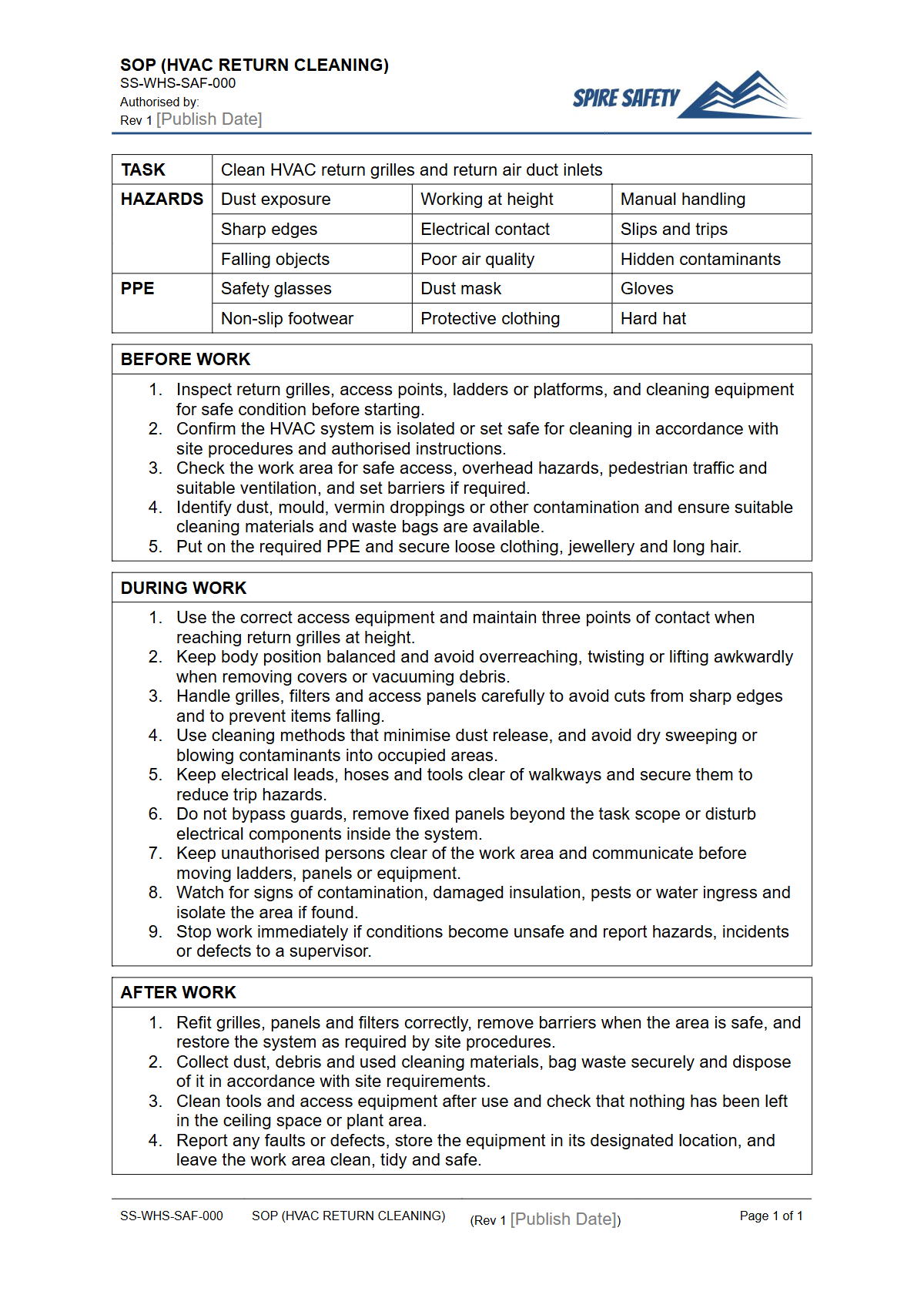
Purpose of the Free Safe Operating Procedure (HVAC Return Cleaning) Template
Maintaining heating, ventilation, and air conditioning (HVAC) systems is essential for workplace health and equipment longevity. This free Safe Operating Procedure (HVAC Return Cleaning) Template provides a structured framework for documenting the required steps to perform the task safely.
An SOP ensures that every worker follows a consistent, pre-approved process, minimising risks associated with electrical energy, hazardous dust, chemicals, and manual handling. By outlining hazards and control measures clearly, it serves as a vital tool for training, supervision, and operational consistency.
Using a standardised procedure helps your organisation meet its primary duty of care under WHS legislation by formalising a safe system of work. This template is designed as a starting point, aligned with Australian WHS principles, to help you create a site-specific document.
Effective SOPs are a cornerstone of comprehensive WHS management systems, demonstrating a proactive approach to risk management.
Video walkthrough
How to use the Free Safe Operating Procedure (HVAC Return Cleaning) Template
This Safe Operating Procedure is available for download in both DOCX and PDF formats. The DOCX file is fully editable, allowing you to tailor it to your specific operational context.
It's crucial to adapt the document to the exact make and model of the HVAC systems at your site, the specific cleaning agents used, and the unique environmental conditions of your workplace.
Important: This is a template, not a finished document. We have drafted it to provide a solid starting point, but you must customise it to reflect the specific machinery, chemicals, hazards, and control measures in your workplace.
A generic procedure that doesn't accurately represent your operational reality creates a significant safety and compliance gap. Your final SOP should be reviewed and approved by a competent person before implementation.
Key Hazards in HVAC Return Cleaning
Cleaning HVAC returns involves several significant hazards that must be identified and controlled. The primary risks include:
- Electrical Hazards: Contact with live electrical components if the system is not properly isolated. Lockout/Tagout (LOTO) procedures are non-negotiable.
- Hazardous Substances: Inhalation of dust, mould, bacteria, and other biological contaminants accumulated in the ductwork. Exposure to cleaning chemicals can also cause respiratory irritation or skin burns.
- Manual Tasks: Awkward postures, forceful movements, and lifting heavy components can lead to musculoskeletal injuries.
- Confined Spaces: Depending on the system's design, accessing certain parts of the ductwork may meet the definition of a confined space, requiring specific entry permits and procedures.
Properly assessing these risks for your specific site is a critical step in customising this SOP. If you are unsure how to conduct a thorough risk assessment, engaging specialist WHS consulting services can provide clarity and ensure all hazards are addressed.
Essential Control Measures
To mitigate the identified hazards, your SOP must detail specific control measures. These should follow the hierarchy of controls, prioritising elimination and engineering controls where possible. Key controls for HVAC cleaning include:
- Isolation: De-energising, locking, and tagging out the HVAC unit and any associated electrical equipment before any work begins.
- Personal Protective Equipment (PPE): Mandating appropriate PPE, such as P2-rated respiratory masks, safety glasses, chemical-resistant gloves, and long-sleeved clothing.
- Ventilation: Ensuring adequate ventilation in the work area to disperse any airborne contaminants or chemical vapours.
- Chemical Safety: Using the least hazardous cleaning products effective for the job, ensuring Safety Data Sheets (SDS) are available, and providing training on correct handling and storage.
- Tools and Equipment: Using well-maintained tools appropriate for the task. For example, some cleaning processes may require compressed air, which should be covered by its own procedure, like our free Air Compressor SOP template.
When to use this Safe Operating Procedure
This SOP should be used whenever maintenance or cleaning of an HVAC return system is performed. It is a critical document for inducting and training new employees or contractors assigned to the task.
It should also be used as a pre-start checklist by experienced technicians to ensure no steps are missed. Furthermore, the SOP serves as an official record of your organisation's prescribed safety method during safety reviews and regular WHS compliance auditing.
Who should use this Safe Operating Procedure
This document is intended for use by all personnel involved in the HVAC cleaning process. This includes:
- HVAC Technicians
- Maintenance Staff and Fitters
- Facilities Managers
- WHS/HSE Officers and Managers
- Supervisors and Team Leaders responsible for overseeing the work
It provides a clear standard of expected behaviour and safety performance for everyone, from the person performing the work to the person supervising it. You can find more templates for various tasks and equipment in our free WHS resources library.
Common mistakes
Common mistakes to avoid
- Forgetting to de-energise and lock out the system before starting work.
- Using incorrect or insufficient Personal Protective Equipment (PPE), especially respiratory protection against dust and mould.
- Using incompatible or overly harsh cleaning chemicals that can damage components or create hazardous fumes.
- Failing to properly contain dust and debris during the cleaning process, leading to contamination of the surrounding area.
Legal references
Legal considerations
The following legal requirements may be relevant to this type of work.
- Work Health and Safety Act (Harmonised) — Provides the primary duties for protecting workers and other people from work health and safety risks.
- Work Health and Safety Regulations (Harmonised) — Sets out requirements supporting the management of workplace hazards and risks.
The following codes may be relevant to this type of work.
- Managing WHS Risks Code of Practice — Provides practical guidance on identifying hazards, assessing risks and applying effective controls.
- Work Health and Safety Consultation, Cooperation and Coordination Code of Practice — Provides practical guidance on consulting workers and coordinating with other duty holders.
- Managing the Work Environment and Facilities Code of Practice — Provides practical guidance on safe work environments, workplace facilities and related controls.
Did you know
Indoor Air Quality
Poorly maintained HVAC systems can circulate dust, allergens, and mould, contributing to poor indoor air quality. The US EPA estimates that indoor air can be two to five times more polluted than outdoor air.
The 'V' in HVAC
The 'Ventilation' component is critical for health. It's the process of replacing or exchanging air within a space to dilute contaminants, control temperature, and remove moisture.
FAQ
Frequently asked questions
01What should be included in an HVAC return cleaning SOP?
02How often should HVAC return vents be cleaned?
03Is an SOP a legal requirement for HVAC cleaning in Australia?
04What is the difference between an SOP and a Safe Work Method Statement (SWMS)?
Share this resource
Free Safe Operating Procedure (HVAC Return Cleaning) Template
Browse Categories
How To Use It
- 1Download and open in Word or PDF.
- 2Replace the placeholders with your business details.
- 3Get it reviewed by a WHS specialist before rollout.
Need it customised?
Our WHS consultants can adapt this template to your site, run a gap analysis, or audit what you already have in place.
Book a Free Consultation WHS consulting servicesor call 1300 156 382
Related templates
- Free Safe Operating Procedure (HVAC Vent Cleaning) Template
- Free Safe Operating Procedure (Hydrant Testing) Template
- Free Safe Operating Procedure (Hydration Station Setup) Template
- Free Safe Operating Procedure (Hydraulic Breaker) Template
- Free Safe Operating Procedure (Hydraulic Crimper) Template
- Free Safe Operating Procedure (Hydraulic Grab) Template