
Free Safe Operating Procedure (Hydrant Testing) Template
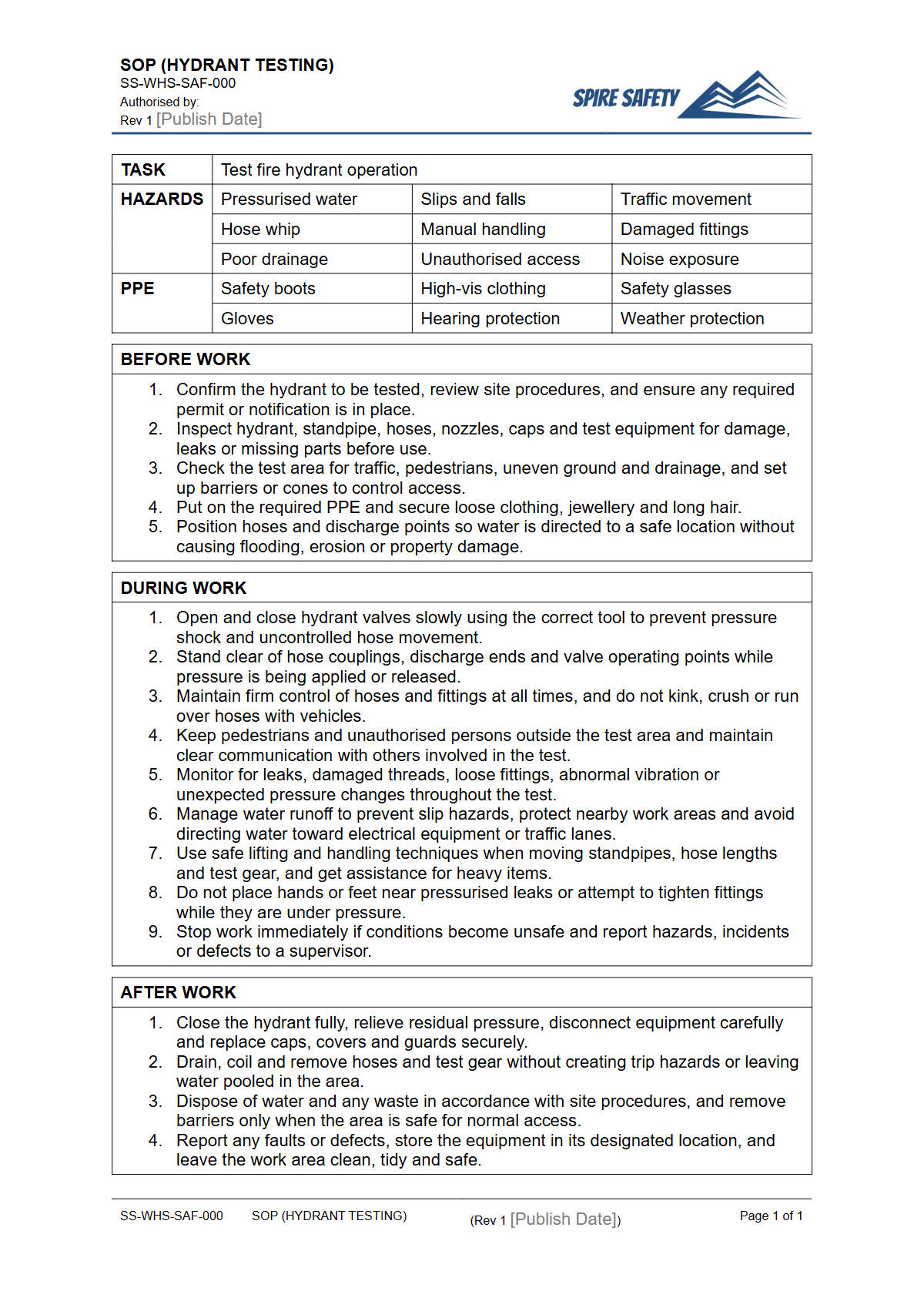
Download our free Safe Operating Procedure (Hydrant Testing) Template. This resource helps you document the steps for safely inspecting fire hydrants.
Free Safe Operating Procedure (Hydrant Testing) Template
DOCX • 126 KB + PDF
Updated Oct 2026
No signup required
Purpose of the Free Safe Operating Procedure (Hydrant Testing) Template
This free Safe Operating Procedure (Hydrant Testing) Template provides a structured framework for documenting the required steps to safely inspect and test fire hydrants. By establishing a clear, step-by-step process, this SOP helps ensure that hydrant testing is conducted consistently and safely, minimising risks to personnel and the public.
It serves as a vital tool for any organisation responsible for maintaining fire safety infrastructure, ensuring equipment is reliable and ready for emergency use. A well-defined SOP is a cornerstone of an effective safety management system.
Using this Safe Operating Procedure helps your organisation control hazards associated with hydrant testing, such as high-pressure water release, slips and falls, traffic interaction, and potential water supply contamination. Formalising your process demonstrates a commitment to due diligence and proactive risk management.
Integrating this document into your broader WHS management systems ensures that safety protocols are consistently applied and regularly reviewed, helping to maintain a safe work environment for everyone involved.
Video walkthrough
How to Use the Free Safe Operating Procedure (Hydrant Testing) Template
This template is designed as a comprehensive starting point. To use it effectively, download the DOCX file and adapt its contents to your specific operational context.
You must review and modify each section to reflect the exact types of hydrants on your site (e.g., wet or dry barrel), the specific tools used, your site's unique environmental conditions, and your organisation's emergency response protocols.
Important: This document is a template and must be customised to suit the specific equipment, environment, and risks present in your workplace. We are not liable for any incidents that may occur from the use of this document.
It is your responsibility to ensure all safety procedures are tailored to your site-specific needs and that they comply with current legislation and Australian Standards. A crucial part of this process involves regular reviews, which can be verified during a WHS compliance auditing process to ensure ongoing suitability.
When to Use a Hydrant Testing SOP
A Safe Operating Procedure for hydrant testing should be used consistently during all testing activities to ensure a standardised, safe approach. Key times for its application include:
- Routine Maintenance: During scheduled inspections and tests as mandated by Australian Standard AS 1851, which outlines frequencies for servicing fire protection systems.
- Post-Installation: After a new hydrant system has been installed or major components have been replaced, to verify correct operation and performance.
- After Repairs: Following any maintenance or repair work on the hydrant or associated water mains to ensure it is fully operational.
- Annual Flow Testing: When conducting pressure and flow tests to gather data for hydraulic analysis or to confirm the system meets design specifications.
Who Should Use This Safe Operating Procedure
This SOP should be used by personnel who are deemed competent to perform hydrant testing. This typically includes:
- Fire Safety Officers: Professionals responsible for the management and maintenance of a building's fire safety measures.
- Qualified Plumbers or Technicians: Tradespeople with specific training and experience in fire hydrant systems.
- Facilities Maintenance Teams: In-house or contracted staff tasked with site maintenance and safety equipment checks.
All users must be trained on this procedure and have a clear understanding of the associated risks. Competency is not just about having the right tools; it's about having documented procedures for all critical tasks, whether it involves facility equipment like in our free Air Compressor SOP template or other site-specific machinery.
Managing Risks During Hydrant Testing
A critical part of this SOP is identifying and controlling risks. Before starting work, a site-specific risk assessment should be completed.
Key hazards include uncontrolled water discharge, traffic in the testing area, manual handling of heavy equipment, and potential for water hammer which can damage pipes. Your customised procedure must outline specific controls for these risks, such as using traffic cones and signs, wearing appropriate PPE (e.g., high-visibility clothing, non-slip footwear), and using correct valve operation techniques.
For guidance on developing robust risk controls, consider engaging expert WHS consulting services.
Documenting procedures is a fundamental aspect of workplace safety across all industries and for all types of equipment. For example, a commercial kitchen would require a specific Safe Operating Procedure for a deep fryer to manage its unique hazards.
Similarly, this hydrant testing SOP addresses the specific risks of that task. For more templates covering a wide range of tasks and equipment, browse our complete free WHS resources library.
Common mistakes
Common mistakes to avoid
- Failing to notify the local fire brigade or building management before testing, which can cause false alarms.
- Opening or closing hydrant valves too quickly, creating a 'water hammer' effect that can damage pipes and fittings.
- Neglecting to implement traffic management, exposing workers to vehicle-related hazards.
- Inadequate record-keeping of test results, pressures, and flow rates, which hinders maintenance planning and compliance tracking.
Legal references
Legal considerations
The following legal requirements may be relevant to this type of work.
- Work Health and Safety Act (Harmonised) — Provides the primary duties for protecting workers and other people from work health and safety risks.
- Work Health and Safety Regulations (Harmonised) — Sets out requirements supporting the management of workplace hazards and risks.
The following codes may be relevant to this type of work.
- Managing WHS Risks Code of Practice — Provides practical guidance on identifying hazards, assessing risks and applying effective controls.
- Work Health and Safety Consultation, Cooperation and Coordination Code of Practice — Provides practical guidance on consulting workers and coordinating with other duty holders.
- Managing the Work Environment and Facilities Code of Practice — Provides practical guidance on safe work environments, workplace facilities and related controls.
Did you know
Hydrant Colour Codes
In Australia, fire hydrants and their markers are often colour-coded according to AS 2419.1 to indicate the size of the water main they are connected to. For example, a blue marker often signifies a main size between 100-150mm.
Static vs. Residual Pressure
Hydrant testing involves measuring two types of pressure. Static pressure is the pressure in the system when no water is flowing, while residual pressure is the pressure that remains in the system when water is flowing during a test.
FAQ
Frequently asked questions
01What is a Safe Operating Procedure for hydrant testing?
02How often should fire hydrants be tested in Australia?
03Who is considered a 'competent person' for hydrant testing?
04Does this template cover both wet and dry barrel hydrants?
Share this resource
Free Safe Operating Procedure (Hydrant Testing) Template
Browse Categories
How To Use It
- 1Download and open in Word or PDF.
- 2Replace the placeholders with your business details.
- 3Get it reviewed by a WHS specialist before rollout.
Need it customised?
Our WHS consultants can adapt this template to your site, run a gap analysis, or audit what you already have in place.
Book a Free Consultation WHS consulting servicesor call 1300 156 382
Related templates
- Free Safe Operating Procedure (Hydration Station Setup) Template
- Free Safe Operating Procedure (Hydraulic Breaker) Template
- Free Safe Operating Procedure (Hydraulic Crimper) Template
- Free Safe Operating Procedure (Hydraulic Grab) Template
- Free Safe Operating Procedure (Hydraulic Hose Testing) Template
- Free Safe Operating Procedure (Hydraulic Isolation) Template