
Free Safe Operating Procedure (Hydraulic Crimper) Template
Document safe work practices for hydraulic crimpers with our customisable Safe Operating Procedure template. Download your free DOCX and PDF to get started.
Free Safe Operating Procedure (Hydraulic Crimper) Template
DOCX • 126 KB + PDF
Updated Oct 2026
No signup required
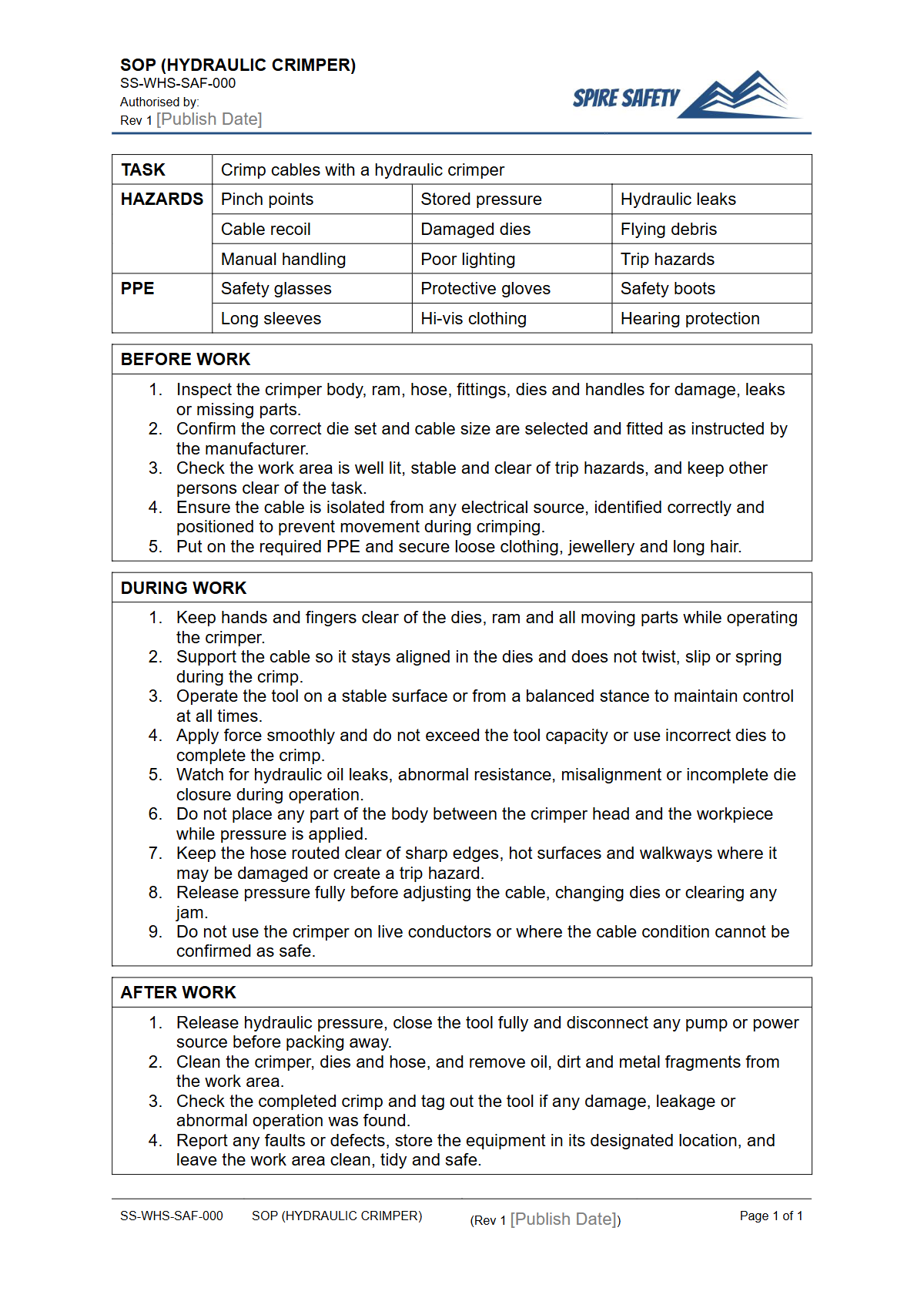
Purpose of the Free Safe Operating Procedure (Hydraulic Crimper) Template
This Free Safe Operating Procedure (Hydraulic Crimper) Template provides a structured framework for documenting the safe use of hydraulic crimping tools in your workplace. A Safe Operating Procedure (SOP) is a critical administrative control that provides clear, step-by-step instructions for workers to follow, ensuring tasks are performed consistently and safely every time.
Using a hydraulic crimper introduces significant hazards, including high-pressure fluid injection, crushing and pinch points, and component failure. This template helps your organisation formalise the required safety measures to manage these risks effectively.
Integrating this SOP into your safety framework helps demonstrate a commitment to providing a safe system of work. It serves as a vital tool for worker training, competency assessment, and daily operational reference.
By clearly outlining pre-operational checks, safe operating steps, and emergency responses, the procedure helps minimise the risk of injury and equipment damage. A well-developed set of SOPs is a fundamental component of effective WHS management systems, providing clarity for both operators and supervisors.
Video walkthrough
How to use the Free Safe Operating Procedure (Hydraulic Crimper) Template
To effectively use this Safe Operating Procedure for hydraulic crimpers, you must adapt it to the specific context of your workplace. It is designed as a comprehensive starting point, not a final document.
A generic procedure cannot account for the unique variables of your equipment, environment, and personnel.
Important: This document is a template and we have populated it with common steps and hazards. You are responsible for customising it to reflect the specific make and model of your hydraulic crimper, the tasks it is used for, and the findings of your site-specific risk assessment.
We strongly recommend consulting with the equipment operators and their supervisors during this customisation process.
Key Sections to Customise
- Plant and Equipment Details: Enter the specific make, model, and identifier for your hydraulic crimper.
- Required PPE: List all personal protective equipment required, such as impact-resistant safety glasses, protective gloves, and safety footwear. Be specific about the standards they must meet.
- Risk Assessment: Ensure the hazards and control measures listed align with your own risk assessment. Add any site-specific risks that have been identified.
- Pre-Operational Checks: Detail the exact inspection steps for your machine. This should include checking hydraulic hoses for leaks or damage, verifying guards are secure, and ensuring die sets are in good condition.
- Step-by-Step Procedure: Write out the precise sequence of actions for a typical crimping task, from selecting the correct die set and setting the pressure to positioning the fitting and activating the machine.
- Emergency Procedures: Outline the exact steps to take in an emergency, including power isolation points, first aid response for hydraulic fluid injection injuries, and emergency contact numbers. This level of detail is also essential when creating documents like a circular saw SOP template.
Once customised, the SOP should be formally approved, and all relevant workers must be trained on its contents. If you require assistance with risk assessments or procedure development, our WHS consulting services can provide expert guidance.
When to use it
A Safe Operating Procedure for a hydraulic crimper should be used as a primary reference document in several situations. It is essential during the induction and training of new employees who will be required to operate the equipment.
It should also be used for periodic refresher training to ensure established safety standards are maintained. Supervisors can use the SOP as a checklist to conduct competency observations and verify that work is being performed correctly.
Operators should refer to the SOP before commencing work, especially for non-routine tasks or if they have not used the equipment recently. Furthermore, the procedure becomes a critical review document following any incident or near miss involving the hydraulic crimper, helping the team identify and rectify gaps in the process.
Its application is similar to other plant-specific documents, such as a free Hydraulic Press SOP, which also governs high-risk equipment.
Who should use it
The SOP for a hydraulic crimper is intended for use by several groups within an organisation to ensure a shared understanding of safety requirements.
- Operators and Tradespeople: The primary users are the workers who physically operate the hydraulic crimper. They rely on the SOP for clear guidance on how to perform their tasks safely and correctly.
- Supervisors and Line Managers: These individuals are responsible for enforcing the procedure. They use it to train staff, monitor work practices, and supports your compliance efforts with the documented safe system of work.
- WHS/HSE Professionals and Managers: Safety personnel use the SOP as a tool to standardise processes across the business. They are typically responsible for drafting, reviewing, and updating the document in line with risk assessments and legislative changes.
- Maintenance Personnel: Workers tasked with servicing the equipment should be familiar with the SOP, particularly the sections on energy isolation and post-maintenance checks. Often, workshop equipment like this is used alongside other machinery that also requires documented procedures, such as a free Air Compressor SOP.
Periodically reviewing and updating all SOPs is a key activity for maintaining safety standards. This process can be integrated into your schedule of WHS compliance audits to ensure documents remain current and effective. For more templates and safety resources, you can browse our complete free WHS resources library.
Common mistakes
Common mistakes to avoid
- Using the incorrect die set for the fitting size, leading to failed crimps.
- Neglecting to inspect hydraulic hoses for wear, abrasion, or leaks before use.
- Placing hands or fingers near the crimping head during operation.
- Failing to release system pressure before changing dies or performing maintenance.
Legal references
Legal considerations
The following legal requirements may be relevant to this type of work.
- Work Health and Safety Act (Harmonised) — Provides the primary duties for protecting workers and other people from work health and safety risks.
- Work Health and Safety Regulations (Harmonised) — Sets out requirements supporting the management of workplace hazards and risks.
The following codes may be relevant to this type of work.
- Managing WHS Risks Code of Practice — Provides practical guidance on identifying hazards, assessing risks and applying effective controls.
- Work Health and Safety Consultation, Cooperation and Coordination Code of Practice — Provides practical guidance on consulting workers and coordinating with other duty holders.
- Managing the Work Environment and Facilities Code of Practice — Provides practical guidance on safe work environments, workplace facilities and related controls.
Did you know
Hydraulic Injection Hazard
A high-pressure leak from a hydraulic hose can inject fluid under the skin, causing severe tissue damage, gangrene, or even death. This is a medical emergency that requires immediate specialist treatment.
FAQ
Frequently asked questions
01What is a Safe Operating Procedure for a hydraulic crimper?
02Is this hydraulic crimper SOP template compliant?
03Who is responsible for writing a hydraulic crimper SOP?
04How often should an SOP be reviewed?
Share this resource
Free Safe Operating Procedure (Hydraulic Crimper) Template
Browse Categories
How To Use It
- 1Download and open in Word or PDF.
- 2Replace the placeholders with your business details.
- 3Get it reviewed by a WHS specialist before rollout.
Need it customised?
Our WHS consultants can adapt this template to your site, run a gap analysis, or audit what you already have in place.
Book a Free Consultation WHS consulting servicesor call 1300 156 382
Related templates
- Free Safe Operating Procedure (Hydraulic Grab) Template
- Free Safe Operating Procedure (Hydraulic Hose Testing) Template
- Free Safe Operating Procedure (Hydraulic Isolation) Template
- Free Safe Operating Procedure (Hydraulic Jack) Template
- Free Safe Operating Procedure (Hydraulic Lift Table) Template
- Free Safe Operating Procedure (Hydraulic Nut Splitter) Template