
Free Safe Operating Procedure (Hydraulic Jack) Template
Establish clear, safe work methods for using hydraulic jacks with our free template. Download the Safe Operating Procedure today to improve workshop safety.
Free Safe Operating Procedure (Hydraulic Jack) Template
DOCX • 126 KB + PDF
Updated Oct 2026
No signup required
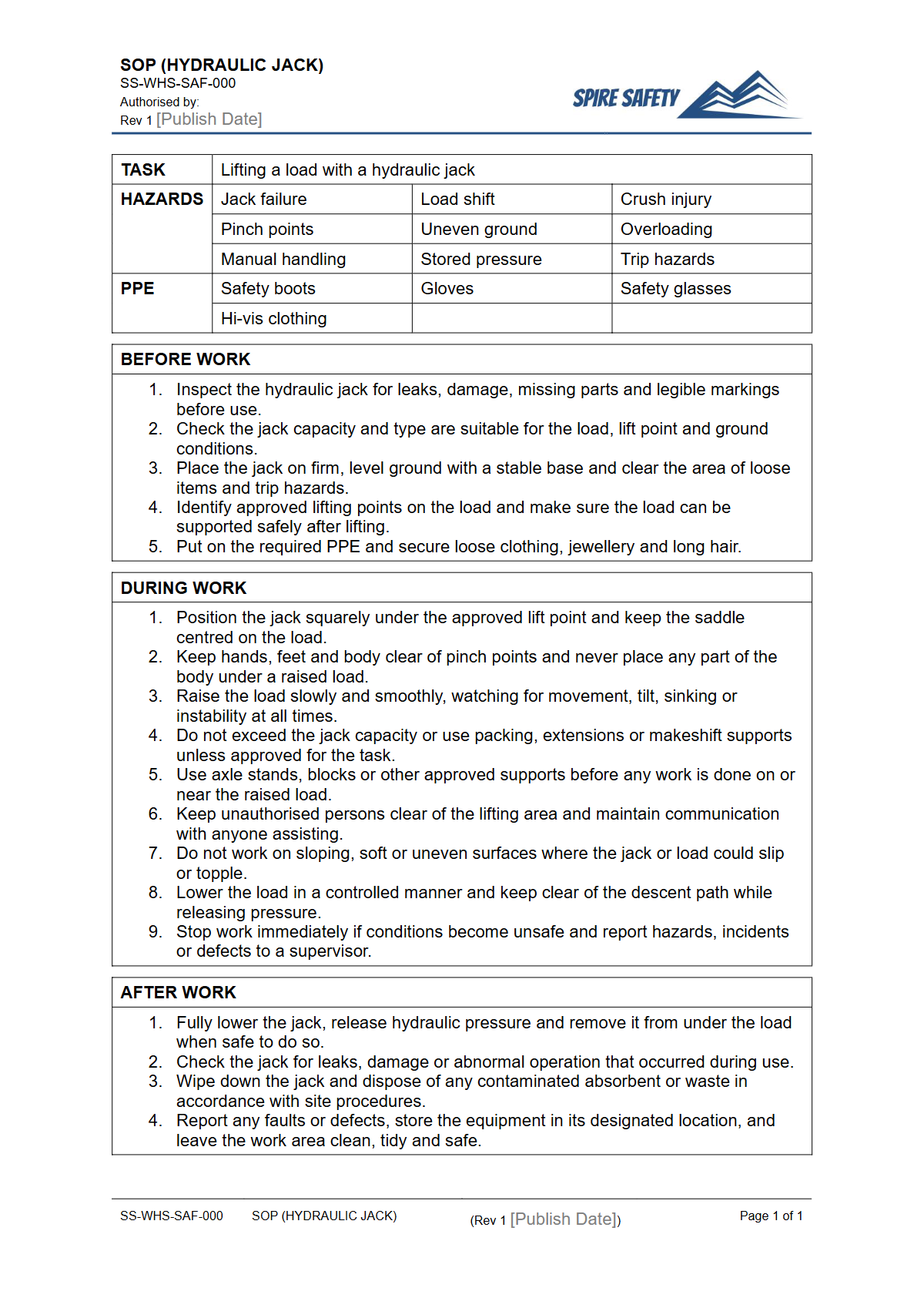
Purpose of the Free Safe Operating Procedure (Hydraulic Jack) Template
Using hydraulic jacks involves significant risks if not managed correctly. This free Safe Operating Procedure (Hydraulic Jack) Template provides a structured starting point for your organisation to document the required safety controls and establish a clear, repeatable process for workers.
A Safe Operating Procedure (SOP) is a foundational document that outlines the step-by-step instructions required to perform a task safely. For hydraulic jacks, this involves managing hazards such as crushing from catastrophic failure, uncontrolled lowering of a load, and high-pressure hydraulic fluid injection injuries.
An effective SOP formalises the pre-operational checks, correct setup, lifting and lowering processes, and post-use storage required to mitigate these risks. Similar to other high-risk equipment, having a documented procedure is vital; for related machinery, you might also require a specific hydraulic press SOP.
Video walkthrough
How to use the Free Safe Operating Procedure (Hydraulic Jack) Template
This template is designed for ease of use and customisation. Simply download the DOCX file to edit and adapt the content to your specific workplace, or download the PDF for immediate reference.
It is structured to align with Australian WHS best practices, covering key areas such as required PPE, risk controls, and emergency procedures.
Important: This document is a template, not a finished procedure. To be effective, you must customise it by incorporating details specific to your site, the models of hydraulic jacks in use, the unique tasks performed, and your organisation's established risk controls.
Once customised, it should be a core component of your overarching WHS management systems, used for training and day-to-day operational guidance.
When to use it
A hydraulic jack SOP should be developed and implemented for any workplace task involving the lifting of heavy objects with this type of equipment. Common scenarios include:
- Vehicle maintenance workshops for lifting cars, trucks, and buses.
- Construction sites for positioning or adjusting heavy components.
- Manufacturing facilities for machinery maintenance and repair.
- Agricultural settings for servicing heavy farm equipment.
While a hydraulic jack is ideal for vertical lifting in these contexts, other tasks might require different equipment and procedures. For example, moving goods horizontally at ground level would be covered by a pallet jack SOP.
Who should use it
This SOP is intended for all personnel who may operate or work near hydraulic jacks. This includes, but is not limited to:
- Mechanics and automotive technicians
- Apprentices and trainees
- Maintenance and service personnel
- Workshop supervisors and managers
Supervisors hold the responsibility for ensuring the procedure is implemented correctly, that all operators are trained on its contents, and that work is performed in accordance with the documented steps. Regular reviews of the SOP's use and effectiveness, sometimes conducted as part of a broader WHS compliance auditing program, help ensure its ongoing relevance and prevent procedural drift.
In a busy workshop environment, managing risks extends beyond a single piece of equipment. Documented procedures for other common tools, such as an air compressor SOP, help build a comprehensive and consistent safety culture across all operations.
For more complex lifting operations that involve mobile plant rather than static equipment, a more detailed procedure covering movement and travel is necessary. Our free telehandler SOP provides a useful framework for managing those specific mobile plant risks.
This hydraulic jack procedure is one of many tools available to help strengthen your safety framework. For more templates, checklists, and guides to assist your organisation, explore our complete free WHS resources library.
Common mistakes
Common mistakes to avoid
- Exceeding the jack's specified Safe Working Load (SWL).
- Working under a vehicle or load supported only by the jack, without the use of rated vehicle support stands.
- Placing the jack on an uneven, soft, or unstable surface, leading to potential slippage.
- Failing to perform a pre-operational inspection for oil leaks, cracked welds, or damaged components.
Legal references
Legal considerations
The following legal requirements may be relevant to this type of work.
- Work Health and Safety Act (Harmonised) — Provides the primary duties for protecting workers and other people from work health and safety risks.
- Work Health and Safety Regulations (Harmonised) — Sets out requirements supporting the management of workplace hazards and risks.
The following codes may be relevant to this type of work.
- Managing WHS Risks Code of Practice — Provides practical guidance on identifying hazards, assessing risks and applying effective controls.
- Work Health and Safety Consultation, Cooperation and Coordination Code of Practice — Provides practical guidance on consulting workers and coordinating with other duty holders.
- Managing the Work Environment and Facilities Code of Practice — Provides practical guidance on safe work environments, workplace facilities and related controls.
Did you know
Pascal's Power
Hydraulic jacks operate on Pascal's Principle, which states that pressure applied to a confined fluid is transmitted undiminished throughout the fluid. This allows a small force on a small piston to generate a massive lifting force on a larger piston.
The Danger of Pinhole Leaks
A tiny, almost invisible pinhole leak in a high-pressure hydraulic hose can release fluid with enough velocity to penetrate skin and cause severe, life-threatening injection injuries. Never use your hand to check for leaks.
FAQ
Frequently asked questions
01What key sections should be included in a Safe Operating Procedure for a hydraulic jack?
02How often should hydraulic jacks be inspected?
03Is specific training required to use a hydraulic jack safely?
04What are the most common hazards associated with hydraulic jacks?
Share this resource
Free Safe Operating Procedure (Hydraulic Jack) Template
Browse Categories
How To Use It
- 1Download and open in Word or PDF.
- 2Replace the placeholders with your business details.
- 3Get it reviewed by a WHS specialist before rollout.
Need it customised?
Our WHS consultants can adapt this template to your site, run a gap analysis, or audit what you already have in place.
Book a Free Consultation WHS consulting servicesor call 1300 156 382
Related templates
- Free Safe Operating Procedure (Hydraulic Lift Table) Template
- Free Safe Operating Procedure (Hydraulic Nut Splitter) Template
- Free Safe Operating Procedure (Hydraulic Power Pack) Template
- Free Safe Operating Procedure (Hydraulic Spreader) Template
- Free Safe Operating Procedure (Hydraulic Torque Tool) Template
- Free Safe Operating Procedure (Hydro Excavation) Template