
Free Safe Operating Procedure (Hydraulic Spreader) Template
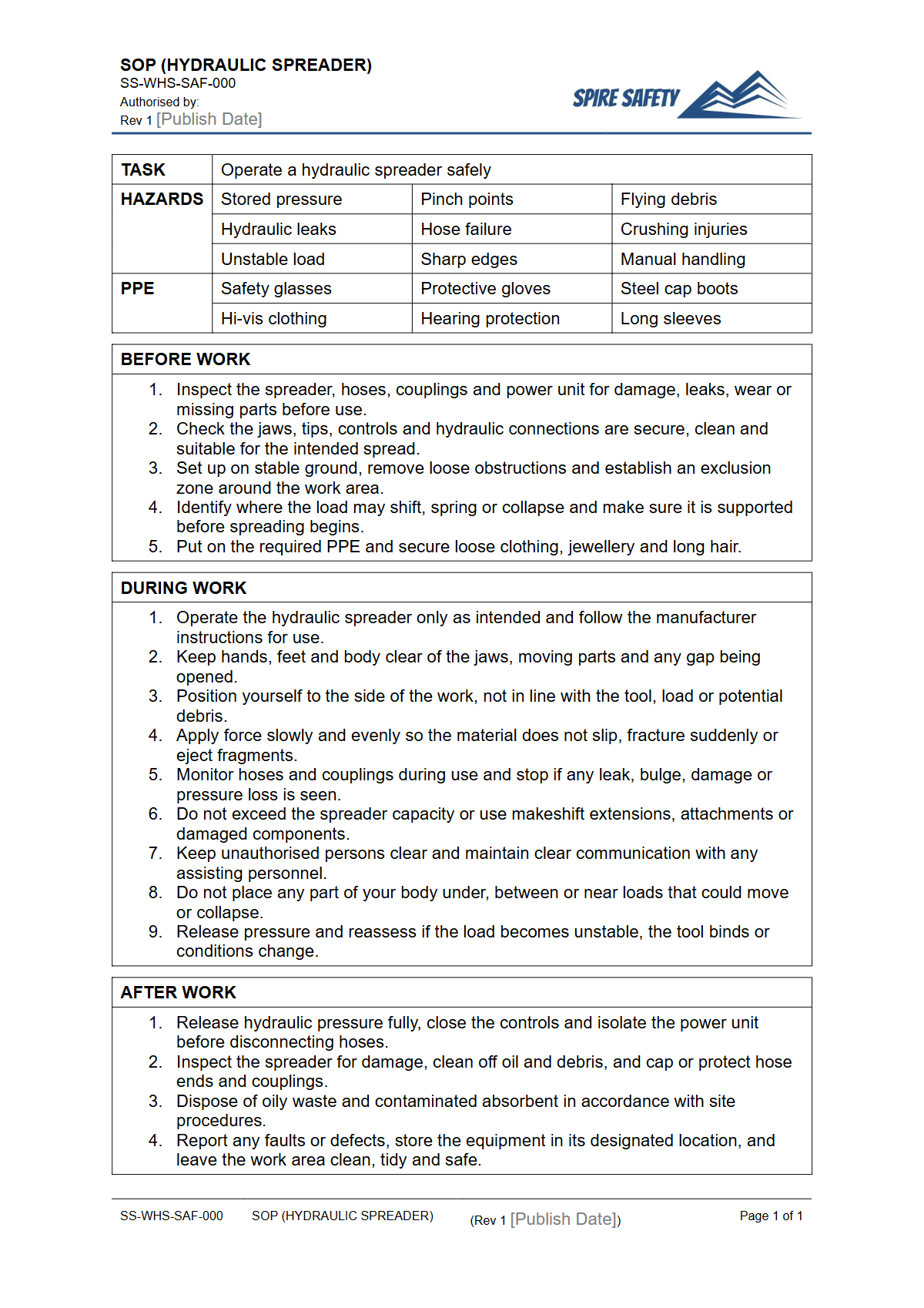
Download our free Safe Operating Procedure (Hydraulic Spreader) Template. This DOCX and PDF resource provides a structured starting point for your safety documents.
Free Safe Operating Procedure (Hydraulic Spreader) Template
DOCX • 126 KB + PDF
Updated Oct 2026
No signup required
Purpose of the Free Safe Operating Procedure (Hydraulic Spreader) Template
A hydraulic spreader is a powerful tool used in various industries, from emergency services and vehicle rescue to manufacturing and demolition. The immense force it generates also presents significant risks, including crushing injuries, high-pressure fluid injection, and tissue damage.
This Free Safe Operating Procedure (Hydraulic Spreader) Template provides a framework for documenting safe work practices, helping you manage these risks effectively.
Developing a detailed SOP is a critical step in fulfilling your duty of care as a Person Conducting a Business or Undertaking (PCBU). It serves as a clear, step-by-step guide for workers, outlining the approved method for operating the equipment safely, from pre-start checks through to shutdown and maintenance.
A well-written SOP standardises procedures, minimises human error, and provides a crucial training resource for new and existing employees.
Video walkthrough
How to use the Free Safe Operating Procedure (Hydraulic Spreader) Template
This document is a downloadable template, available in both DOCX and PDF formats. It is designed as a structured starting point, aligned with Australian WHS principles.
Before implementation, it is essential that you customise the content to reflect the specific circumstances of your workplace.
You must incorporate details specific to your site, including the make and model of the hydraulic spreader, unique environmental hazards, and your organisation's emergency response procedures. This process involves conducting a thorough risk assessment for the task.
The same principle applies when documenting procedures for other high-risk equipment, such as when using a hydraulic press SOP. We cannot know the specific hazards in your workplace, so you are responsible for ensuring the final document is complete and accurate for your operational context.
Key Components of a Hydraulic Spreader SOP
A robust SOP for hydraulic equipment should be comprehensive, covering all phases of the equipment's use. Our template guides you through structuring these key sections to create a complete and practical document.
Pre-Operational Checks
Before any power is applied, a thorough inspection is necessary to identify potential faults. This section of the SOP should detail a checklist of items for the operator to verify, including:
- Inspecting hydraulic hoses for leaks, kinks, cracks, or abrasion.
- Checking fluid levels and looking for signs of contamination.
- Ensuring all guards and safety features are in place and functional.
- Verifying that the work area is clear of personnel and obstructions.
- Confirming the correct personal protective equipment (PPE) is available and worn.
This systematic approach is fundamental for all plant and equipment, not just hydraulic tools. For instance, our Telehandler SOP template also emphasises a rigorous pre-start inspection routine.
Operating Procedures
This is the core of the SOP, detailing the step-by-step sequence for performing the task safely. It should be written in clear, simple language that is easy for operators to follow.
Key instructions to include are positioning the tool securely, ensuring a stable body posture, applying pressure gradually, and constantly monitoring the workpiece for signs of stress or unexpected movement. It should explicitly forbid unsafe practices like exceeding the tool's rated capacity, using cheater bars, or disabling safety interlocks.
Post-Operational Tasks
Safe operation doesn't end when the main task is complete. The SOP must outline the correct shutdown procedure, which includes releasing any stored pressure in the system, cleaning the tool, and returning it to its designated storage location.
This section should also specify inspection and reporting requirements for any faults or damage identified during use. Proper shutdown is crucial for all powered equipment, including those reliant on different power sources, as detailed in our Air Compressor SOP.
Integrating the SOP into Your Safety System
An SOP is not a standalone document; it is a vital component of a broader safety framework. It should be integrated into your comprehensive WHS management systems, linking directly to your risk assessments, worker training records, and equipment maintenance logs.
Using the SOP as a primary document for operator training ensures that all workers receive consistent and correct instruction on how to perform their tasks safely.
Review and Auditing
Workplace environments, equipment, and procedures evolve over time. Your hydraulic spreader SOP should be treated as a living document, subject to regular review—typically annually or whenever there is a change in equipment, personnel, or process.
Regular reviews and formal audits ensure the SOP remains relevant and effective. An independent perspective from a WHS compliance auditing service can help identify gaps or areas for improvement in your safe work procedures and their practical application.
By customising and implementing this template, you create a safer environment for your team and build a stronger safety culture. Explore our entire free WHS resources library for more templates and guides to support your safety management system.
Common mistakes
Common mistakes to avoid
- Failing to inspect hydraulic hoses for leaks, cracks, or bulges before every use.
- Neglecting to wear appropriate PPE, especially high-impact safety glasses and protective gloves.
- Exceeding the tool's rated capacity or using it for unintended purposes, such as lifting.
- Operating the tool without a stable footing or a clear work area free of other personnel.
Legal references
Legal considerations
The following legal requirements may be relevant to this type of work.
- Work Health and Safety Act (Harmonised) — Provides the primary duties for protecting workers and other people from work health and safety risks.
- Work Health and Safety Regulations (Harmonised) — Sets out requirements supporting the management of workplace hazards and risks.
The following codes may be relevant to this type of work.
- Managing WHS Risks Code of Practice — Provides practical guidance on identifying hazards, assessing risks and applying effective controls.
- Work Health and Safety Consultation, Cooperation and Coordination Code of Practice — Provides practical guidance on consulting workers and coordinating with other duty holders.
- Managing the Work Environment and Facilities Code of Practice — Provides practical guidance on safe work environments, workplace facilities and related controls.
Did you know
Jaws of Life
Hydraulic spreaders are famously known as the "Jaws of Life" when used by emergency services for vehicle extrication, highlighting their immense power and importance in rescue operations.
Hydraulic Pressure
Hydraulic systems can operate at pressures exceeding 10,000 PSI (700 bar). A pinhole leak at this pressure can inject hydraulic fluid through the skin and deep into tissues, requiring immediate and specialised medical attention.
FAQ
Frequently asked questions
01What are the main hazards of a hydraulic spreader?
02Is a Safe Operating Procedure legally required for a hydraulic spreader in Australia?
03How often should a hydraulic spreader SOP be reviewed?
04What training is required to operate a hydraulic spreader?
Share this resource
Free Safe Operating Procedure (Hydraulic Spreader) Template
Browse Categories
How To Use It
- 1Download and open in Word or PDF.
- 2Replace the placeholders with your business details.
- 3Get it reviewed by a WHS specialist before rollout.
Need it customised?
Our WHS consultants can adapt this template to your site, run a gap analysis, or audit what you already have in place.
Book a Free Consultation WHS consulting servicesor call 1300 156 382
Related templates
- Free Safe Operating Procedure (Hydraulic Torque Tool) Template
- Free Safe Operating Procedure (Hydro Excavation) Template
- Free Safe Operating Procedure (Hydroponic Cleaning) Template
- Free Safe Operating Procedure (Hydroponic Mixing) Template
- Free Safe Operating Procedure (Hygrometer) Template
- Free Safe Operating Procedure (IBC Cleaning) Template