
Free Safe Operating Procedure (Hygrometer) Template
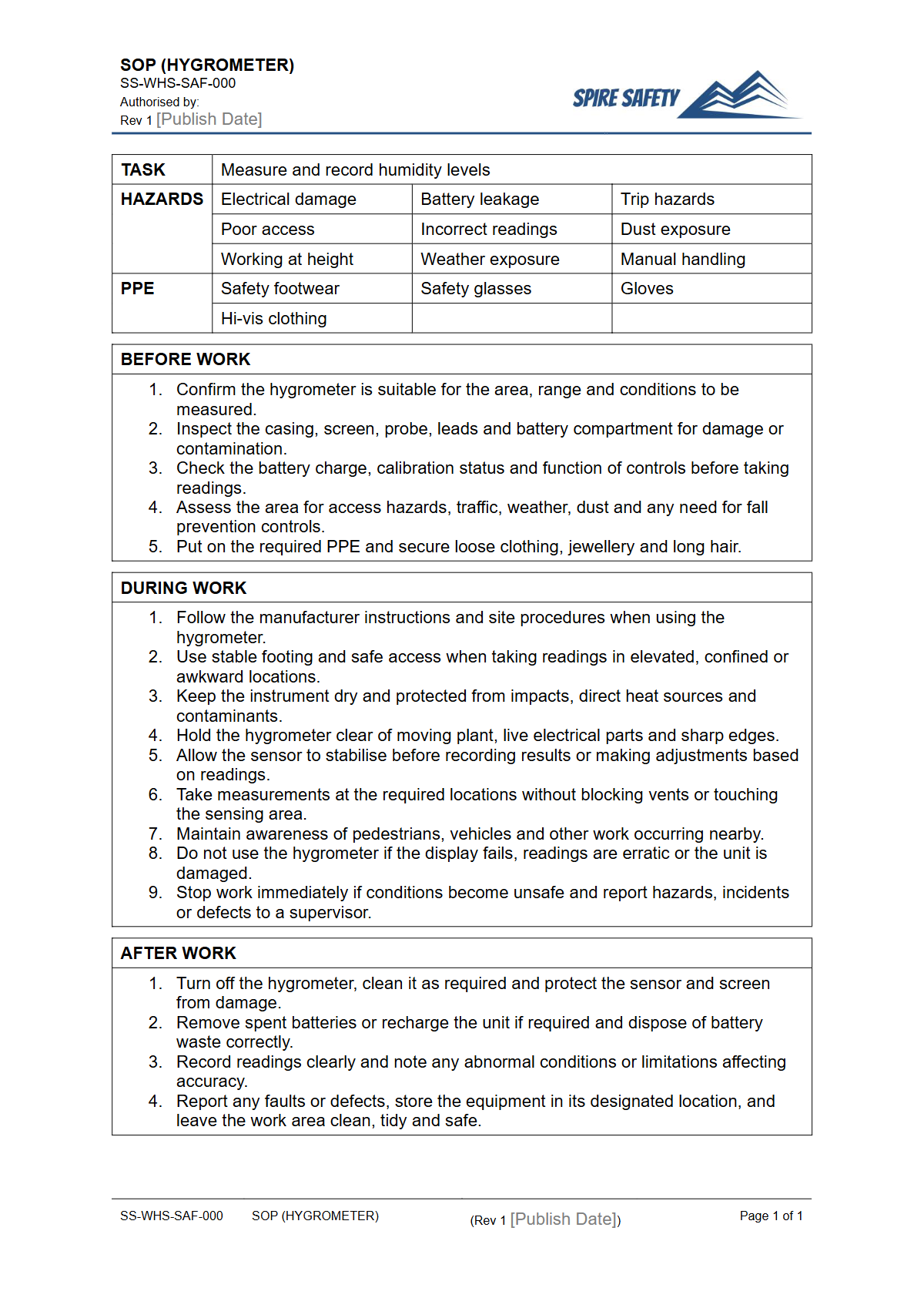
Establish clear guidelines for using hygrometers with our customisable template. This document provides a structured format for outlining key operational steps.
Free Safe Operating Procedure (Hygrometer) Template
DOCX • 126 KB + PDF
Updated Oct 2026
No signup required
Purpose of the Free Safe Operating Procedure (Hygrometer) Template
A hygrometer is a critical instrument for measuring humidity or the amount of water vapour in the air. In a work setting, uncontrolled humidity can lead to a range of hazards, including mould growth, static electricity buildup, heat stress, and damage to sensitive materials or equipment.
This Free Safe Operating Procedure (Hygrometer) Template provides a structured framework for documenting the safe and correct use of these devices, helping your organisation maintain consistent environmental monitoring and control.
Using a formal SOP ensures that all personnel understand how to operate the hygrometer correctly, where to place it for accurate readings, and what actions to take when humidity levels fall outside the acceptable range. It standardises the process, which is fundamental to managing risks associated with atmospheric conditions and forms a key part of your overall safety management documentation. Integrating clear procedures like this one is a core component of effective WHS management systems.
Video walkthrough
How to use the Free Safe Operating Procedure (Hygrometer) Template
This template is provided in both DOCX and PDF formats for your convenience. To use it, simply download the file and begin customising it to reflect the specific requirements of your workplace.
It is designed as a starting point, aligned with Australian WHS practice, to guide you in creating a comprehensive and site-specific procedure.
Important: This is a template, not a finished document. To be effective, you must customise it with information relevant to your business.
This includes adding your company name and logo, and filling in all sections with details about your specific hygrometer model, its designated locations, calibration schedules, and the personnel authorised to use it. We have included prompts and tables to guide you, but the final responsibility for accuracy and completeness lies with you.
What to include in your SOP
- Hazard Identification: List potential risks associated with incorrect hygrometer use or unmanaged humidity (e.g., electrical hazards, mould exposure, equipment malfunction).
- Personal Protective Equipment (PPE): Specify any PPE required, if applicable, for the task or environment.
- Pre-operational Checks: Detail the steps for inspecting the hygrometer before use, such as checking battery levels and ensuring the sensor is clean.
- Operating Steps: Provide a clear, step-by-step guide for taking and recording a measurement.
- Post-operational Tasks: Outline procedures for cleaning, storing, and logging data from the device.
- Calibration and Maintenance: Define the frequency and method for calibrating the hygrometer to ensure its continued accuracy.
Creating robust SOPs for all workplace equipment is a best practice. For another example of a procedure for common kitchen equipment, see our Free Safe Operating Procedure (Deep Fryer) Template.
When to use it
A Hygrometer SOP should be implemented in any environment where humidity control is critical to safety, product quality, or operational integrity. This includes a wide range of industries and applications, such as:
- Food Storage and Preparation: Preventing mould and bacterial growth in cool rooms, dry stores, and commercial kitchens.
- Manufacturing: Controlling humidity that can affect processes like painting, coating, or the handling of hygroscopic materials (e.g., wood, paper).
- Laboratories and Cleanrooms: Maintaining strict environmental parameters to protect sensitive experiments and equipment.
- Data Centres: Preventing static discharge that can damage electronic components.
- Agriculture: Monitoring conditions in greenhouses and storage silos to optimise growth and prevent spoilage.
- Museums and Archives: Preserving delicate artefacts that can be damaged by improper humidity levels.
In industrial settings, managing the quality of compressed air is also vital, and humidity is a key factor. Procedures for related equipment can be documented using resources like our Free Air Compressor SOP Template.
Who should use it
This SOP is intended for any person required to operate a hygrometer as part of their duties. It also serves as a critical resource for supervisors and WHS managers responsible for training and compliance. Specific roles that would benefit from this procedure include:
- Facility and Maintenance Managers
- WHS Officers and Coordinators
- Laboratory Technicians
- Warehouse and Logistics Personnel
- Quality Assurance Inspectors
- Team Leaders and Supervisors
The document serves as a training tool for new employees and a reference guide for experienced staff, ensuring everyone follows the same approved method. Regular reviews of SOPs during a WHS compliance audit can help verify that documented procedures are being followed correctly in practice. You can find more procedural templates for various tools and machinery in our free WHS resources library.
Common mistakes
Common mistakes to avoid
- Forgetting to perform and document regular calibration, leading to inaccurate readings.
- Placing the hygrometer in a location that gives unrepresentative data, such as in direct sunlight, near a vent, or too close to a heat source.
- Failing to define and act upon humidity readings that fall outside the acceptable range specified in the SOP.
- Using a single, generic procedure for different types of hygrometers without customising for each model's specific functions.
Legal references
Legal considerations
The following legal requirements may be relevant to this type of work.
- Work Health and Safety Act (Harmonised) — Provides the primary duties for protecting workers and other people from work health and safety risks.
- Work Health and Safety Regulations (Harmonised) — Sets out requirements supporting the management of workplace hazards and risks.
The following codes may be relevant to this type of work.
- Managing WHS Risks Code of Practice — Provides practical guidance on identifying hazards, assessing risks and applying effective controls.
- Work Health and Safety Consultation, Cooperation and Coordination Code of Practice — Provides practical guidance on consulting workers and coordinating with other duty holders.
- Managing the Work Environment and Facilities Code of Practice — Provides practical guidance on safe work environments, workplace facilities and related controls.
Did you know
Hair Power
Some of the earliest hygrometers, invented in the 18th century, used human or animal hair. The hair's natural tendency to expand and contract with changes in humidity was used to move a needle on a dial, providing a reading.
Relative vs. Absolute
Most workplace hygrometers measure relative humidity (RH). This is the amount of water vapour in the air expressed as a percentage of the maximum amount the air could hold at that specific temperature.
FAQ
Frequently asked questions
01What is a hygrometer used for in a WHS context?
02How often should a hygrometer be calibrated?
03Is a Safe Operating Procedure legally required for a hygrometer?
04Can I use this template for any type of hygrometer?
Share this resource
Free Safe Operating Procedure (Hygrometer) Template
Browse Categories
How To Use It
- 1Download and open in Word or PDF.
- 2Replace the placeholders with your business details.
- 3Get it reviewed by a WHS specialist before rollout.
Need it customised?
Our WHS consultants can adapt this template to your site, run a gap analysis, or audit what you already have in place.
Book a Free Consultation WHS consulting servicesor call 1300 156 382
Related templates
- Free Safe Operating Procedure (IBC Cleaning) Template
- Free Safe Operating Procedure (IBC Decanting) Template
- Free Safe Operating Procedure (Ice Bin Cleaning) Template
- Free Safe Operating Procedure (Ice Crusher) Template
- Free Safe Operating Procedure (Ice Machine) Template
- Free Safe Operating Procedure (Ice Maker Cleaning) Template