
Free Safe Operating Procedure (Ice Bin Cleaning) Template
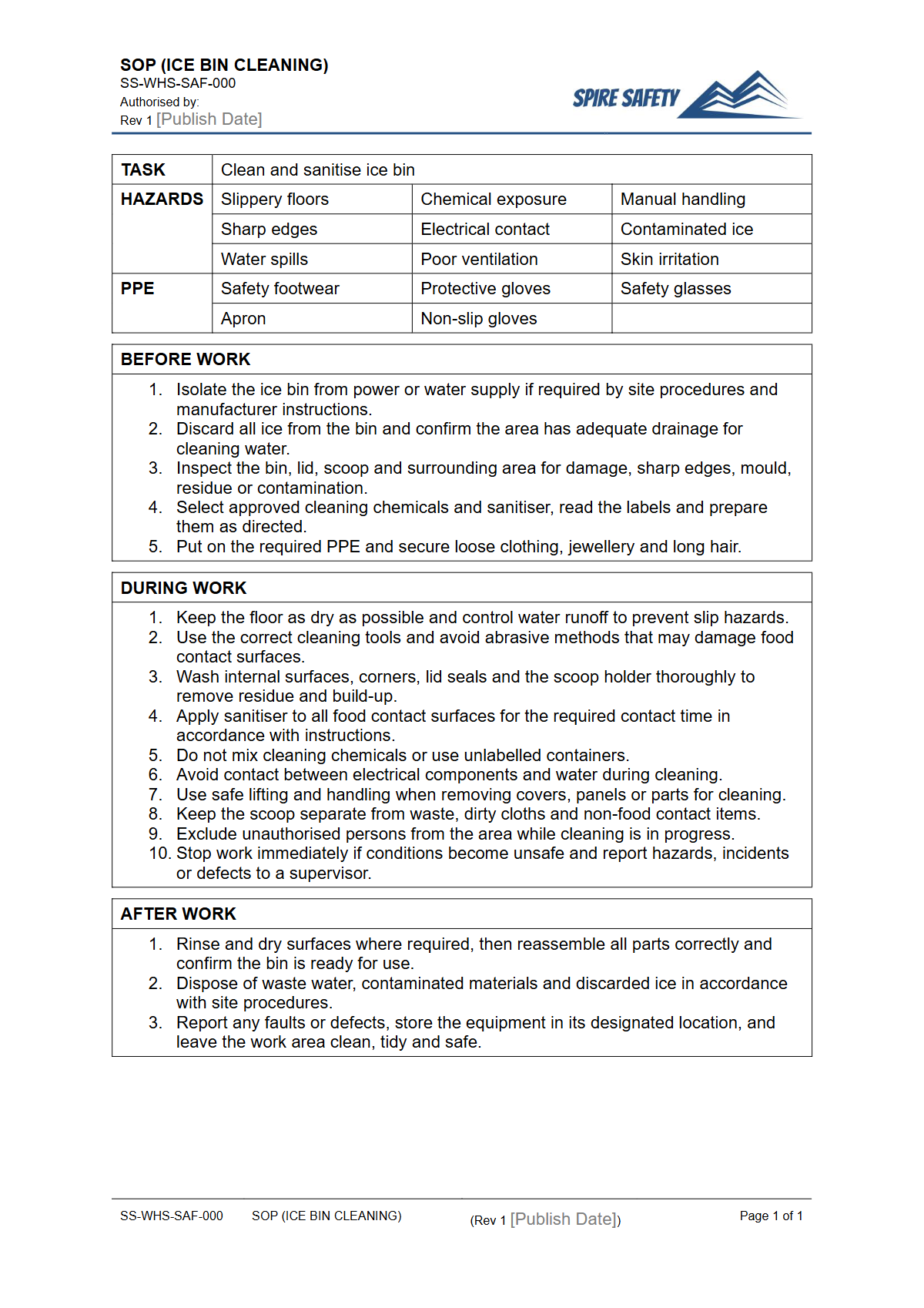
Download our free Safe Operating Procedure for Ice Bin Cleaning to formalise your safety processes. This template helps outline controls for key hazards.
Free Safe Operating Procedure (Ice Bin Cleaning) Template
DOCX • 126 KB + PDF
Updated Oct 2026
No signup required
Purpose of the Free Safe Operating Procedure (Ice Bin Cleaning) Template
Maintaining a clean ice bin is critical for food safety and workplace hygiene in hospitality, healthcare, and food service environments. This Free Safe Operating Procedure (Ice Bin Cleaning) Template provides a structured framework for documenting the steps required to clean and sanitise commercial ice machines and bins safely.
It helps an organisation meet its duty of care by identifying hazards such as slips on wet floors, manual handling injuries from moving ice or components, and exposure to cleaning chemicals. Formalising this process ensures consistency, aids in training, and demonstrates a commitment to health and safety.
By implementing a clear SOP, you can minimise the risk of foodborne illnesses caused by contaminated ice and reduce the likelihood of worker injuries. This document serves as a practical tool for supervisors to enforce correct procedures and for workers to have a clear, step-by-step guide to follow. While this SOP covers ice bin cleaning, similar principles apply to other kitchen equipment, as detailed in resources like our deep fryer operation SOP.
Video walkthrough
How to use the Free Safe Operating Procedure (Ice Bin Cleaning) Template
This template is provided in both DOCX and PDF formats for your convenience. The DOCX file is fully editable, allowing you to tailor the content to your specific workplace.
It is crucial to adapt the document to reflect the exact make and model of your ice machine, the specific cleaning chemicals used, and your site-specific risk controls.
To effectively use this Safe Operating Procedure for Ice Bin Cleaning, you should:
- Insert your company name, logo, and relevant site details.
- Review each step and modify it to match your internal processes.
- Reference the Safety Data Sheets (SDS) for all cleaning chemicals used and specify the required Personal Protective Equipment (PPE), such as gloves and safety glasses.
- Incorporate details from the manufacturer’s operating manual.
- Consult with workers who perform the task to ensure the procedure is practical and accurate.
- Obtain sign-off from a manager or supervisor before implementation.
Important: This is a template only. We have provided a solid foundation based on Australian WHS principles, but you must customise this document to address the unique hazards and operational context of your own workplace.
Integrating this SOP into a broader WHS management system ensures it is part of a holistic approach to safety.
When to use it
This Safe Operating Procedure should be used whenever a commercial ice bin or ice machine requires cleaning and sanitising. The frequency of this task should be determined by a risk assessment, considering factors like usage volume, environmental conditions, and manufacturer recommendations, but it is typically performed on a weekly or fortnightly basis.
The SOP should also be used as a primary training document for new employees tasked with cleaning duties and as a refresher for existing staff. It serves as a critical reference before, during, and after the cleaning task to ensure all safety steps are followed correctly.
Who should use it
This SOP is intended for all personnel responsible for cleaning and maintaining ice machines. This typically includes kitchen hands, hospitality staff, cleaners, and maintenance workers.
Supervisors and managers should also be familiar with the procedure to ensure they can effectively oversee the task, conduct training, and verify that the documented controls are being implemented correctly. Competency in this task involves not just reading the SOP, but also receiving practical training on the correct isolation procedures, chemical handling, and manual handling techniques.
For businesses needing support in developing and rolling out procedures like this, engaging professional WHS consulting services can provide expert guidance.
Reviewing and Improving the SOP
Safe Operating Procedures are not static documents. They should be reviewed regularly—at least annually—or whenever there is a change in equipment, chemicals, or processes.
An incident or near-miss related to ice bin cleaning should also trigger an immediate review of the SOP to identify and rectify any procedural gaps. Conducting periodic WHS compliance audits can help verify that this and other procedures are being followed correctly and remain effective. For more templates and safety guides, you can explore our free resources library.
Common mistakes
Common mistakes to avoid
- Forgetting to electrically isolate and de-energise the ice machine before starting any cleaning.
- Using incompatible cleaning and sanitising agents together, which can create hazardous chemical reactions.
- Failing to allow all components to air dry completely before reassembly, which can trap moisture and promote mould growth.
- Not placing 'Wet Floor' signs in the surrounding area, creating a serious slip hazard for other workers.
Legal references
Legal considerations
The following legal requirements may be relevant to this type of work.
- Work Health and Safety Act (Harmonised) — Provides the primary duties for protecting workers and other people from work health and safety risks.
- Work Health and Safety Regulations (Harmonised) — Sets out requirements supporting the management of workplace hazards and risks.
The following codes may be relevant to this type of work.
- Managing WHS Risks Code of Practice — Provides practical guidance on identifying hazards, assessing risks and applying effective controls.
- Work Health and Safety Consultation, Cooperation and Coordination Code of Practice — Provides practical guidance on consulting workers and coordinating with other duty holders.
- Managing the Work Environment and Facilities Code of Practice — Provides practical guidance on safe work environments, workplace facilities and related controls.
Did you know
Invisible Hazards
Ice machines can be breeding grounds for bacteria and mould, forming a biofilm or 'slime' that is often not visible to the naked eye. Regular, thorough cleaning is the only way to prevent contamination and potential foodborne illness.
The Weight of Water
A standard 10-litre bucket of ice weighs approximately 9 kilograms. Repetitively lifting and moving full buckets during cleaning can pose a significant manual handling risk if not managed with proper ergonomic techniques.
FAQ
Frequently asked questions
01What PPE is required for cleaning an ice bin?
02How often should a commercial ice bin be cleaned?
03Why is a Safe Operating Procedure necessary for a simple task like cleaning an ice bin?
04Can this SOP template be used for any brand of ice machine?
Share this resource
Free Safe Operating Procedure (Ice Bin Cleaning) Template
Browse Categories
How To Use It
- 1Download and open in Word or PDF.
- 2Replace the placeholders with your business details.
- 3Get it reviewed by a WHS specialist before rollout.
Need it customised?
Our WHS consultants can adapt this template to your site, run a gap analysis, or audit what you already have in place.
Book a Free Consultation WHS consulting servicesor call 1300 156 382
Related templates
- Free Safe Operating Procedure (Ice Crusher) Template
- Free Safe Operating Procedure (Ice Machine) Template
- Free Safe Operating Procedure (Ice Maker Cleaning) Template
- Free Safe Operating Procedure (Ice Scoop Handling) Template
- Free Safe Operating Procedure (Illegal Dump Cleanup) Template
- Free Safe Operating Procedure (Impact Crusher Clearing) Template