
Free Safe Operating Procedure (Impact Crusher Clearing) Template
Download our free Safe Operating Procedure (Impact Crusher Clearing) template to manage high-risk tasks. Customise this DOCX or PDF to suit your site.
Free Safe Operating Procedure (Impact Crusher Clearing) Template
DOCX • 126 KB + PDF
Updated Oct 2026
No signup required
Purpose of the Free Safe Operating Procedure (Impact Crusher Clearing) Template
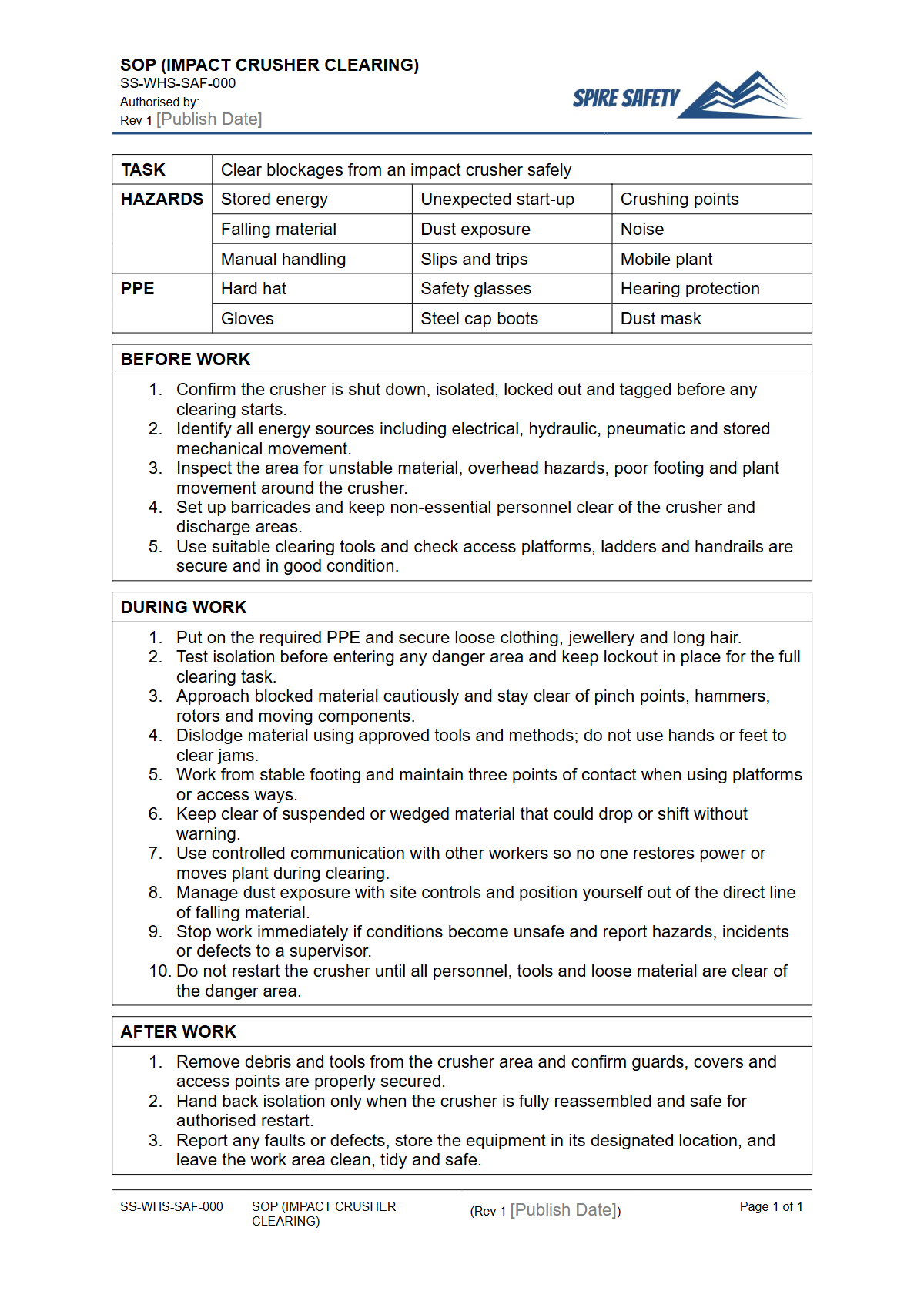
Clearing a blockage from an impact crusher is a high-risk maintenance task that requires a formal, documented process to protect workers. This Free Safe Operating Procedure (Impact Crusher Clearing) Template provides a structured starting point for organisations to develop a site-specific procedure.
The document outlines the critical steps for isolating energy sources, accessing the crushing chamber, removing obstructions, and returning the plant to service safely. By formalising these steps, you can significantly reduce the risk of serious injuries associated with stored energy, unexpected movement, and manual handling.
A robust SOP is a key component of managing plant safety, especially for equipment like crushers that are often integrated with other machinery. A well-defined procedure for clearing the crusher should also account for interlocking systems, such as the feeder and discharge conveyors.
For guidance on associated equipment, you can also download our free Conveyer System SOP to ensure a holistic approach to safety in your crushing circuit.
Video walkthrough
How to use the Free Safe Operating Procedure (Impact Crusher Clearing) Template
This template is provided as a foundation and must be adapted to your specific workplace. Download the DOCX file and begin by reviewing each section against your organisation's own risk assessments and the manufacturer's instructions for your particular impact crusher model.
It is critical to involve operators and maintenance personnel in this process, as they possess direct experience with the equipment and its hazards.
Note: We have provided this template as a guide based on common Australian WHS practice. It is your responsibility to ensure it is customised to reflect the specific machinery, personnel, and isolation procedures used on your site.
Effective customisation is essential for the SOP to be a useful control measure. Successful implementation of procedures like this one forms part of a business's broader safety framework.
Developing comprehensive WHS management systems helps ensure that all aspects of workplace safety are systematically addressed and continuously improved.
Key Customisation Steps:
- Plant Identification: Specify the exact make, model, and identification number of the impact crusher.
- Isolation Points: Detail the precise locations and methods for all energy isolations, including electrical, hydraulic, pneumatic, and gravitational sources. Incorporate your site-specific Lock-Out Tag-Out (LOTO) procedure.
- Personnel: Define the roles, responsibilities, and required competencies for anyone performing the task.
- PPE: List the mandatory Personal Protective Equipment (PPE) required, such as hard hats, safety glasses, steel-capped boots, gloves, and respiratory protection.
- Consultation: Record the names of the workers and supervisors consulted during the development of the final SOP.
After customising the document, it should be formally reviewed and approved by a competent person within your organisation, such as a Site Supervisor or WHS Manager. Regular WHS compliance auditing can help verify that procedures like this are being followed correctly and remain effective over time.
This external perspective is valuable for identifying gaps between documented procedures and actual work practices.
When to use this Safe Operating Procedure
This Safe Operating Procedure should be used whenever a worker needs to clear a blockage, jam, or obstruction from within the crushing chamber of an impact crusher. It also applies to any maintenance task that requires a person to place any part of their body within the operational zones of the machine where they could be struck by moving parts.
It is not intended for routine operation or pre-start checks but for a specific, high-risk, non-routine task. Using a formal SOP ensures every step, from shutdown to restart, is performed in a consistent and safe sequence.
Who should use this Safe Operating Procedure
This SOP is intended for competent and authorised personnel who have received specific training on the impact crusher and the task of clearing blockages. This typically includes:
- Plant Operators: Who are often the first to identify a blockage and may be authorised to perform basic clearing procedures.
- Maintenance Fitters: Who handle more complex blockages or related mechanical repair tasks.
- Supervisors: Who are responsible for overseeing the work, ensuring the SOP is followed, and signing off on permits if required.
All individuals using the SOP must be verified as competent in your site's isolation and LOTO procedures. This procedure is just one part of a suite of documents needed to manage a site with heavy machinery. You may also find our Scraper SOP template useful for managing risks associated with other common earthmoving plant. For a wider selection of safety documentation, browse our complete free WHS resources library.
Common mistakes
Common mistakes to avoid
- Failing to verify isolation and zero energy state before starting work.
- Using the template without customising it for the specific make and model of the crusher.
- Neglecting to include procedures for re-energising and restarting the plant safely.
- Inadequate training for workers on the specific steps outlined in the customised SOP.
Legal references
Legal considerations
The following legal requirements may be relevant to this type of work.
- Work Health and Safety Act (Harmonised) — Provides the primary duties for protecting workers and other people from work health and safety risks.
- Work Health and Safety Regulations (Harmonised) — Sets out requirements supporting the management of workplace hazards and risks.
The following codes may be relevant to this type of work.
- Managing WHS Risks Code of Practice — Provides practical guidance on identifying hazards, assessing risks and applying effective controls.
- Work Health and Safety Consultation, Cooperation and Coordination Code of Practice — Provides practical guidance on consulting workers and coordinating with other duty holders.
- Managing the Work Environment and Facilities Code of Practice — Provides practical guidance on safe work environments, workplace facilities and related controls.
Did you know
Stored Energy Hazard
Even after the power is cut, the heavy rotor in an impact crusher can retain significant kinetic energy and continue to rotate. It must be brought to a complete stop and mechanically secured before access.
Consultation is a Requirement
The model WHS Act legally requires employers to consult with workers and their health and safety representatives when developing procedures that affect their work, as they have direct knowledge of the tasks and risks.
FAQ
Frequently asked questions
01What is the most critical step when clearing an impact crusher?
02Who is responsible for developing a Safe Operating Procedure for an impact crusher?
03How often should an SOP for impact crusher clearing be reviewed?
04Can this SOP template be used for other types of crushers like jaw or cone crushers?
Share this resource
Free Safe Operating Procedure (Impact Crusher Clearing) Template
Browse Categories
How To Use It
- 1Download and open in Word or PDF.
- 2Replace the placeholders with your business details.
- 3Get it reviewed by a WHS specialist before rollout.
Need it customised?
Our WHS consultants can adapt this template to your site, run a gap analysis, or audit what you already have in place.
Book a Free Consultation WHS consulting servicesor call 1300 156 382
Related templates
- Free Safe Operating Procedure (Impact Driver) Template
- Free Safe Operating Procedure (Impact Wrench) Template
- Free Safe Operating Procedure (Inboard Motor) Template
- Free Safe Operating Procedure (Inbound Freight Check) Template
- Free Safe Operating Procedure (Inbound Load Staging) Template
- Free Safe Operating Procedure (Incontinence Linen Bag) Template